Mirror Review
June 18, 2026
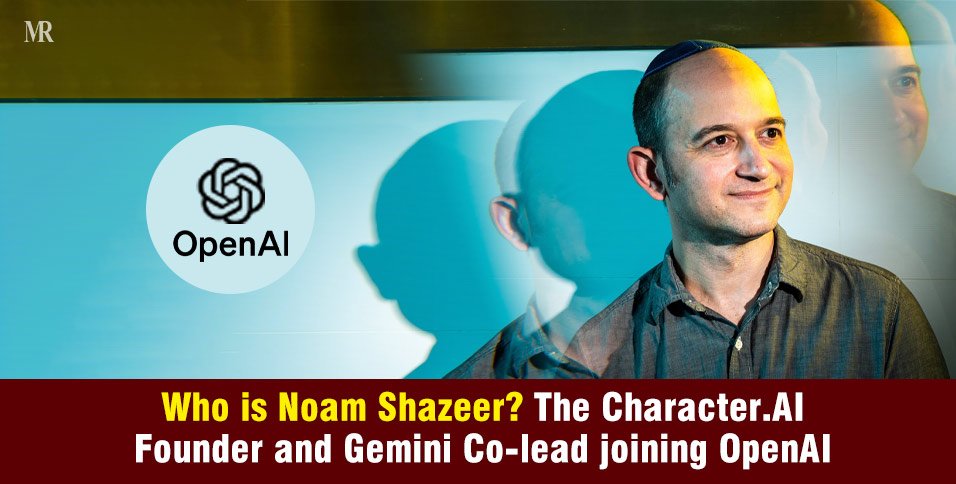
Noam Shazeer, the co-lead of Google Gemini and former CEO of Character.AI, is leaving Google to join OpenAI. His move to the ChatGPT maker follows less than two years after Google paid $2.7 billion to rehire him and his research team from his startup. Now, OpenAI secures one of the most influential computer scientists of the modern era as the company prepares for an initial public offering.
Who is Noam Shazeer?
Noam Shazeer is an American computer scientist and entrepreneur who stands as one of the primary inventors of the large language model revolution. He graduated from Duke University in 1998 before entering the tech industry.
Over his two decades in software engineering, Shazeer built the core infrastructure that powers modern search engines, digital advertising, and generative AI systems. Tech experts view him as a foundational architect of the tools billions of people use daily.
Noam Shazeer’s Early Engineering Work at Google
Shazeer first joined Google in December 2000 during the early days of the search engine. His initial work at Google focused on improving the platform’s fundamental usability. He successfully upgraded the spelling corrector for the search engine, making it easier for users to find accurate results.
Later, Shazeer wrote the PHIL algorithm. This specific code became the vital foundation for Google AdSense, the advertising system that generated a massive portion of the company’s global revenue. He worked as a software engineer until 2009, took a brief break, and returned in 2012 as a Principal Software Engineer.
Inventing the Modern AI Foundation
Noam Shazeer’s most famous contribution to computer science arrived in 2017. He co-authored a historic research paper titled “Attention Is All You Need.” This single paper introduced the Transformer architecture, which serves as the direct engine behind almost every modern AI system, including ChatGPT, Claude, and Gemini.
During the development of the Transformer, Shazeer took on critical engineering tasks:
- He personally designed the multi-head attention mechanism.
- He designed the system’s residual architecture.
- He coded the very first working implementation that performed better than state-of-the-art standards.
Beyond the Transformer, Shazeer pioneered the Sparsely-gated Mixture of Experts (MoE) in 2016, a technique used to make massive AI models run efficiently
In 2018, he built Mesh-Tensorflow, which became the first practical system capable of training giant Transformers across supercomputers.
He also contributed heavily to the T5 text-to-text framework in 2019 and Google’s early LaMDA dialogue system.
The Character.AI Era and the $2.7 Billion Return
In 2021, Shazeer and fellow researcher Daniel De Freitas chose to leave Google. The duo had championed an aggressive push into conversational AI chatbots, but the company declined to pursue the project publicly at the time.
They subsequently founded Character.AI, a startup that allowed users to create and interact with customized AI personalities. Character.AI achieved massive popularity and became the very first chatbot system to launch on the Transformer architecture, beating OpenAI’s ChatGPT to the public market.
The tech landscape changed rapidly after ChatGPT launched, forcing major companies to chase top talent.
In August 2024, Google signed a unique partnership deal with Character.AI. The search giant paid a staggering $2.7 billion to purchase non-exclusive rights to Character.AI’s technology and successfully bring Shazeer and De Freitas back to its DeepMind unit. Under this special agreement, Shazeer assumed the role of Vice President of Engineering and Co-lead of Gemini.
Driving the Gemini Evolution
Upon his return in late 2024, Google tasked Shazeer with closing the competitive gap between its internal models and OpenAI. Analysts credit his leadership as a primary reason Google managed to accelerate its AI capabilities quickly.
During his recent tenure, Shazeer helped guide the team through several major updates, including the rollout of the Gemini 3.5 Flash model and the Gemini Spark AI agent.
His work ensured that Google remained a frontrunner in multi-modal capabilities, directly matching the performance of its peers.
The Noam Shazeer OpenAI Announcement
Writing on X, Noam Shazeer expressed his gratitude for his time at his previous company while looking forward to his next chapter.
“It was a difficult decision to move on. I’m incredibly proud of the amazing team at Google and everything we’ve built together,” Shazeer wrote. “I’m excited to share that I’ll be joining OpenAI and look forward to working with the exceptional team there.”
The news drew immediate praise from leadership at his new home. OpenAI CEO Sam Altman shared his excitement regarding Noam Shazeer joining OpenAI, highlighting how long he had hoped to recruit the researcher.
“Noam is one of the people I have most wanted to work with since the very beginning of OpenAI,” Altman stated on X. “Only took 10 years. I think it will be worth the wait!”
A Google spokesperson acknowledged his departure by stating, “We are grateful for Noam’s meaningful contributions to Google over the years.”
Why Noam Shazeer is Joining OpenAI Now
The next phase of the Noam Shazeer OpenAI career path comes at a critical time for the artificial intelligence sector.
Major labs like Anthropic, Meta, Google, and OpenAI are currently locked in an intense talent war, dangling massive compensation packages to land elite researchers.
OpenAI represents an attractive destination due to its current corporate momentum. The company recently filed confidentially for an initial public offering. Bringing in a historic figure like Shazeer right before going public provides a major boost to investor confidence.
End Note
The sudden departure of Noam Shazeer from Google proves that elite human talent remains the most valuable asset in tech. By securing the co-author of the Transformer paper, OpenAI gains an engineer who deeply understands how to train and scale the next generation of frontier models. As Noam Shazeer begins his new chapter at OpenAI, the shift will likely ripple through the entire tech ecosystem, altering the development speed of future AI tools
Maria Isabel Rodrigues