Mirror Review
March 27, 2026
NASA is moving into the final stages of preparation for the historic Artemis II Launch, currently targeted for no earlier than April 1, 2026.
This mission represents the first time in over 50 years that humans will venture to the vicinity of the Moon, serving as a critical crewed test flight for the Space Launch System (SLS) rocket and the Orion spacecraft.
The Crew and Mission Objectives
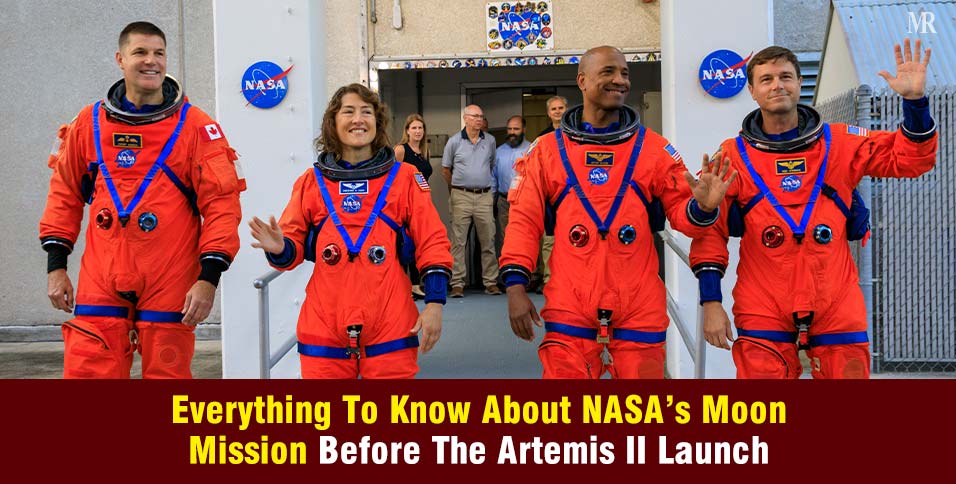
The Artemis II Launch will carry a four-person crew on an approximately 10-day journey around the far side of the Moon.
This mission is designed to test Orion’s life-support systems with humans aboard for the first time.
- Commander Reid Wiseman (NASA): Leading the first crewed Artemis flight.
- Pilot Victor Glover (NASA): The first person of color to participate in a lunar mission.
- Mission Specialist Christina Koch (NASA): The first woman assigned to a Moon mission.
- Mission Specialist Jeremy Hansen (CSA): The first Canadian astronaut to travel to deep space.
Moreover, the mission profile includes a “hybrid” orbit.
After launch, the crew will spend the first 24 hours in a high Earth orbit to verify spacecraft performance before a second burn sends them toward the Moon.
At their farthest point, they are expected to travel 248,655 miles from Earth, breaking the distance record for human spaceflight previously held by Apollo 13.
The “Ignition” Initiative
In March 2026, NASA Administrator Jared Isaacman announced a significant overhaul of the Artemis program titled “Ignition”.
This initiative shifts the agency toward a “mission-first” culture to accelerate the establishment of a permanent lunar base.
A major part of this strategy involves canceling the Lunar Gateway space station in its current form to prioritize $20 billion in surface infrastructure at the lunar South Pole.
Isaacman explained the change during a recent industry event: “It should not really surprise anyone that we are pausing Gateway in its current form and focusing on infrastructure that supports sustained operations on the lunar surface”.
Isaacman has also pushed for a faster launch cadence, aiming for at least one lunar mission per year to prevent “skill atrophy” within the workforce.
He emphasized the urgency of this new era, stating: “The clock is running in this great-power competition, and success or failure will be measured in months, not years”.
Technical Preparations and Countdown
The path to the Artemis II Rocket Launch has not been without challenges.
In February 2026, a helium flow issue discovered during a wet dress rehearsal forced teams to roll the SLS rocket back to the Vehicle Assembly Building for repairs.
After successful maintenance and battery swaps, the rocket returned to Launch Pad 39B on March 20, 2026.
The countdown to the NASA Artemis II Launch begins 49 hours and 40 minutes before liftoff. Key milestones include:
- L-45H 30M: Orion spacecraft power-up.
- L-10H 40M: Commencement of tanking operations for liquid oxygen and hydrogen.
- L-4H: The flight crew boards the Orion spacecraft.
- T-6M: Orion switches to internal power and ascent pyrotechnics are armed.
- T-0: Booster ignition and liftoff.
Looking Ahead: Artemis III and Beyond
The “Ignition” framework has also redefined the goals of subsequent missions.
Artemis III, now targeted for mid-2027, has been repurposed from a lunar landing to a technology demonstration mission in Earth orbit.
This flight will test the rendezvous and docking capabilities of commercial landers from SpaceX and Blue Origin.
The first actual return to the lunar surface is now planned for Artemis IV in 2028.
By standardizing the SLS rocket configuration and increasing mission frequency, NASA hopes to have a semi-permanent presence on the Moon by the end of the decade.
The NASA Artemis II Launch is the vital bridge to this future.
As Jared Isaacman noted, this revised approach aims to “build muscle memory, bring down risk and gain confidence” just as the Apollo program did, but with a new ultimate goal: “This time, the goal is to stay”.