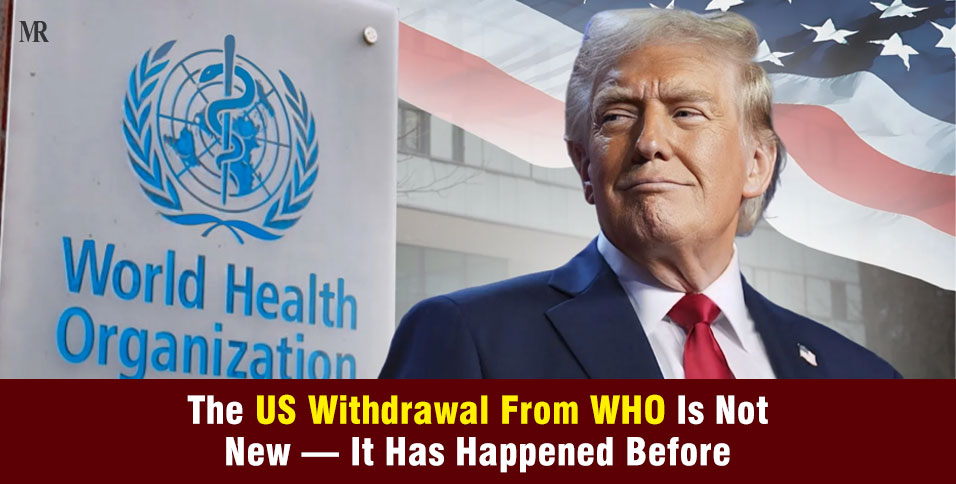
On January 22, 2026, the United States formally completed its withdrawal from the World Health Organization after a year-long process triggered by an executive order.
The US Withdrawal From WHO is not simply a new development. In fact, it is the second time this major shift has happened, driven by longstanding concerns about global health governance, funding, and national interests.
This time, the decision follows a signed executive order and a completed legal process.
This article explains the latest news, traces historical context, and offers insight into what’s likely next.
The Previous US WHO Exit Attempt of 2020
The first serious US withdrawal from WHO took shape in 2020, at the height of the COVID-19 pandemic.
Then-President Donald Trump announced that the U.S. would leave the World Health Organization, accusing it of being too close to China and slow to respond to early outbreak warnings.
At the time, the United States was the largest financial contributor to the WHO, funding roughly 15% of its total budget through mandatory dues and voluntary programs.
The announcement immediately raised alarms across public health agencies, universities, and global health nonprofits.
However, that earlier exit never fully materialized.
Why the 2020 US Exit From WHO Did Not Happen
Despite the announcement, the United States did not complete the withdrawal process in 2020. Several factors intervened:
- Legal timing rules
WHO rules require a one-year notice period and full payment of outstanding dues before a member can exit.
- Domestic pushback
Congress moved to limit funding cuts, and public health leaders warned that leaving during a pandemic would weaken US disease surveillance.
- Change in administration
In January 2021, President Joe Biden reversed course on his first day in office, halting the withdrawal and restoring ties with the WHO.
As a result, the U.S. leaves World Health Organization headline never became reality then. The US stayed, resumed funding, and rejoined WHO-led programs on vaccines, surveillance, and emergency response.
That pause matters because it shaped how both sides approached the issue later.
What Changed This Time Around
The current United States World Health Organization exit follows a more deliberate and legally complete path.
In January 2025, a new executive order restarted the withdrawal process. This time, the administration allowed the full notice period to run, stopped participation in WHO governance bodies, and ended funding streams tied to WHO programs.
By early 2026, the requirements were met. As a result, the United States has officially withdrawn from the WHO.
Unlike the earlier attempt, there was no reversal.
Why the US Keeps Returning to This Decision
To understand why the US exits World Health Organization again, it helps to look beyond personalities and focus on structural tensions.
Longstanding US Concerns
Across administrations, critics have raised similar points:
- WHO’s dependence on voluntary funding tied to donor priorities
- Limited enforcement power over member states
- Political pressure from large countries during crises
- Slow decision-making during fast-moving outbreaks
Supporters of withdrawal argue that these issues weaken national control during emergencies. They believe the US can respond faster through bilateral health agreements rather than a global body.
A Shift Away From Multilateral Systems
The WHO exit fits a wider pattern in US foreign policy debates. Similar arguments have appeared around trade bodies, climate agreements, and security alliances.
The logic is consistent: global institutions can dilute national influence, while direct partnerships offer more control.
What Happened After the Last Attempt
The earlier withdrawal attempt still had consequences, even though it was reversed.
- WHO began planning for reduced US funding
- Other countries increased contributions to fill short-term gaps
- Trust between US agencies and WHO leadership weakened
- Global health coordination became more cautious and fragmented
Those aftershocks matter now. Many countries remember the uncertainty of 2020 and are preparing contingency plans to avoid disruption this time.
What This Exit Means in Practical Terms
With the US officially leaving, several changes follow immediately:
- No US seat in WHO decision-making bodies
- No direct access to WHO-led emergency coordination
- Loss of influence over global health standards
- Funding gaps in disease programs once backed by US money
The administration has stated it will pursue direct global health partnerships, but these will require new agreements, data-sharing frameworks, and trust-building that once existed automatically through WHO membership.
When Is the US Leaving WHO Fully Effective?
The withdrawal is already in effect following the completion of the one-year notice period and administrative steps.
What remains unresolved are practical transitions, including data-sharing mechanisms and coordination during future outbreaks.
What History Suggests Happens Next
Based on the previous exit attempt, several outcomes are likely:
- Global health coordination becomes more fragmented
- WHO adjusts by shifting reliance toward Europe and Asia
- The US builds parallel systems at higher cost
- Future administrations face pressure to rejoin
History shows that health crises tend to push countries back toward cooperation. Whether that happens again will depend on the scale and timing of the next global emergency.
End Note
The US withdrawal from WHO is not a sudden break but the continuation of a debate that began years ago.
The earlier attempt revealed how hard it is to replace global health systems once they are weakened.
This time, the exit is real, complete, and already reshaping how the world prepares for the next crisis.
Whether the US remains outside or eventually returns, the consequences of this decision will extend far beyond Washington and Geneva.
Maria Isabel Rodrigues