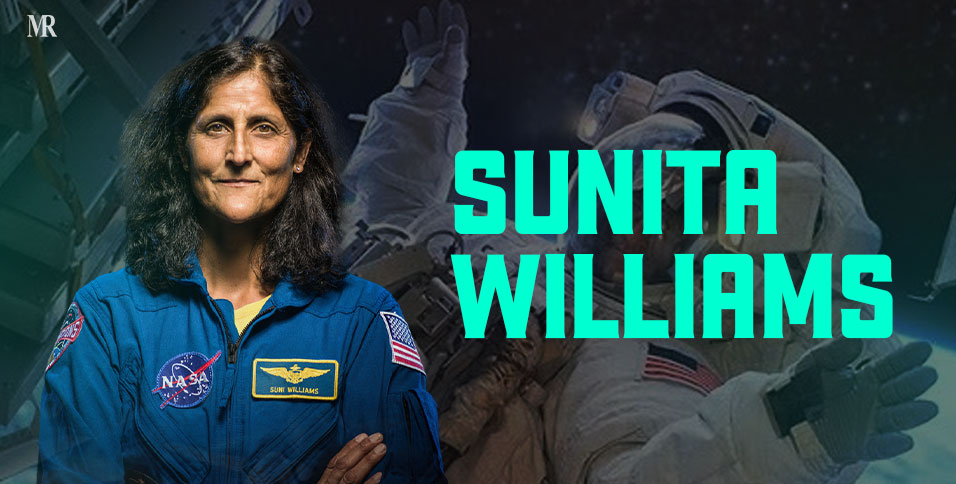
A life beyond Earth is not built in orbit alone. It is shaped over decades of discipline, risk, and quiet resolve on Earth. With the retirement of Astronaut Sunita Williams, one of NASA’s most accomplished space explorers, the story of such a life now comes fully into view.
After nearly 30 years with NASA and more than 600 days in space, Sunita Williams, widely known as Suni Williams, has officially retired from active service. Her departure marks the end of a remarkable era in human spaceflight, one defined by long-duration missions, record-setting spacewalks, and leadership aboard the International Space Station.
As space exploration enters a new phase led by commercial spacecraft and global partnerships, Williams’ journey explains what it truly takes to succeed beyond Earth.
This blog traces the life and career of retired astronaut Sunita Williams, highlighting the milestones that shaped her path, from her early Navy years to commanding the ISS and piloting Boeing’s first crewed Starliner mission.
By reading this biography, you will learn:
- How Sunita Williams prepared for space long before joining NASA
- Why her time in space reshaped long-duration missions
- What her legacy means for future astronauts and global spaceflight
So let’s get started!
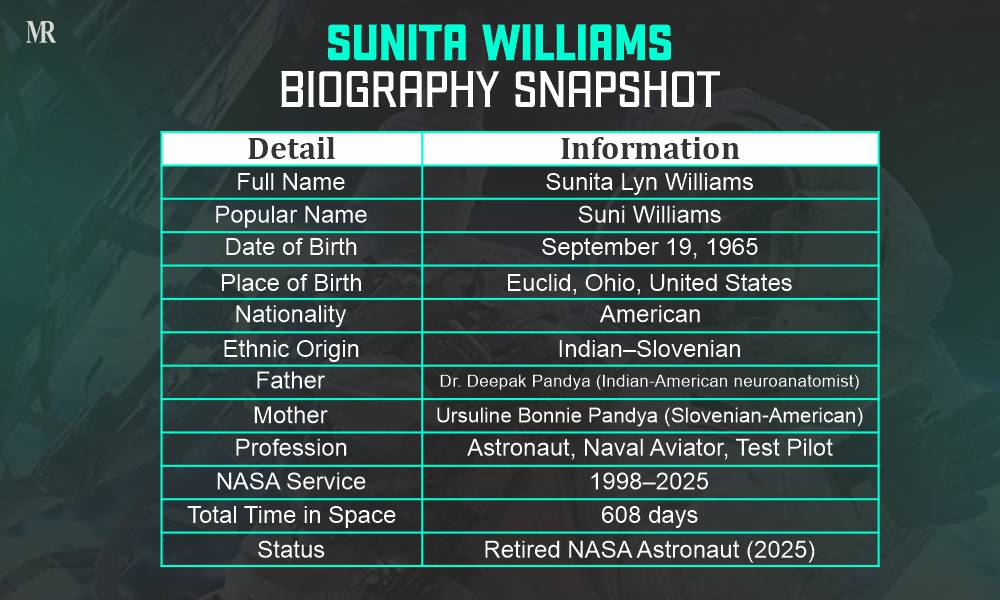
Sunita Williams: Biography Snapshot
Early Life and Education
Sunita Lyn Williams was raised in a family that valued education, service, and curiosity.
Growing up in Ohio and later Massachusetts, she developed an early interest in science, athletics, and aviation.
Her multicultural background exposed her to diverse perspectives from a young age, shaping her adaptability and global outlook.
She attended Needham High School in Massachusetts, where she was an active student and athlete.
Now that we have seen her biography and early life, let’s understand her early career before joining NASA.
The Pre-NASA Career of Sunita Williams
After graduating, Suni Williams enrolled at the United States Naval Academy, choosing a path that combined discipline, leadership, and technical learning. These formative years laid the foundation for her future career in aviation and space exploration.
- Naval Academy and Commissioning (1987):
Sunita Williams graduated from the U.S. Naval Academy with a degree in physical science and was commissioned as an ensign in the U.S. Navy. This training grounded her in discipline, science, and leadership from the start.
- Diving and Extreme-Environment Training:
Early in her career, she qualified as a Basic Diving Officer. Working in pressurized underwater environments taught her risk management, life-support awareness, and teamwork.
- Becoming a Naval Aviator (1989):
Williams earned her wings as a Naval Aviator and trained on rotary-wing aircraft. Flying helicopters demanded fast decision-making, precision, and calm under pressure.
- Operational and Humanitarian Missions:
She flew missions across the Mediterranean, Red Sea, and Persian Gulf, supporting Operation Desert Shield and Operation Provide Comfort. She also led helicopter relief operations after Hurricane Andrew, gaining real-world leadership experience in crisis conditions.
- Elite Test Pilot Training (1993):
Williams graduated from the U.S. Naval Test Pilot School, one of the most selective programs in military aviation. As a test pilot, she evaluated complex aircraft systems and identified risks before fleet deployment.
- Advanced Engineering Education (1995):
She earned a master’s degree in engineering management, strengthening her ability to lead complex technical missions and bridge operations with systems engineering.
Together, these experiences shaped Sunita Williams into a pilot, engineer, and leader long before she ever reached space.
NASA Career Milestones of Sunita Williams
After a distinguished naval career, Astronaut Sunita Williams transitioned to NASA to lead some of the most complex missions in human history. These major career turning points reveal how she evolved into one of NASA’s most trusted astronauts.
1. Selection for the NASA Astronaut Corps
In June 1998, NASA selected Suni Williams for the astronaut program. This milestone represented the culmination of a decade of preparation in the Navy. She reported to the Johnson Space Center in Houston for training in August 1998. The selection process involved rigorous physical exams and psychological evaluations. Only a small fraction of applicants receive this prestigious honor.
She joined Astronaut Candidate Class 17, also known as “The Penguins”. Her training included orientation tours of various NASA facilities. Specifically, she mastered the systems of the Space Shuttle and the International Space Station. She also performed wilderness survival exercises to prepare for emergency landings. Additionally, she began flight training in the supersonic T-38 jet. This period transformed her from a naval pilot into a spaceflight professional.
2. International Collaboration and Underwater Training
Sunita Williams worked closely with the Russian Space Agency following her training. She spent time in Moscow to learn the Russian contributions to the space station. Specifically, she served as a liaison for the first Expedition crew. This role required her to learn the Russian language and culture. International cooperation remains a critical element of modern space exploration.
In May 2002, she participated in the NEEMO 2 underwater mission. She lived in the Aquarius habitat for nine days to simulate orbital life. Underwater habitats provide a high-fidelity analog for the isolation of space. Williams practiced maintenance tasks while wearing pressurized diving suits. This milestone enhanced her understanding of crew dynamics in confined spaces. Ultimately, these experiences prepared her for the psychological demands of long-duration spaceflight.
3. First Spaceflight and Expedition 14/15
On December 9, 2006, Sunita Williams launched on mission STS-116. She flew aboard the Space Shuttle Discovery to the International Space Station. This milestone marked her official entry into the elite group of humans in space. She served as a Flight Engineer for Expedition 14 upon arrival. Later, she rotated to the Expedition 15 crew to continue her work.
During this mission, she helped expand the structural capacity of the station. Specifically, she worked on the installation of the P6 truss assembly. This mission also saw her donate her ponytail to the Locks of Love charity. She spent a total of 192 days in space during this first flight. This duration set a new record for the longest single spaceflight by a woman at that time. Consequently, she became a global icon for female explorers.
4. Running the First Orbital Marathon
Innovation often accompanies the career of Astronaut Sunita Williams. In April 2007, she completed the first marathon in space. She ran the 26.2-mile distance on a specialized station treadmill. This achievement coincided with the annual Boston Marathon on Earth. She finished the race in 4 hours, 23 minutes, and 46 seconds.
Bungee cords held her to the treadmill to counter the effects of microgravity. Physical exercise is mandatory for astronauts to prevent muscle atrophy. Williams utilized this event to promote health and fitness across the globe. Moreover, the race demonstrated the psychological benefits of maintaining Earth-like routines. This milestone remains one of her most famous and relatable achievements. Ultimately, she proved that human endurance extends far beyond the atmosphere.
5. Commanding Expedition 33
Astronaut Sunita Williams returned to space on July 14, 2012. She launched aboard the Soyuz TMA-05M spacecraft from Kazakhstan. Initially, she served as a Flight Engineer for Expedition 32. However, she soon transitioned to a historic leadership role. On September 16, 2012, she officially became the commander of Expedition 33.
This milestone made her only the second woman to command the outpost. She took responsibility for the safety and productivity of the entire crew. Specifically, she managed an international team consisting of Russian and Japanese colleagues. Her command focused on maximizing scientific research and maintaining station systems. She led with a style that emphasized teamwork and democratic collaboration. This successful tenure proved her exceptional management capabilities in extreme environments.
6. The First Triathlon in Space
During Expedition 33, she sought to push the limits of orbital exercise again. In September 2012, Astronaut Sunita Williams completed the first triathlon in space. She used the station’s Advanced Resistive Exercise Device for the swimming portion. For the cycling and running legs, she utilized the stationary bike and treadmill. This milestone highlighted the ingenuity of NASA’s fitness equipment.
She finished the three events with a time of 1 hour, 48 minutes, and 33 seconds. This achievement showed that comprehensive athletic training is possible in microgravity. Specifically, it provided data on how resistive machines can simulate Earth-bound sports. Williams used her platform to inspire students to pursue healthy lifestyles. Consequently, she became a dual pioneer in both space science and human performance.
7. Selection for the Commercial Crew Program
In 2015, NASA selected Suni Williams for a new flight category. She became one of four astronauts to test a commercial spacecraft. Specifically, she trained on the Boeing CST-100 Starliner and the SpaceX Crew Dragon. This milestone marked a shift from government-only launches to private-sector partnerships. The goal involved establishing reliable crew transport from American soil.
She worked closely with Boeing engineers to design the Starliner’s cockpit. This role required her to evaluate flight controls and touch-screen interfaces. Furthermore, she helped develop the procedures for docking with the space station. Her years of experience as a test pilot made her an ideal candidate for this role. This milestone represented her transition into the future of the aerospace industry.
8. The Historic Starliner Crew Flight Test
On June 5, 2024, Astronaut Sunita Williams launched on the Boeing Starliner. She served as the pilot for the first crewed test flight of the vehicle. This mission aimed to certify the spacecraft for long-duration missions. She and Commander Butch Wilmore docked with the station on June 6. This milestone was the first time a woman flew on the maiden crewed mission of a new spacecraft.
However, the mission encountered unexpected technical difficulties. Engineers identified five helium leaks and five thruster malfunctions in the propulsion system. These issues prevented a scheduled return after eight days. Consequently, NASA extended their stay to nine months for safety reasons. Williams remained calm and focused throughout the uncertainty of the mission and denied being stuck. She utilized the extra time to conduct over 900 hours of research.
9. Setting the All-Time Female Spacewalk Record
While waiting for a return flight in 2024-2025, she performed vital maintenance. Suni Williams completed two additional spacewalks during this period. These excursions focused on repairing the station’s truss and antenna systems. On one of these walks, she achieved a monumental milestone. She officially became the woman with the most cumulative spacewalk time in history.
She has logged 62 hours and 6 minutes outside the station across nine spacewalks. This achievement places her fourth on the all-time global list for all astronauts. Spacewalking requires intense physical coordination and mental focus. Specifically, astronauts must manage their life-support systems while moving in a vacuum. Williams proved her endurance by surpassing the previous record held by Peggy Whitson. This milestone solidified her legacy as an elite extravehicular operator.
10. Safe Splashdown and Final Retirement
On March 18, 2025, Sunita Williams returned to Earth. She flew home aboard a SpaceX Dragon capsule after her Starliner was deemed too risky. The capsule splashed down safely in the Gulf of Mexico near Florida. This milestone concluded an epic 286-day odyssey in orbit. She and Wilmore had traveled 121 million miles during their mission.
Following her return, the space agency announced her final career milestone. Sunita Williams retired from NASA effective December 27, 2025. She spent 27 years in service, logging a total of 608 days in space and 3 space missions. NASA Administrator Jared Isaacman called her a “trailblazer” who shaped the future of exploration. Her retirement marks the end of an era for human spaceflight. Ultimately, her work paved the way for the upcoming Artemis missions to the Moon.
Technical Research and Scientific Contributions
During her space missions, Sunita Williams played an active role in advancing scientific research critical to long-duration spaceflight and future deep-space missions.
Key research contributions include:
- Studying long-term effects of microgravity on the human body, helping scientists prepare astronauts for missions to Mars.
- Conducting plant-growth experiments, including monitoring Romaine lettuce in the ISS hydroponic systems to support space-based food production.
- Investigating fluid behavior in microgravity which improved the design of fuel storage and life-support systems.
- Supporting experiments with the Alpha Magnetic Spectrometer (AMS) to analyze cosmic rays and explore the origins of the universe.
- Troubleshooting and maintaining complex onboard laboratory equipment using her engineering expertise.
Cultural Significance and Global Inspiration
The heritage of Sunita Williams plays a central role in her public persona. She possesses an Indian-American father and a Slovenian-American mother. Throughout her career, she carried cultural artifacts into orbit to celebrate her roots.
Specifically, she took a copy of the Bhagavad Gita and the Upanishads to the ISS. She also carried a small idol of Lord Ganesha for spiritual guidance.
These gestures resonated deeply with millions of people in India. She often spoke of her visits to her father’s ancestral village in Gujarat as a “homecoming”.
Moreover, she inspired a new generation of students in both the U.S. and India to pursue STEM. In 2013, she shared a message with Indian children stating that the world is open to them.
Her accomplishments earned her the Padma Bhushan, India’s third-highest civilian honor.
Ultimately, she served as a bridge between nations through the common goal of space exploration.
The Future of Human Spaceflight After Williams
Suni Williams retirement marks a transition from the ISS era to NASA’s Artemis Moon program. Her work on the Commercial Crew Program established the foundation for regular private launches. Specifically, the certification of the Starliner will continue based on the data she provided. Future missions to the Moon will build upon her research into human physiology in microgravity. NASA aims to land the first woman on the lunar surface using the systems she helped test.
Furthermore, her role in international diplomacy set a standard for future collaborations. She encouraged India to increase its presence in the global space race. The upcoming Gaganyaan mission by ISRO will benefit from the expertise she shared during her visits. Williams expressed hope that one day she would see samosas on the Moon. Consequently, her legacy will continue to inspire explorers as they venture further into the solar system.
Conclusion
The retirement of Sunita Williams marks the close of a defining era in human spaceflight. Her career showed that success in space is built on discipline, resilience, steady leadership, and not just technology.
From piloting aircraft to commanding the International Space Station, Williams helped shape how astronauts live and work in orbit. The knowledge she contributed will continue to guide future missions to the Moon and beyond.
As she steps away from active service, her legacy remains clear: exploration advances when preparation meets perseverance. Sunita Williams leaves behind a roadmap for the next generation, ready to live a life beyond Earth.
Maria Isabel Rodrigues