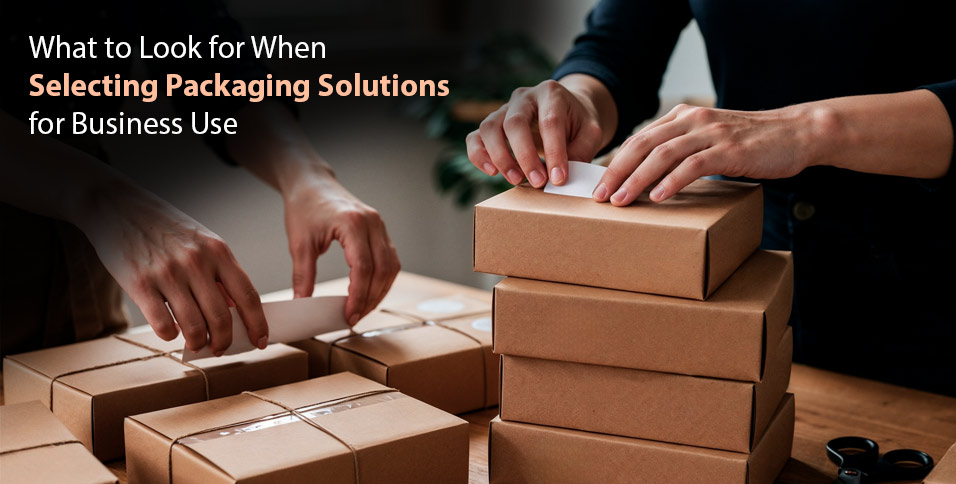
It has an impact on all areas of your business. Good packaging solutions protect goods against damage, save you money, and enable you to deliver goods to your customers in pristine condition. Wrong packaging solutions affect you adversely, and that is why you need packaging expert advice.
These are but a few benefits you enjoy with the right packaging solutions for your business. Irresponsible packaging solutions affect all areas of your business, including your products, finances, employee welfare, and your business
A typical day in the operations of Australian businesses dealing in physical products means the aspect of packaging goes beyond the checklist of tasks to be accomplished. Rather, it varies from being a decision linked to the operations of your business in terms of the bottom-line impact, the impact on employees’ safety, and the impact on your brand.
Understand Your Product and Volume Requirements
Prior to judging individual solutions, you have to understand the reality of the products you’re actually packing, or rather, shipping. Your products determine your needs more than any other factor in selecting your packaging. Are you handling small similar items or different items with varying sizes, weights, or breakabilities?
Fragile products require higher protection packaging and care, while more robust products may require only basic securing. Complexly shaped or varying size products require variable packaging solutions depending on the specific needs. Information about these will enable you to differentiate between the design of packaging for products that require only basic securing and products that require higher protection packaging.
The quantity of shipments is as important as the nature of shipments. If you are handling ten shipments of pallets on a daily basis, your requirements are quite different from another that has two shipments of pallets on a weekly basis. The quantity will determine at which point automation becomes an economically viable option.
Remember to consider the seasonality of peaks and growth rates. A packing solution that just satisfies the existing requirements will become an even greater constraint as the volumes escalate. Businesses that make informed and intelligent decisions assess solutions in terms of where they are headed, rather than where they are. Increasing capacity for growth will ensure that systems are replaced because of growth, rather than because they are obsolete.
Manual vs Automated Packing Solutions
Deciding between manual and automated packaging methods depends on the volume and budget that your company can afford. Manual packaging may be ideal if you handle multiple products. With manual packaging, your company can package any merchandise by simply adjusting techniques. This implies that you cannot be limited by certain equipment.
Nevertheless, the shortcomings in hand packaging become more and more apparent as the volume of the business escalates. Consistency is dependent on the individual operator and results in inconsistencies regarding the level to which the product has been packaged. Labour costs accrue over time, and there are also potential risks associated with hand packaging that can be mitigated by automated systems.
For companies processing regular pallet shipments, automated systems can improve efficiency. One example is wrappers, which help stabilise loads during transport and enhance safety. Evaluating automated systems allows businesses to compare efficiency, cost, and scalability when selecting packaging solutions.
This isn’t necessarily an either-or choice. A combination strategy can be effective, where high-volume standard processes are automated while unusual items are handled manually. This approach balances efficiency where it is most valuable with flexibility for those individual products.
Automation becomes cost-effective when the benefits of labour cost savings, consistency of output, and a lower rate of damage are realized in a reasonable time frame to offset the equipment expenses. Already in the position of contemplating crossing the threshold of cost-effectiveness, the consideration changes from asking whether the business affords automation to whether the business affords the cost of not automating.
Safety, Compliance, and Risk Reduction
Safety factors that should not be overlooked in the workplace include those related to packaging. Issues like manual lifting of heavy loads, repetitive motions through wrapping and securing, and injuries from unstable loads are all potential dangers that will impact your workplace.
Load stability also is not just about protecting the packaged goods; it’s about protecting the people who will be handling the load throughout the supply chain as well. Loads that are not properly secured tend to move about when the vehicles are in transit. This poses a risk not just to the workers in the warehouses but also to the delivery personnel as well.
Observance of work health and safety laws is not optional in Australian businesses. In addition to being within the law, there is a right to provide safe work practices for workers in employment. Packaging solutions offering greater security against manual handling injury continue to be important for work health safety.
The reputation and financial damage costs in relation to some workplace accidents are not limited to workers’ compensation claims. Productivity costs, higher insurance costs, litigation costs, as well as those related to the effects on teamwork are some factors that determine the total costs of any workplace accident related to unsafe packaging practices in a company. Preventative spending on safer solutions can bring in returns in terms of accident prevention alone, to say nothing of efficiency gains.
Compliant packaging will also shield your reputation. Should the items be astoundingly damaged or carelessly packed upon unboxing, this would reflect adversely on you as professionals. Customers will not care about the methods you used in packaging; however, they will be shocked to see damaged merchandise as a result of improper tying-down procedures.
Cost Considerations Beyond Purchase Price
In assessing solutions based on packaging, one fails to see the forest for the trees because cost of ownership, including time, consumables, maintenance, and the real cost of product compromise through damage, will easily outweigh any cheaper initial investment, regardless of cost. A lowly priced option would easily turn out to be costly when compared to an upscale system that costs even more to purchase initially.
“Labour time” is a constant cost base, compounded over thousands of boxes. For every five minutes it takes in your current processing, your automated solution will cut it to two minutes, meaning a saving of three minutes, and it isn’t long before you are saving half an hour a day on just your first ten pallets, or better still, more than two hours a week, or in excess of one hundred hours a year.
Damage costs affect more than replacement products. Then there is the cost of customer service time spent on complaining consumers, the cost of reverse logistics for replacement products, and lost customer relationships due to poor delivery performance. Packaging solutions that lower the frequency of damages pay for themselves through avoided costs that may not be recorded on any invoice but certainly affect one’s bottom line.
Maintenance and durability: Quality equipment differs from the cost-effectiveness of fake economy by certain premises related to maintenance and durability. Cheap equipment may be repaired or replaced from time to time and will cost more in the long run compared to the durability of equipment. While assessing your equipment choice, you should inquire about the durability of the equipment, the level of its maintainability, or availability of spare parts.
Scalability and Business Growth
The packages your business requires ought to facilitate scalability and not hinder it. Some packaging solutions are working well for the amount of business your company has now, but when you grow and the number of orders rises, these solutions become a limiting factor. The companies making the decisions analyze the scalability of the packages.
Flexibility is as important as capacity. When your product range keeps changing or you enter other categories, can your packaging solutions change accordingly? This is what makes certain solutions inflexible and restrains your strategies. It is important to adopt methods that can offer you consistency, efficiency, and flexibility at the same time.
Think about how you might get to where you want to be in three years. If you’re in a manual process and you think volumes will support automation, you would want to integrate well for future scaling. As you’re setting up automation for the first time, you would want a supplier to provide you better future capabilities instead of having to reinvent every step along the way.
Do not introduce bottlenecks, which will restrict growth. This could be a situation where you are unable to handle the packaging of the number of orders you are receiving. This will mean you are limited in the way you grow because of your packaging operations.
Making an Informed Decision
In considering solutions for packaging needs, one has to look into several categories of solutions in order to make a systematic comparison. Do not confine yourself to the most obvious solutions, nor to the supplier that you first consider. Familiarize yourself with what solutions are out there in the area of manual solutions, semi-automated solutions, and automated solutions. Bear in mind not only the expenditures in equipment but also the operational expenditures.
Suppliers should be assessed based on factors that extend past the cost of purchase. Linked to that is factors such as local presence, responses to support inquiries, warranty, among others. Businesses that are Australian will reap the benefits of selecting suppliers who are located close by.
Request demonstrations when possible. Observing equipment in action with your own products can provide insight that specifications do not. Contact customers of potential suppliers. The lived experience of existing customers can open your eyes to the reality of claims versus delivery.
Protecting Operations Through Smart Packaging Choices
Protecting operations does not Packaging solutions should facilitate easy and effective business operation. The right solutions protect products, people, and costs. Wrong solutions cause constant friction in business. It often involves additional expense and risk that compounds with time. It is a good idea to consider key elements such as product attributes, volumes, safety issues, the cost of ownership, and scalability before settling on the solution of choice.
Backend issues, even with automated alternatives such as wrapping machines, also influence smooth workflow and quality of delivery when considered with due care according to the business. Australian companies competing in their respective markets understand the importance of packaging as an operational factor. Australian companies take the time to understand their needs, researching different alternatives available to select solutions that not only meet their needs but also help in achieving operational excellence.