Mirror Review
November 25, 2025
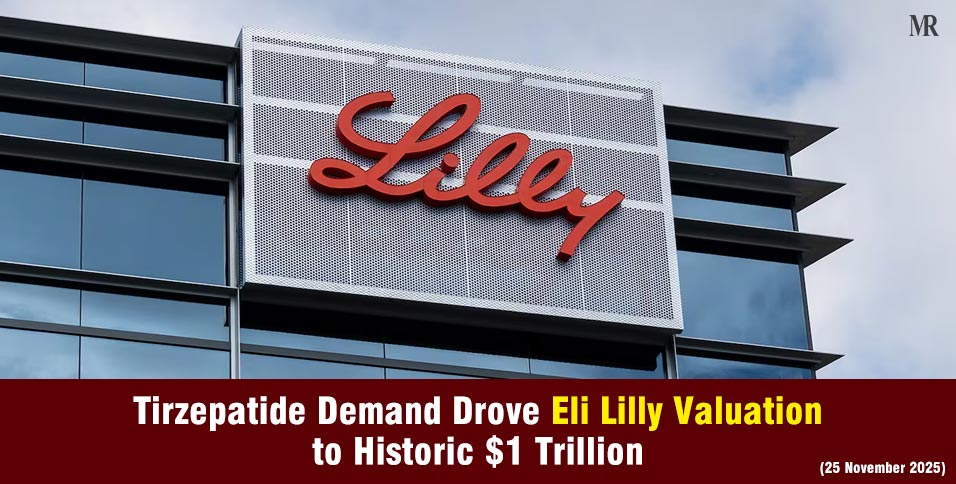
The Eli Lilly valuation crossed $1 trillion recently, making it the first pharmaceutical company to reach the trillion-dollar market cap. The rise came after extraordinary demand for tirzepatide, the drug behind Mounjaro and Zepbound.
With this, investors now see metabolic health as one of the most profitable markets in healthcare.
This milestone also shows a long-term shift in how the world treats obesity, diabetes, and chronic metabolic conditions.
The surge in Eli Lilly market cap is the result of scientific breakthroughs, large-scale manufacturing bets, shifting public awareness about weight loss, and the growing acceptance of metabolic drugs as a long-term health solution.
Below is a breakdown of what actually drove the Eli Lilly valuation past the $1T mark and why investors think the company still has room to grow.
1. GLP-1 Drugs Sparked a Global Weight Loss Boom
The clearest driver of Eli Lilly’s $1T valuation was the performance of its tirzepatide-based drugs:
- Mounjaro: For diabetes
- Zepbound: For obesity
These two drugs have become global blockbusters. They delivered more than half of Lilly’s recent quarterly revenue and dominated the fast-growing GLP-1 category.
Why this mattered:
- The metabolic health and obesity market is now considered one of the most valuable segments in healthcare.
- Tirzepatide acts on two gut hormones, GLP-1 and GIP, giving it an edge in both weight-loss and glycemic control.
- Early clinical data suggest stronger and faster weight reduction compared with many alternatives.
This drug class is also reshaping public health trends. Employers, governments, insurers, and families are shifting budgets to GLP-1 drugs because obesity and diabetes drive huge long-term medical costs. Furthermore, the demand is expected to run for many years.
Eli Lilly CEO David Ricks said the company understood the scale of the opportunity very early on. Reflecting on the moment he first saw the breakthrough tirzepatide data, he explained: “People ask, ‘When did you know tirzepatide was going to be big?’ The answer is that day.”
2. Strong Financial Performance in Q3 2025
Q3 2025 financial results helped support the rapid Eli Lilly valuation climb. Key details from their latest quarterly report are:
- Total Q3 2025 revenue: $17.6 billion
- GLP-1 franchise sales in first 9 months of 2025: nearly $25 billion
- Research spending: up significantly as Lilly ramps up pipeline investment
- Future guidance: raised again, signaling confidence in long-term momentum
The company is also maintaining healthy margins despite rising production costs. This financial stability gave investors further confidence that the tirzepatide boom is not a short-lived spike.
Hank Smith, Haverford Trust, commented, “Investors have historically liked secure earnings growth, and Eli Lilly is the only large-cap pharma that has that kind of earnings profile.”
3. First-Mover Advantage and Large-Scale Manufacturing
Another major factor behind Eli Lilly’s valuation rising sharply is its operational scale.
Key advantages are:
- Faster manufacturing expansion compared to rivals
- Larger global distribution capacity
- Proven ability to secure supply chain in a high-demand environment
- Early investment in long-term production sites, including multi-billion-dollar facilities
Many experts point out that tirzepatide’s dual-action mechanism gives Lilly a clinical edge, but scale is what allowed them to convert that advantage into revenue at this size.
Kevin Gade, Bahl & Gaynor (Lilly shareholder) said, “They are doing so many things outside of obesity, but to suggest anything is driving share price beyond obesity at this point, I don’t know if that would be a factual statement.
4. Strategic Deals and Growing Partnerships
Lilly’s rise was not powered by tirzepatide alone. The company has spent years building a forward-looking pipeline.
Important strategic moves include:
- Acquisitions in gene therapy and metabolic disease to expand beyond GLP-1 drugs
- Partnerships with biotech firms focused on next-generation weight-loss treatments
- Development of oral obesity drugs like orforglipron, which could open new patient segments
- Collaborations in AI-driven drug discovery that speed up new molecule development
- Large-scale manufacturing partnerships that guarantee future supply stability
Lilly has also benefited from favorable policy moments, including agreements that expand patient access to certain weight-loss drugs through new pricing arrangements.
This broad strategy reassures investors that the company is not depending on one product alone.
5. Investor Sentiment Behind the Soaring Valuation
Investor confidence played a huge role in the Eli Lilly valuation jump. Here’s what shaped market sentiment:
- Lilly trades at high forward earnings multiples, showing investor belief in long-term dominance.
- The weight-loss drug narrative transforms Lilly from a traditional pharma company into a high-growth “health-tech” player.
- Long-term demand for metabolic health solutions is seen as predictable and extremely large.
- Analysts expect tirzepatide drugs to stay industry leaders for several years.
After reaching the $1 trillion valuation milestone, Lilly’s stock jumped again as traders saw it as confirmation that the GLP-1 category is still underpriced relative to future demand.
Evan Seigerman, BMO Capital Markets, stated, “The current valuation points to investor confidence in the longer-term durability of the company’s metabolic health franchise.”
Key Risks Investors Are Watching
Even with the strong position, several challenges remain.
- Pricing pressure for obesity drugs could reduce margins.
- Competition from other drugmakers in the GLP-1 and metabolic health space is rising fast.
- Regulatory decisions for new drugs and safety findings may influence long-term growth.
- Global supply constraints could delay expansion if demand continues to surge.
These risks are important because the company’s valuation relies on continued momentum.
End Note
Eli Lilly’s move into the $1 trillion club marks a once-in-a-generation shift in healthcare economics.
The Eli Lilly valuation did not rise on hype alone. It grew on the back of real demand, strong execution, smart partnerships, strategies, and a clear first-mover advantage in metabolic health.
The company now stands at the intersection of medicine, technology, and global public health.
As long as tirzepatide demand stays strong and Lilly continues to expand its pipeline, many investors believe this valuation is not the peak, but the start of a new era in healthcare.