Mirror Review
November 20, 2025
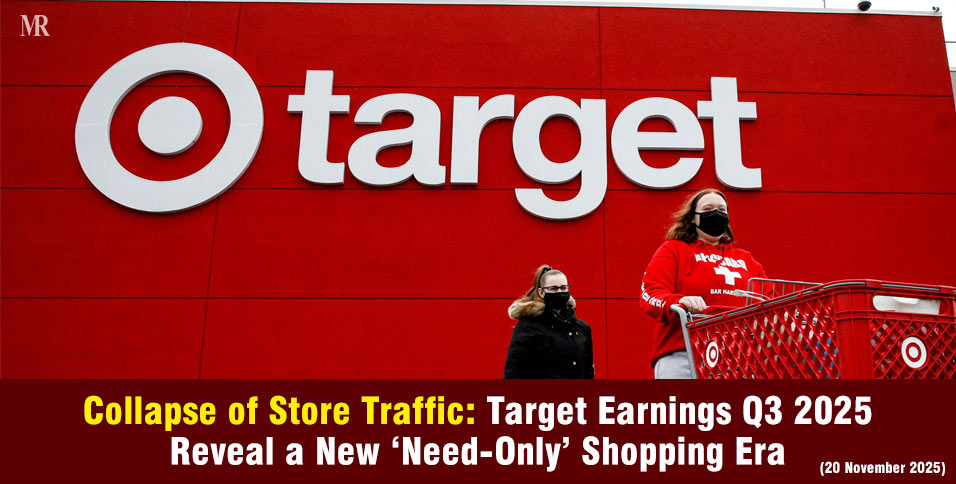
For years, a Target run meant walking in for one item and walking out with a full cart! That familiar experience is fading since Americans today are shopping with more intention, making fewer trips, and pausing nonessential purchases.
The Target earnings Q3 2025 report shows this shift clearly from last year:
- Net sales dipped to $25.3 billion, down 1.5%
- Comparable sales fell 2%
- Store-originated sales dropped 3.8% as store traffic declined 2.2%
- Digital comparable sales grew 2.4%, supported by more than 35% growth in same-day delivery
Still, the Target earnings report cut its Q4 outlook as shoppers remain price sensitive and value-driven.
Incoming CEO and COO Michael Fiddelke said, “We’re laying the foundation for a stronger, faster, and more innovative Target. It’s grounded in our purpose of bringing joy to our guests and focused on growth.”
He further added, “We know there’s work to do, and we have the best team in retail to do it. With clear priorities guiding us, I’m proud of our progress and confident we’re on the right path.”
This proves that Target is preparing for a retail landscape driven by value, convenience, and mission-based shopping instead of browsing and impulse buying.
Here are 5 reasons why Target Earnings Q3 2025 Reveal ‘Need-Only’ Shopping Era
1. Store Traffic Is Declining, Reshaping Target’s Entire Business
Target’s model is built around stores: 97% of all merchandise is fulfilled by or through them. When traffic falls, the ripple effect is immediate.
Key metrics from the Target Earnings Q3 2025:
- Store sales down 3.8%
- Store traffic down 2.2%
This isn’t just a seasonal dip. It’s a behavioral change.
Shoppers are making fewer store visits and are treating trips as functional runs, not browsing experiences. That shift cuts into:
- impulse buying
- higher-margin discretionary purchases
- add-on items that once fueled Target’s category growth
In short, a drop in traffic hits both volume and profitability at once.
2. Digital Sales Are Rising, but Costs Are Too
Digital comparable sales rose 2.4%, driven by 35%+ growth in same-day delivery through Target Circle 360. This signals convenience still matters, but at a cost.
Moreover, despite operational efficiencies, operating income fell nearly 19%.
Why? Because digital convenience, especially same-day pickup and drive-up, remains expensive to fulfill.
Target is stuck in a tension familiar across retail:
- Consumers want faster, cheaper digital convenience
- Retailers struggle to make it profitable
This gap is widening as behavior shifts away from stores.
3. Discretionary Categories Are Weakening
Consumers are sticking to basics and delaying everything else.
Category performance snapshot from the Target Earnings Q3 2025:
- Food & Beverage: up to $6B
- Hardlines: slight growth
- Apparel, Home, Household Essentials: declining
This “need-only” mindset explains why categories tied to lifestyle upgrades, décor, and fashion remain soft.
In the Target Q3 2025 report, Target’s response heading into the holidays was clear:
- 20,000+ new holiday items
- Thousands of gifts starting at $5
- Thanksgiving meals for four under $20
- Lower prices on thousands of essential items
The revised strategy is to pull shoppers back with value.
4. Non-Merchandise Revenue Is Becoming a Quiet Powerhouse
While merchandise slowed, non-merchandise revenue grew nearly 18%, which is a standout bright spot in the Target results.
This includes:
- Roundel advertising
- Membership revenue
- Marketplace services
Retail media networks like Roundel generate margins far higher than product sales.
This is one of Target’s most defensible long-term growth levers and a hedge against soft discretionary spending.
5. Consumer Behavior Has Entered a New Phase
Target’s Q4 guidance reflects caution:
- Low single-digit sales decline expected
- Full-year GAAP EPS: $7.70–$8.70
But the deeper insight isn’t guidance, it’s behavior.
Across retail, consumers are now defined by:
- fewer store trips
- value-first decision making
- smaller discretionary baskets
- increasing digital reliance
- membership-led loyalty ecosystems
Collectively, these shifts form a clear pattern: Americans are embracing intentional, “need-only” shopping.
Conclusion: A New Normal Is Here
The Target earnings Q3 2025 are a snapshot of a consumer mindset undergoing long-term change.
- Store traffic is declining.
- Shoppers are more selective.
- Digital convenience is rising, but expensive.
- Discretionary spending is subdued.
- And revenue growth is increasingly coming from non-merchandise streams like retail media.
Target is adapting with sharper pricing, convenient fulfillment options, and expanded media revenue. Workforce and cost restructuring, including conversations around Target layoffs, also indicate a company preparing for the future.
But the bigger story is this: Retail is shifting from discovery to necessity, and store traffic may never return to its pre-2020 patterns.