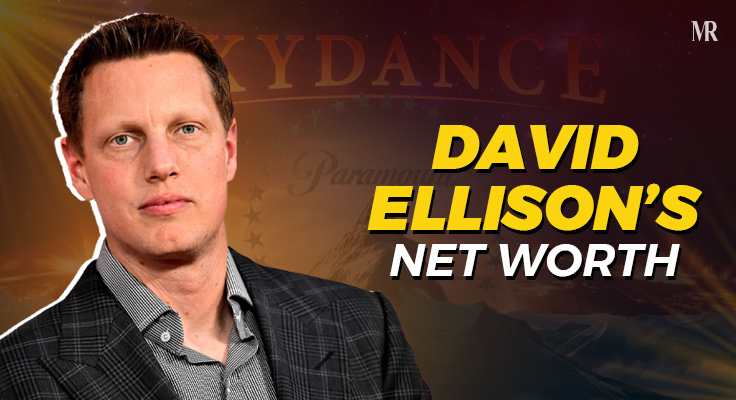
When you hear the name Ellison, you probably think of Oracle-level wealth, right? But David Ellison’s story is something truly different. How exactly did David Ellison’s net worth climb to that eye-watering estimate of $500 million? It wasn’t just about the inheritance (though, let’s be honest, that was a heck of a start!). This figure is really the story of his “baby,” Skydance Media.
But hold on, because that $500 million number? It just got a massive shake-up thanks to the huge Paramount Skydance merger.
We’re about to walk through his entire financial journey, step-by-step. We’ll see how he went from a kid with a world-famous dad to the man sitting at the head of one of the biggest entertainment conglomerates on the planet. This isn’t just a finance report; it’s the chronicle of an empire being built.
Let’s Explore David Ellison’s Net Worth Journey
1. The “Oracle” Foundation: From Inheritance to Early Lessons
Let’s set the scene. David Ellison was born on January 9, 1983, in Santa Clara County, California. He’s the eldest child of Oracle co-founder Larry Ellison and Barbara Boothe.
As you can imagine, his upbringing in Woodside, California, was surrounded by significant wealth and access. I mean, his father, Larry Ellison, is famously one of the world’s richest individuals!
But David’s story isn’t just about inheritance. He wanted to build his own legacy in the cutthroat media world.
Of course, that inheritance didn’t hurt. He channeled some of his Oracle trust fund holdings—we’re talking an estimated $200 million in stock transfers right on his 25th birthday—into long-term equity stakes across different industries. Smart.
He even gave filmmaking a shot, studying briefly at the University of Southern California’s School of Cinematic Arts, but he dropped out in 2005.
His next move? He jumped right into acting and even co-financed the 2006 World War I drama Flyboys, where he also snagged a starring role.
But… oof. This is where reality hit. Despite a hefty $65 million budget, the film only pulled in about $18 million. That’s a major commercial setback. But you know what? It was also a massive learning experience for Ellison.
That early, hands-on (and slightly painful!) production experience was the exact push he needed. It made him realize his future wasn’t in front of the camera, but behind it. This led him straight to establishing Skydance Media.
2. The Founding of Skydance: An Entrepreneurial Leap
So, in 2006, David Ellison launched Skydance Media. This was his big leap.
The real turning point, the moment that changed everything, came in 2009–2010. Ellison secured a landmark five-year, $350 million co-financing agreement with Paramount Pictures. Wow!
This deal, which was partly funded by his father, was structured brilliantly. It involved a $150 million equity investment and a $200 million revolving credit facility. This gave Skydance the muscle to fund massive projects and, just as importantly, build strong studio ties.
This “co-financing” model was the secret sauce. Ellison wasn’t just another producer begging for money. He was a financial partner. He was sharing the risks, which meant he also got to share in the potentially huge returns from successful intellectual properties.
And success came fast. Skydance hit gold early with True Grit. Can you believe it? The film snagged 10 Oscar nominations and grossed over $252 million on just a $38 million budget.
That single triumph immediately solidified Skydance’s financial footing and proved its production capacity. They were officially in the game.
3. Building the Skydance “Ecosystem”: Assets and Works
With that momentum, Skydance Media didn’t just sit still. It began expanding its portfolio across all kinds of entertainment sectors, establishing itself as a seriously prolific content creator.
- Skydance Films: The Franchise King
Ellison’s strategy was clear: focus on co-financing massive, bankable intellectual properties. And boy, did it pay off.
Under his leadership, Skydance produced a string of Hollywood blockbusters. The film franchises are just incredible:
- Mission: Impossible franchise: This is the big one. Skydance backed five Mission: Impossible movies, including Mission: Impossible – Rogue Nation, Fallout, and Top Gun: Maverick. Collectively, these have grossed over $3.3 billion worldwide. Just… wow.
- Star Trek reboot series: Skydance produced two Oscar-nominated Star Trek movies. Star Trek Into Darkness (2013) brought in $467 million, and Star Trek Beyond (2016) pulled in $343 million.
- Jack Reacher: This film was one of the early investments that really drove box office traction and got critical acclaim.
- Terminator: They weren’t all wins, though. Skydance backed two Terminator movies, and Terminator: Dark Fate (2019) reportedly lost Paramount and Skydance over $120 million. Ouch. But that’s the risk of co-financing!
- Skydance Television: Diversification
In 2013, Skydance smartly expanded into television, creating massive new revenue streams through some very successful series.
We’re talking hits like Grace & Frankie on Netflix, the super-popular Jack Ryan & Reacher series on Amazon Prime Video, and the epic Foundation on Apple TV+. They were everywhere!
- Skydance Animation: The Future Play
But why stop there? The studio diversified again in 2016–2017 by launching Skydance Animation. This was a big play for the future.
They even recruited the former Pixar chief, John Lasseter, to lead their animation slate. As a result, they secured a lucrative, exclusive partnership with Apple TV+ for animated films like Luck.
- Skydance Interactive: The Niche Asset
And to cover all bases, Skydance Interactive was also launched for VR gaming. They notably developed titles such as The Walking Dead: Saints & Sinners.
All of these expansions were fueled by strategic capital raises and building up those all-important equity stakes.
4. The Top Gun: Maverick Multiplier: A Defining Success
We have to talk about Top Gun: Maverick. This film stands out as a monumental success for Skydance Media and a massive factor in David Ellison’s wealth journey.
The film grossed nearly $1.5 billion globally. Think about that! It became one of Skydance’s most profitable ventures, ever.
With a budget of approximately $170 million, Top Gun: Maverick achieved a staggering net profit of $391.1 million. That profit was shared among Paramount, Skydance, and New Republic.
This single film dramatically increased the private valuation of Skydance. Following a $400 million strategic investment round led by KKR in 2022, Skydance was valued at over $4 billion—and this was before the merger.
This success cemented Ellison’s personal stake and the company’s financial standing in a huge way. What a ride!
5. The Climax: Chairman of Paramount Skydance
This all leads to the climax of the story: David Ellison’s journey to acquire Paramount Global.
It happened fast. On July 24, 2025, the U.S. Federal Communications Commission (FCC) approved the $8 billion acquisition of Paramount Global by Skydance Media.
Then, on August 7, 2025, the merger officially closed. A new entity was born: Paramount Skydance Corporation (listed as Nasdaq: PSKY).
This deal is almost hard to comprehend. It valued the combined company at an enterprise value of approximately $28 billion.
And David Ellison? He is now positioned as the chairman and CEO of the newly formed Paramount Skydance corporation. This puts him in control of iconic brands like CBS, MTV, Comedy Central, and Paramount Pictures.
So, while his estimated net worth was previously hovering around $500 to $520 million (tied to his controlling interest in a roughly $4 billion private company), his wealth is now intrinsically linked to a significant stake in a $28 billion public media conglomerate. That’s a different league entirely.
Under the new ownership structure, David Ellison holds 50% of the voting rights in the combined firm. His father, Larry Ellison, holds 27.5%, and RedBird Capital holds 22.5%. He is, without a doubt, the man in charge.
6. The “Ellison Method”: Leadership, Secrets & Challenges
So, what’s the “Ellison Method”? His approach seems to combine strategic financial backing with a very talent-friendly ethos. It’s how he attracted major figures like Tom Cruise to his Skydance projects.
Unlike his father, who primarily acts as an investor, David Ellison takes a very hands-on leadership role, focused on building a creative ecosystem.
His ability to forge powerful partnerships and his sheer, bold entrepreneurship have been the keys to transforming Skydance Media into a true Hollywood powerhouse.
However, this transformative merger isn’t without its massive challenges.
The FCC’s approval came with specific commitments from Skydance. These include pledges to dismantle Diversity, Equity, and Inclusion (DEI) programs at Paramount and to appoint an ombudsman for news bias complaints.
As you can imagine, these decisions have sparked substantial backlash in media circles.
Furthermore, the task of integrating two major media entities is massive. It will involve significant operational adjustments, including workforce reductions and the ambitious goal of achieving $2 billion in spending cuts.
Ellison’s stated aim is to transform Paramount into a “tech hybrid” company. He wants to leverage artificial intelligence to enhance content creation and streamline production processes, potentially (and fascinatingly) in partnership with Oracle.
My Opinion
David Ellison’s net worth journey is truly a masterclass in strategic growth. He moved far beyond the shadow of his father’s incredible fortune to become a dominant force in Hollywood. His initial seed capital, mixed with a personal passion for storytelling and aviation, built a rock-solid foundation.
Through Skydance, he proved his sharp acumen, meticulously co-financing blockbusters while diversifying into TV, animation, and gaming. Top Gun: Maverick was the rocket fuel, boosting Skydance’s valuation. But the Paramount acquisition is the real crown jewel. It completely transforms his individual wealth, cementing his status not just as a producer but as a major media mogul overseeing a vast, multi-billion-dollar enterprise.
Here Are Some Lessons From David Ellison’s Journey:
- Leverage Failure as Data:
That early flop, Flyboys, wasn’t the end. It was critical data. It became the learning experience that informed his pivot to production and shaped his future strategies.
- The Power of Co-Financing:
He didn’t just produce. Ellison’s model of co-financing let him share the risk, yes, but it also let him keep significant equity and creative control in major franchises. That’s how you really amplify returns.
- Marry Personal Passion with Business:
His lifelong love for aviation (rooted since childhood!) inspired the name “Skydance.” It also informed his production choices, like Top Gun: Maverick, which he personally championed.
- Strategic Diversification Beyond Core Business:
Ellison was smart. He didn’t just stick to films. He proactively pushed Skydance into television, animation, and interactive gaming, building a tough ecosystem that could handle market ups and downs.
- Cultivate Mentorship and Talent:
He soaked up early mentorship from figures like Steve Jobs. Plus, his ability to attract and collaborate with top-tier talent, like Tom Cruise and former Pixar chief John Lasseter, was absolutely crucial to Skydance’s success and stellar reputation.
If you found this deep dive into David Ellison’s journey insightful, do me a favor and share it with your friends and network!