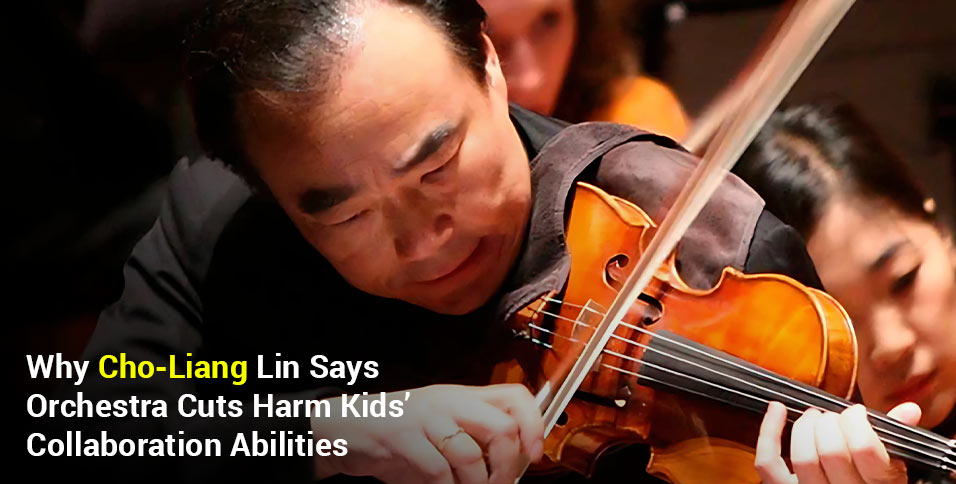
When renowned violinist Cho-Liang Lin received an email in late 2024 from a teacher working in Taiwan’s mountains, it contained a desperate plea. The teacher had spent 12 years traveling weekly to remote indigenous villages, teaching violin-making and performance to economically disadvantaged children with extraordinary natural abilities. Budget cuts now threaten to eliminate programs entirely.
“This phenomenon affects American schools and schools in Taiwan alike,” Lin explained, his voice carrying decades of watching music education disappear globally. The question facing administrators: are school orchestras expendable extras, or do they serve purposes that classroom learning cannot replicate?
Lin warns that eliminating ensemble programs creates a generation unprepared for collaborative work. The evidence for this crisis is already mounting worldwide.
Global Evidence of Educational Erosion
Music education cuts have become a worldwide phenomenon, affecting developed and developing nations alike. Budget pressures consistently target arts programs first, viewing them as expendable compared to core academic subjects.
International statistics reveal the scope:
- United States: 1.3 million students lost arts education access (2008-2012)
- United Kingdom: 21% reduction in music teachers since 2010
- Australia: 40% of schools eliminated instrumental programs after 2015
- Canada: Music education funding decreased 28% over the past decade
These cuts create cascading effects. Fewer music teachers mean larger class sizes and reduced individual attention. Eliminating instrumental programs forces families to seek private lessons, creating economic barriers that exclude lower-income students entirely. The pattern remains consistent: rural and economically disadvantaged communities suffer disproportionately while urban schools with stronger fundraising capabilities preserve their programs.
What Orchestra Actually Teaches
Cho-Liang Lin teaches at Rice University’s Shepherd School of Music and previously spent years at The Juilliard School. His classroom experience shows that participating in ensembles fosters skills that are fundamentally different from those gained through individual study or traditional academic methods.
“You learn how to play with other kids, and that’s a great formula to know how to work together,” Lin explains. “If somebody near you plays out of tune, you’re not going to kick that person. You work things out.”
Orchestra demands real-time cooperation where students must listen to 20 or 40 other players simultaneously, adjust their volume and timing based on what they hear, and make split-second decisions about whether to follow or correct when someone makes a mistake. Unlike classroom learning, where students primarily absorb information individually, ensemble playing requires constant mutual awareness and shared responsibility for outcomes.
How This Learning Actually Works
Orchestra programs provide what Cho-Liang Lin calls “incredible motivating factors” that create self-directed improvement. Students receive immediate feedback through performance opportunities that offer public validation. Competition experiences teach both gracious winning and losing. During rehearsals, peer feedback naturally develops listening skills as students adjust their playing based on what they hear around them.
“When you improve, that is an incredible motivator,” Lin says. “When you win a competition and get feedback saying ‘Hey, you’re playing great,’ those are incredible encouragements.”
Leadership roles emerge organically as principal players and section leaders build responsibility within their groups. Students learn to balance individual excellence with collective goals, discovering when to lead and when to support—skills that transfer directly to adult collaboration.
Specific Skills That Transfer to Careers
The abilities developed through ensemble participation map directly onto modern workplace demands. When section members disagree on interpretation, they must negotiate solutions without disrupting the larger group, developing conflict resolution skills. Students learn time management by balancing individual practice with collective rehearsal schedules and meeting deadlines that impact others.
Reading conductor cues and responding to ensemble dynamics builds non-verbal communication abilities essential for professional settings. Orchestra members learn to anticipate colleagues’ needs, adjusting their contributions in real-time based on what they observe around them.
“It’s different from sitting in a classroom studying geometry because you actively participate in the activity,” Cho-Liang Lin emphasizes.
When a flute player rushes the tempo, violinists must decide whether to follow or steady the group—the same split-second judgment calls required in fast-moving business environments.
The Workplace Collaboration Crisis
Cho-Liang Lin managed multi-million dollar budgets during his 18-year tenure as Music Director of La Jolla SummerFest. His professional experience intersects with growing evidence that employers face a collaboration crisis:
- 75% of employers rank teamwork as a critical skill gap in new hires
- Companies lose $62.4 billion annually due to poor collaboration
- Meeting facilitation skills are declining among entry-level hires
- Cross-functional project management creates anxiety for new graduates
“You have to come in to the first rehearsal totally prepared,” Lin explains about his professional expectations. “But you still have to be ready to adapt.”
Remote learning during COVID-19 accelerated concerning trends. Younger workers increasingly struggle with face-to-face collaboration, constructive criticism delivery, and real-time group problem-solving. These are precisely the skills that ensemble training develops automatically.
“All my guest artists have to check their ego at the door,” Lin explains about managing world-class musicians. “Everybody’s equal, but we have to rehearse.”
Research confirms the connection: National Association for Music Education studies show ensemble students demonstrate significantly higher teamwork, leadership, and conflict resolution skills than non-participants. Students in arts programs show four times higher creative problem-solving abilities, while music students score 57-63 points higher on SATs than non-participants.
Practical Solutions for Cash-Strapped Schools
Despite budget constraints, schools can preserve ensemble programs through targeted approaches:
Partnership Programs: Collaborate with local orchestras to share resources and expertise, reducing costs while maintaining high-quality instruction.
Community Integration: Involve parents and volunteers to reduce staffing costs while building broader support for programs.
Technology Integration: Use digital notation and practice tracking tools while maintaining live ensemble experiences that develop collaboration skills.
Cross-Curricular Connections: Demonstrate academic value by integrating music programs with math, science, and language arts curricula.
Performance opportunities remain crucial regardless of program size. “Whether you have a 20-piece orchestra in elementary school, or you want to enter local competitions, these are tools for improvement and motivating factors,” Lin explains.
A Generation at Risk
Students arriving at university without ensemble experience struggle with the collaborative demands of professional music training, requiring remedial social skills that elementary orchestra programs once provided automatically. Cho-Liang Lin witnesses this firsthand as students who excel individually fail when forced to work in groups.
“That’s why I always worry when the school orchestra gets kicked out of the curriculum,” he reflects.
School ensembles remain among the few spaces where young people learn to subordinate individual preferences for collective goals. Collaborative skills learned during youth create adults better equipped for democratic participation and community engagement.
Lin’s message to administrators is urgent: investing in school orchestra programs develops citizens capable of working together. The alternative is a generation unprepared for collaborative demands that define modern economic success.
The choice facing school boards isn’t between music and academics but between preparing students for individual achievement versus collaborative success. Lin’s four decades in classical music demonstrate which approach creates lasting impact.