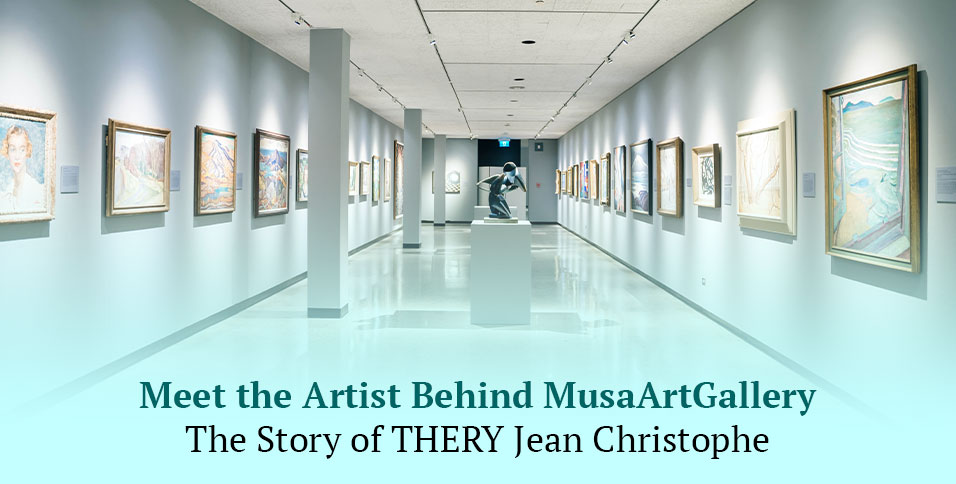
When you browse through MusaArtGallery, you see striking canvases of abstraction—works that feel alive, personal, and timeless. But behind every canvas lies a story just as powerful as the art itself: the journey of its founder, THERY Jean Christophe. From finance to fine art, from childhood memories shaped by his mother’s hands in Japanese Raku ceramics to his current mission of bringing abstraction into homes worldwide, his path is anything but ordinary.
This is the story of how one man’s life, influences, and vision gave birth to a gallery that now resonates with art lovers around the world.
From Numbers to Colors: A Leap of Faith
Jean Christophe’s career began far from the world of painting. Like many who follow the “safe path,” he studied finance, working diligently in an environment defined by numbers, analysis, and structured systems. Yet, beneath the surface of balance sheets and portfolios, creativity was quietly waiting to break free.
Working in finance taught him discipline and structure, but the further he advanced in that world, the more he felt something was missing. He craved a space to express himself—a way to connect beyond calculations and forecasts. For him, art wasn’t just a hobby, it was a calling he could no longer ignore.
Leaving finance for art was not an easy decision. It meant walking away from stability into uncertainty. But as Jean Christophe explains, “Art was the only place where I could breathe, the only place where I wasn’t confined by rules.” That courage to leap into the unknown would become the foundation of MusaArtGallery.
A Mother’s Hands: The Influence of Raku
Every artist carries pieces of their childhood into their work, and for Jean Christophe, those memories are deeply tied to his mother. She was an artist herself, working with the Japanese Raku technique, a traditional method of pottery that emphasizes imperfection, spontaneity, and harmony with nature.
As a child, he would watch her hands carefully shape clay, then fire it in ways that allowed fire, air, and water to leave unpredictable marks. No two pieces ever came out the same—each one carried its own spirit.
That philosophy of embracing imperfection and chance stayed with him. Raku was more than just pottery; it was a lesson in life and art. It taught him that beauty often comes from what you cannot control. Today, when he paints, that same spirit of spontaneity and acceptance of the unexpected flows into his abstract creations.
The Language of Abstraction
While some artists gravitate toward realism, Jean Christophe found his voice in abstraction. Why? Because abstraction speaks a universal language.
In a world divided by cultures, borders, and languages, abstraction offers something different. It bypasses words and taps directly into emotion. A swirl of color, a sharp line, a textured surface—these are things the mind doesn’t need to “translate.” They connect instantly to the heart.
“I want my work to open a dialogue without words,” Jean Christophe says. “Everyone brings their own story, their own feelings to an abstract piece. It’s not about what I impose—it’s about what the viewer feels.”
This vision became the essence of MusaArtGallery: a space where abstraction isn’t just decoration, but a bridge between artist and audience, between personal memory and collective feeling.
Building MusaArtGallery
The transition from individual artist to gallery founder came naturally. Jean Christophe wanted more than to simply create; he wanted to share art on a larger scale. MusaArtGallery was born from this desire to make high-quality, inspiring abstract works accessible to people around the world.
He envisioned a platform where art wouldn’t be locked away in museums or limited to collectors, but instead available to anyone who wanted to enrich their home, office, or personal space with meaning. Each canvas offered by the gallery is carefully curated and produced to maintain the spirit of the original work, ensuring that what people receive is not just a print, but a piece of artistic soul.
Through MusaArtGallery, Jean Christophe has blended his financial discipline with his creative instincts. The result is a gallery that is not only artistically rich but also built on a solid foundation of quality, trust, and accessibility.
Art as Connection
For Jean Christophe, art has always been about connection. In finance, he dealt with numbers; in art, he deals with emotions. And he believes emotions are what bring people together.
His work invites people to pause in a world that never stops. Each canvas is an invitation to slow down, to feel, and to reflect. Whether it hangs in a minimalist living room, a busy office, or a hotel lobby, the art carries with it the ability to change the atmosphere of a space and the mindset of those who see it.
This commitment to connection also extends to MusaArtGallery’s mission: to provide art that resonates with people from all walks of life, across borders and cultures. As Jean Christophe explains, “Art should not be reserved for the elite. It belongs to everyone who is willing to feel.”
The Challenges and Triumphs
Like every creative journey, Jean Christophe’s path was not without obstacles. Transitioning from finance to art meant starting over, building credibility, and navigating a world that often undervalues creativity.
Yet, every challenge only reinforced his commitment. The early days of MusaArtGallery were filled with trial and error—testing production methods, finding the right balance between accessibility and quality, and reaching audiences who might not yet know they needed art in their lives.
Slowly but surely, the gallery grew. Customers began to connect deeply with the works, sharing how the pieces changed their living spaces or even inspired them personally. Those stories became the fuel that kept the vision alive.
Looking Forward: The Future of MusaArtGallery
Today, MusaArtGallery stands as a growing international brand, with customers discovering its collections from across the globe. Yet for Jean Christophe, the journey is just beginning.
His vision for the future includes expanding the collection to new forms, experimenting with digital art, and continuing to collaborate with artisans who share his philosophy. But no matter how the gallery evolves, the core will remain the same: art as a bridge, art as connection, art as emotion.
For Jean Christophe, each painting, each canvas, is a continuation of his mother’s lesson in Raku: embrace imperfection, welcome the unexpected, and find beauty in the dialogue between artist, material, and viewer.
A Personal Invitation
Behind every canvas at MusaArtGallery is more than color and texture—it’s the story of a man who dared to leave behind stability for passion, who carries his mother’s influence into every brushstroke, and who believes art has the power to connect us all.
If you’ve ever felt drawn to abstraction, if you’ve ever wanted art that doesn’t just hang on a wall but becomes part of your story, Jean Christophe’s journey is an invitation.
You can explore his work and collections at MusaArtGallery.