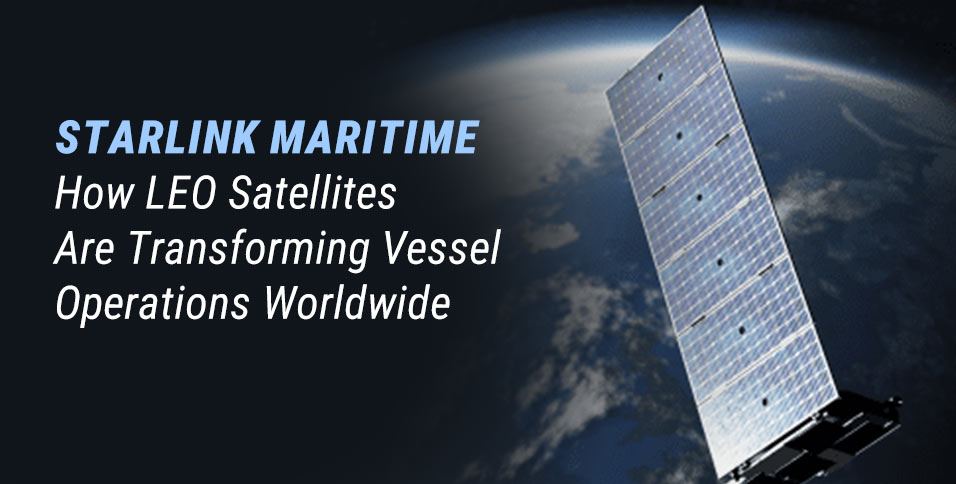
In today’s global maritime landscape, where digitalisation is driving operational excellence, connectivity at sea is no longer optional—it’s essential. For decades, vessels navigating offshore routes have had limited access to high-performance communications, often relying on traditional satellite systems with significant latency and limited speed.
That dynamic is changing rapidly. Starlink Maritime, a Low Earth Orbit (LEO) satellite internet service, is revolutionising how vessels operate—delivering unmatched broadband performance across the world’s oceans. By drastically reducing latency and offering high-throughput data, Starlink Maritime is reshaping onboard operations, crew welfare, and fleet management.
1. The Challenge of Maritime Connectivity
Maintaining connectivity at sea has long been a complex challenge. Traditional systems, primarily using geostationary (GEO) satellites, orbit at over 35,000 km above Earth. While reliable, these networks often suffer from:
- High latency that disrupts real-time communication
- Limited bandwidth
- High data costs
- Weather-related signal instability
For shipowners and operators, these limitations have long stood in the way of complete digital integration.
2. Why LEO Technology Makes a Difference
LEO satellites orbit much closer to Earth—at altitudes of around 550 km—offering major advantages over GEO-based solutions:
- Latency below 100 milliseconds
- Download speeds of 100–250 Mbps
- Stable connections even in high-mobility environments
This breakthrough performance allows vessels to engage in real-time communication, operate cloud-based platforms, and support smart applications previously constrained by traditional connectivity.
3. Real-Time Vessel Operations, Unlocked
With Starlink Maritime onboard, vessels of all types—from container ships and research vessels to offshore platforms and luxury yachts—can run critical operations without delay or interruption.
⚓ Operational Benefits Include:
- Remote monitoring of machinery and systems
- Instant data transfer to shore-based control rooms
- Enhanced voyage planning through live weather and sea-state updates
- Support for cloud-based maintenance tools and analytics
- Improved cargo management with real-time tracking
The result is faster, more informed decision-making, reduced downtime, and enhanced safety across all maritime sectors.
4. Enhancing Crew Welfare with High-Speed Access
For seafarers, staying connected to family and the outside world is essential for mental well-being and morale. With Starlink Maritime:
- Crew can access video calls, social media, and entertainment platforms
- Online training and upskilling become available at sea
- The digital divide between shore and ship is significantly reduced
This leap in welfare services directly contributes to better crew retention and satisfaction—a growing concern for fleet operators globally.
5. Simplified Installation and Durable Maritime Hardware
Starlink Maritime kits come with marine-grade, weather-resistant terminals designed to withstand:
- Harsh environmental exposure (saltwater, humidity, UV)
- Vibrations from engines or waves
- Continuous movement at sea
The flat-panel antenna design allows for quick installation and automatic satellite tracking. This simplicity makes it ideal for both new builds and retrofits across a variety of vessel types.
6. Cost-Effective High Performance
In addition to performance, Starlink Maritime delivers an excellent cost-to-speed ratio. Operators benefit from:
- Lower cost per gigabyte compared to legacy systems
- Transparent pricing structures
- Scalable solutions for fleets of all sizes
For fleets with heavy data needs—such as offshore vessels, survey ships, or expedition cruises—the long-term savings and operational gains are significant.
7. A Hybrid Connectivity Strategy for Redundancy
Despite its strength, LEO connectivity is best implemented within a hybrid communication model—where multiple satellite services complement each other. Leading maritime operators now combine Starlink with GEO-based VSAT systems to:
- Ensure failover protection
- Route critical traffic via secured channels
- Maintain full service in regulatory-restricted regions
This balanced approach ensures maximum uptime, security, and coverage, particularly during long voyages through mixed jurisdictions.
8. IEC Telecom’s Starlink Maritime Portfolio
For successful deployment and reliable lifecycle support, vessel operators turn to IEC Telecom, a recognised provider of satellite connectivity solutions and an authorised reseller of Starlink Maritime.
IEC Telecom’s Starlink Maritime portfolio includes:
- The Flat High Performance Kit, delivering download speeds up to 220 Mbps and operating in international waters with low-latency performance
- Marine-grade hardware designed for harsh conditions and simple installation
- Flexible subscription plans that allow vessels to activate, pause, or scale service based on seasonal operations
- Value-added services such as OptiView for bandwidth control, L-band backup integration, and crew welfare management tools
Explore the full Starlink Maritime Portfolio here: https://iec-telecom.com/en/solution/starlink-maritime/
With deep industry expertise and a tailored approach, IEC Telecom ensures Starlink solutions are strategically integrated to support diverse maritime operations.
9. Regulatory Compliance and Global Expansion
As Starlink Maritime expands globally, ensuring regulatory compliance is vital. With the help of experienced partners, operators can manage:
- Country-specific licensing
- Importation and setup procedures
- Maritime safety and cybersecurity compliance
Starlink Maritime is now active on most global shipping routes, with regulatory clearance expanding in new markets every quarter. Fleet operators are encouraged to consult local specialists to ensure full compliance and uninterrupted service.
10. Enabling the Future of Maritime Innovation
Starlink Maritime is more than just a connectivity solution—it’s a foundational technology for future maritime innovation, supporting:
- Remote vessel operation
- Real-time video surveillance and AI analytics
- Onboard automation and edge computing
- Augmented and virtual reality training for crews
As the industry moves toward smart shipping and autonomous systems, low-latency, high-throughput communication will be the bedrock of this evolution.
Conclusion
Starlink Maritime is rewriting the rulebook for vessel connectivity. Its LEO-based technology brings exceptional performance, crew empowerment, and smart operational capabilities to vessels around the world—connecting them well beyond the horizon.
With trusted providers like IEC Telecom delivering full-service support and integration, maritime businesses can now deploy Starlink solutions with confidence—backed by global expertise and a proven portfolio.
As digitalisation accelerates across the seas, Starlink Maritime ensures that your fleet doesn’t just stay connected—it stays ahead.
Also Read: Starlink gets FCC clearance to launch satellites for high-speed internet services