Mirror Review
May 20th, 2025
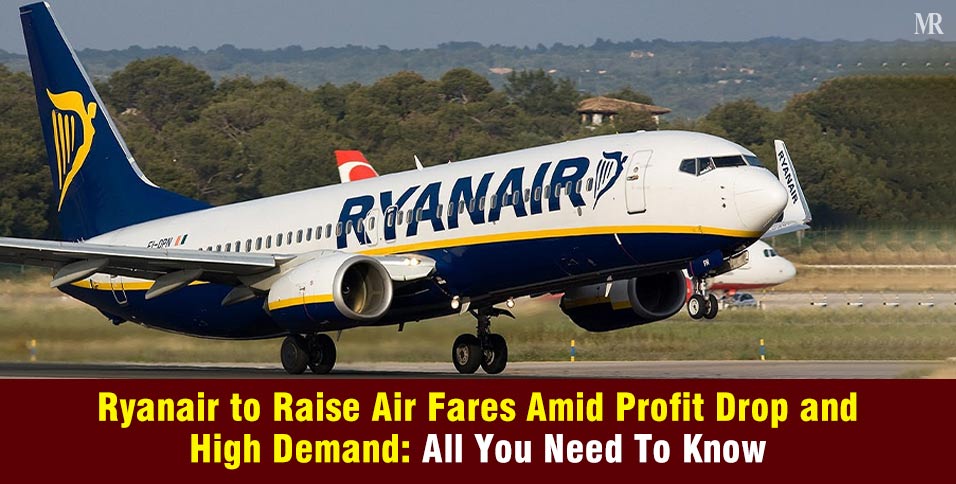
- Ryanair, Europe’s largest budget airline, is set to raise air fares this summer.
- This decision of Ryanair to raise air fares comes after a challenging year where lower ticket prices impacted profits, leading to a 16% fall in annual earnings.
- Despite carrying a record 200 million passengers in 2024-25, average ticket prices were down 7%.
Here’s Why Ryanair is Raising Air Fares:
- Rebounding from Profit Decline
Ryanair’s profits after tax fell to €1.61 billion (£1.35 billion) for the year ending March 31, 2025, down from €1.92 billion (£1.61 billion) in 2024.
This decline was primarily due to a 7% drop in average ticket prices.
Michael O’Leary, the airline’s chief executive, commented that the full-year results were “very good in the context of last year, where we had the row with the OTAs [online travel agents] and fares fell 7% – it’s a remarkably robust set of numbers”.
He further stated that the airline “cautiously” expects to recover “most, but not all” of the fare decline, which should boost profits.
- Strong Demand and Capacity Constraints
Neil Sorahan, Ryanair’s Chief Financial Officer, said, “Demand is robust all across the network. We operate into 37 different countries. We’re seeing strong summer demand everywhere”.
Peak fares are “modestly” ahead of last year. Fares since April are on track to be “a mid-high teen per cent ahead” by the end of next month compared to the same period last year.
This trend is expected to continue through July, August, and September.
European short-haul capacity is expected to be tight for the next few years. This is mainly because several European Airbus operators are dealing with Pratt & Whitney engine repairs, and there are delays in Boeing deliveries.
O’Leary stated, “These capacity constraints, combined with our substantial cost advantage, strong balance sheet, low-cost aircraft orders and industry leading operational resilience will, we believe, facilitate Ryanair’s controlled profitable growth to 300m passengers p.a. by FY34”.
- Rising Operational Costs
While total revenue increased by 4% to €14 billion for the financial year 2025, operating costs jumped by 9% to €12.4 billion. These costs include staff salaries and other expenses.
Ryanair expects some unit cost increases this financial year, mainly due to a rise in environmental taxes and air-traffic control charges.
However, the airline believes fuel hedging, new aircraft, and cost control are likely to offset these increases.
- Strategic Growth and Shareholder Returns
Despite the challenges, Ryanair is focused on controlled profitable growth, aiming for 300 million passengers annually by FY34.
The airline flew a record 200 million passengers over the past 12 months and expects to fly 206 million passengers in the year to March 31, 2026.
Michael O’Leary stated that the delays in Boeing deliveries had left Ryanair “a little bit cash rich at the moment” and “surplus cash will return to shareholders”.
Ryanair is paying out about €400 million in dividends this year. A €750 million share buy-back is also set to start next week.
- Addressing External Factors
Ryanair is navigating potential external developments such as the risk of tariff wars, macroeconomic shocks, and geopolitical conflicts.
Michael O’Leary commented on Boeing deliveries, stating, “We have fixed-price contracts with Boeing – tariffs will be an issue for Boeing’s account, not for ours, but we will work with Boeing to try to find ways around them”.
Neil Sorahan echoed this, stating, “If we were to see an increase in our prices, then we’d have to reserve our right to delay, cancel, or buy elsewhere”.
O’Leary also noted the option of taking deliveries onto a UK register rather than a European one, bypassing any tariff risk.
End Note
The decision of Ryanair to raise air fares might not be welcome news for summer travelers, but it reflects broader industry pressures—from rising costs to aircraft delays.
With demand still strong and capacity tight across Europe, fare increases seem inevitable.
For passengers, it’s a reminder to book early, compare options, and stay informed as the travel landscape shifts.
Whether you’re planning a getaway or watching your wallet, staying ahead of airline trends is more important than ever.