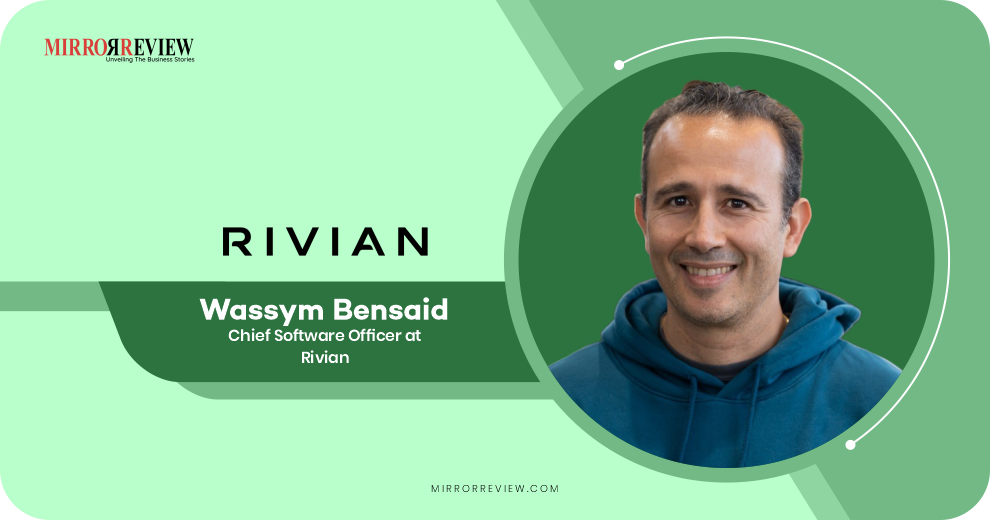
There is a particular kind of engineer who does not simply build products but reimagines what those products can become. Wassym Bensaid belongs firmly in that category.
Since January 2024, Wassym Bensaid has served as Chief Software Officer at Rivian, the electric vehicle company that has spent the last several years advancing a bold proposition: that the modern automobile is no longer defined solely by mechanical engineering, but by software. It is an idea reshaping the automotive industry in real time, and Wassym, whose career spans semiconductors, wireless systems, Android platforms, IoT, and consumer electronics, has spent more than two decades preparing for precisely this moment.
His rise at Rivian reflects both technical depth and organizational trust. He joined the company in October 2019 as Senior Director of System Architecture and Integration, helping shape the foundational software infrastructure behind Rivian’s vehicles. Within months, he advanced to Senior Director of Software and Technology, before becoming Vice President of Software Development later in 2020.
The momentum continued. In October 2021, he was appointed Senior Vice President of Software Development, overseeing Rivian’s increasingly sophisticated software ecosystem during one of the company’s most critical growth phases. By January 2024, he assumed the role of Chief Software Officer, formalizing his position as one of the key architects behind Rivian’s software-defined future.
What makes that trajectory especially compelling is not simply its speed, but the breadth of experience behind it. Long before electric vehicles became software platforms on wheels, he was already building the technologies that made connected systems possible.
From European Engineering Labs to Global Platforms
Wassym’s professional journey began in Europe at the dawn of the wireless computing era, inside the engineering environments that quietly shaped the modern connected world.
His earliest role came in 1999 at LEM in Geneva, Switzerland, where he worked on tools software development. From there, he moved through a series of technically demanding positions that steadily deepened his expertise in embedded systems and platform integration.
In 2001, he worked as a DSP Audio Software Developer at STMicroelectronics in Grenoble, France, before joining Philips Semiconductors in Zurich as an HW Layer Software Developer. By 2002, he had joined Motorola in the Greater Toulouse metropolitan area as a Platform Technical Lead, spending more than two years refining his understanding of mobile architectures and embedded software systems.
He later transitioned to Freescale Semiconductor, where he spent nearly five years across leadership roles, including Modem Integration Technical Lead and Smartphone Platform Program Manager. Those years immersed him in the growing complexity of connected devices, wireless integration, and large-scale software coordination.
Looking back, the pattern becomes unmistakable: He consistently gravitated toward industries undergoing technological reinvention.
Intel and the Android Revolution
In 2009, Wassym joined Intel Corporation, beginning a seven-year chapter that would place him at the center of the smartphone and Android expansion era.
Starting as a Smartphone Platform Program Manager, he eventually rose through multiple senior leadership positions, including Director of Android Platforms, Senior Director of Android Execution, and Senior Director of Android Software Engineering.
At Intel, the challenge was not simply building software. It was orchestrating highly complex interactions between hardware, operating systems, connectivity layers, and user experience across global platforms operating at enormous scale.
The experience proved formative. It sharpened the systems-level thinking that now defines modern automotive software development, where vehicles increasingly function as integrated computing environments rather than isolated mechanical machines.
Preparing for the Connected Vehicle Era
After Intel, Wassym moved into the Internet of Things sector, joining Silver Spring Networks in 2017 as Vice President of IoT Systems Architecture in the San Francisco Bay Area. The role expanded his work into connected infrastructure and large-scale intelligent systems, areas that would later become central to next-generation mobility.
In 2018, he joined RED Digital Cinema as Vice President of Engineering for the RED Hydrogen project, an ambitious attempt to merge advanced imaging, communication, and mobile technologies into a new consumer platform.
On paper, it may have appeared to be an unconventional detour. In reality, it reinforced a consistent theme across his career: an attraction to technically ambitious products operating at the edge of transformation.
Then, in October 2019, came Rivian.
Building the Software-Defined Vehicle
The phrase “software-defined vehicle” has become one of the automotive industry’s defining concepts, but at its core, the idea is remarkably straightforward: a vehicle should continue evolving long after it leaves the factory.
Features can improve through over-the-air updates. Safety systems can become smarter over time. User experiences can evolve continuously rather than remaining fixed at the moment of purchase.
At Rivian, Wassym has been instrumental in turning that philosophy into reality.
His responsibilities extend far beyond traditional automotive software. They encompass system architecture, platform integration, intelligent connectivity, user experience, and the increasingly complex relationship between hardware and cloud-based services.
The work demands an unusual combination of disciplines: semiconductor understanding, operating system expertise, large-scale systems integration, consumer technology intuition, and organizational leadership. His career, across multiple industries and technical ecosystems, positioned him uniquely well for that challenge.
A Career Defined by Complexity
What distinguishes Wassym is not a single breakthrough moment, but a consistent willingness to move toward complexity rather than away from it.
Across more than two decades, he has worked in semiconductors, wireless communication, Android ecosystems, IoT infrastructure, consumer electronics, and electric mobility. He has led global engineering teams, managed large-scale platform programs, and delivered products across industries that were themselves being redefined in real time.
At Rivian, those experiences converge.
The company has built much of its identity around the belief that software will define the next generation of transportation. In many ways, Wassym Bensaid is helping write that future line by line, system by system, update by update, and as the automotive industry moves steadily toward intelligent, connected, software-driven mobility, his work increasingly sits at the center of where transportation is heading next.
Read more : Automotive Innovation, AI Transformation & Industry Leadership Leaders to Watch in 2026