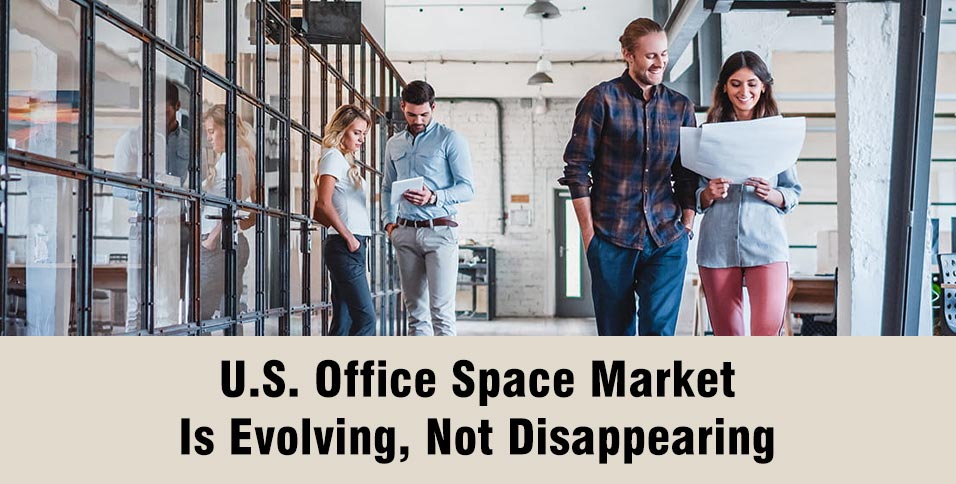
The pandemic permanently altered how Americans work, reshaping demand for commercial office space in 2025. With hybrid arrangements now the norm, offered by nearly four out of five U.S. companies, businesses are rethinking how much space they require and what qualities matter most. Average lease sizes have shrunk compared to pre-2020, and more than 1.3 billion square feet of office space is scheduled to roll over between 2025 and 2027.
Yet despite predictions of collapse, the office market has not vanished. Instead, it has entered a period of transformation marked by a growing divide between properties that can attract tenants and those that cannot.
Hybrid Work and the New Office Equation
The traditional office, built for a five-day, in-person workweek, no longer reflects the way teams operate. Hybrid models have reshaped real estate strategies, with many companies choosing smaller but higher-quality footprints that emphasize collaboration and employee experience over sheer square footage.
This recalibration is forcing landlords to adapt. Tenants increasingly demand flexible layouts, wellness-focused amenities, and central locations that help draw employees into the office. For businesses competing for talent, the workspace itself has become part of the employer brand.
Flight to Quality: Trophy Assets Hold Strong
Across the U.S., top-tier “trophy” buildings are the clear outperformers. These properties, defined by advanced systems, sustainability certifications, and a full suite of amenities, have kept vacancy rates well below broader averages.
In markets such as Park Avenue in Manhattan, Boston’s Back Bay, and Uptown Dallas, trophy vacancies hover around 10%, compared to closer to 16–17% for general Class A space. Finance, legal, and tech firms are anchoring demand, drawn by high-quality environments that support hybrid work.
For companies considering a move to New York, office space in Manhattan remains one of the most resilient and desirable choices in the country.
Wellness, Amenities, and the Employee Experience
Beyond location and prestige, tenants are prioritizing wellness-driven amenities. Features such as abundant natural light, outdoor terraces, fitness centers, and flexible breakout spaces are now central to leasing decisions.
A Cornell University study found that workers in naturally lit environments reported an 84% reduction in eyestrain, headaches, and drowsiness, clear evidence that design impacts productivity. Companies are also leveraging green spaces, meditation rooms, and on-site services to create environments that support mental health and improve retention.
This trend signals a shift: office space is no longer just a cost center, but a strategic investment in employee wellbeing and performance.
Markets Outperforming in 2025
Several U.S. submarkets illustrate the resilience of quality-driven demand:
- Boston (Back Bay): Financial and consulting firms continue to renew and expand.
- New York (Park Avenue): Blackstone and other major players are doubling down on trophy assets.
- Dallas (Uptown): Developments like 1919 Woodall Rodgers are seeing robust leasing activity.
- Chicago (West Loop): Tenants are consolidating into modern properties with efficient layouts.
These markets highlight how demand is clustering in high-quality, centrally located assets while older buildings face challenges.
Growth in Emerging Submarkets
It’s not only traditional corridors performing well. “Adolescent” submarkets such as Fulton Market in Chicago, UTC in San Diego, and Irvine Spectrum in Orange County are capturing outsized demand thanks to new supply, attractive pricing, and vibrant amenities.
Collectively, these emerging areas make up less than 10% of the U.S. office inventory yet contribute more than their share of net absorption. For investors, they represent the next wave of opportunity.
Investor Perspectives: Risk and Reward
For landlords and investors, the picture is mixed. Trophy assets remain in high demand, while older, less flexible buildings are facing rising vacancies and declining rents. Private buyers are actively targeting distressed properties, repositioning them with competitive amenities and sustainable retrofits.
ESG considerations are also shaping investment. Buildings with strong sustainability credentials are increasingly commanding rent premiums, while older stock that fails to meet environmental standards is at risk of obsolescence.
In this environment, timing and strategy are critical. Investors who can acquire underperforming assets at discounts and reposition them effectively stand to benefit in the long term.
Lessons From London
The U.S. is not alone in this transformation. London’s office market is experiencing similar trends, with tenants gravitating toward modern, flexible buildings that support hybrid work. Trophy assets in King’s Cross and the City continue to see strong demand, while legacy properties struggle.
The comparison underscores a global truth: the future of office space is quality over quantity. Companies on both sides of the Atlantic are consolidating footprints while upgrading to environments that enhance productivity and wellbeing.
Looking Ahead: 2026 and Beyond
The next five years will be defined by further adaptation. Key themes include:
- Technology integration: AI-powered building systems will streamline energy use, security, and tenant services.
- Sustainability pressures: Regulatory frameworks and tenant preferences will increase demand for green-certified buildings.
- Hybrid evolution: Office space will be designed as collaboration hubs, with less emphasis on individual desk space.
- Global capital flows: International investors will continue targeting trophy assets in major U.S. and UK cities, reinforcing the resilience of these markets.
Implications for Tenants
For occupiers, the takeaway is clear: success lies in aligning office strategy with employee needs. Hybrid-friendly layouts, wellness amenities, and prime locations are no longer perks they are expectations. Many firms are downsizing square footage but upgrading the quality of their space to remain competitive in talent attraction.