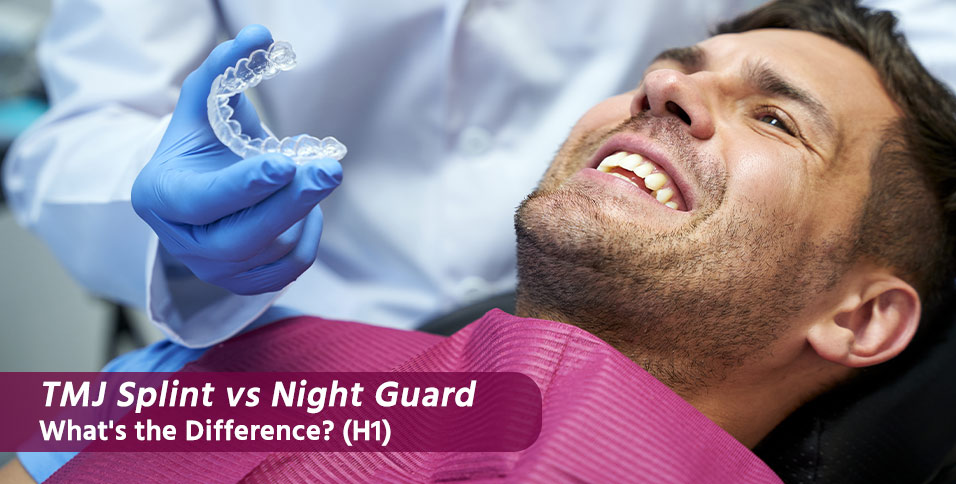
TMJ splint vs night guard, that’s a debate everyone with jaw pain gets into. You see, jaw pain is either caused by issues with your temporomandibular joint or teeth grinding (bruxism). And dentists usually recommend two very similar-looking, yet technically different, dental appliances for both cases. That is what confuses people.
For TMJ issues, a TMJ splint is recommended. For teeth grinding, a dental night guard is used. And to be fair, you can’t really tell them apart in a single glance. So, what’s the difference between them, and which one is right for you? Let’s find out.
What Exactly Are These Appliances?
Although both are worn over the teeth, they are not interchangeable. One mainly shields the teeth. The other is often prescribed as part of jaw-joint therapy. That distinction matters more than most people expect.
What Is a Night Guard?
A night guard for teeth grinding absorbs pressure and prevents upper and lower teeth from wearing against each other night after night. It primarily acts as a protective barrier.
Night guards usually do not attempt to change jaw mechanics. Instead, they form a cushion between the teeth, protecting against the effects of bruxism like enamel wear, cracked fillings, or morning tooth sensitivity.
Compared with a TMJ splint, a night guard is often simpler in construction and easier for patients to adapt to.
What Is a TMJ Splint?
A TMJ mouth splint, also called an occlusal splint, is a custom oral appliance designed for people dealing with temporomandibular joint dysfunction. It usually sits over either the upper or lower teeth and creates a controlled bite surface that reduces stress on the jaw joint.
Its purpose is to stabilize the jaw, limit excessive muscle tension, and guide the lower jaw into a less strained position. In many cases, dentists prescribe it when a patient reports clicking, jaw locking, facial soreness, or pain near the ears.
These splints are usually made after a dental evaluation because fit matters a great deal. If the appliance does not align correctly, symptoms can worsen rather than improve. Some patients feel relief quickly. Others need several adjustments before the bite feels balanced.
TMJ Splint vs Night Guard: Material Differences
Material plays a big role in how each appliance performs.
A TMJ splint is typically made from hard acrylic. That rigidity allows it to maintain a stable bite relationship and support jaw positioning through the night. Because it needs to influence muscle activity and joint loading, softness would reduce its effectiveness.
Night guards come in more than one material type. Soft versions are commonly made with EVA materials, usually 3mm in thickness. Hard night guards are thinner, usually 2mm, but made with PTEG material. Some are dual-layered, soft inside and firmer outside, which gives a balance of comfort and durability.
This difference in material is one reason the two appliances should not be casually swapped. What feels softer is not always what the jaw actually needs.
Design Differences Between TMJ Splints & Night Guards
At first glance, they can look similar, but the design tells a different story.
A TMJ splint is often thicker and built with a very deliberate bite surface. That surface helps control where the teeth contact when the jaw closes. In some cases, only certain teeth are allowed to touch the splint at first, which helps reduce pressure in specific muscles.
A night guard usually follows the natural shape of the teeth more closely. It covers the biting surfaces and protects against direct friction, but it does not intentionally therapeutically alter bite contact.
So while both sit in the mouth overnight, one is engineered as a treatment tool and the other as a protective layer.
How Does the Functionality Differ?
Function is where the comparison becomes clearer.
A TMJ splint is meant to manage symptoms linked to jaw-joint dysfunction. That includes reducing muscle overactivity, lowering pressure on the temporomandibular joint, and helping the jaw move with less strain. For someone waking up with jaw stiffness or hearing clicking when chewing, this appliance often targets the root of the discomfort.
A night guard protects the teeth from the effects of grinding. It does not necessarily stop grinding itself, but it prevents enamel from taking the damage.
This is why the occlusal splint vs night guard discussion often comes up in dental consultations. An occlusal splint is therapeutic, while a mouth guard is protective. They overlap in appearance, but not in intent.
Some people assume a night guard automatically treats TMJ because jaw pain improves once grinding pressure is reduced. That happens sometimes, but it is not guaranteed.
When to Use Each Appliance?
The choice depends on what symptoms are leading the diagnosis.
If someone mainly has worn enamel, chipped edges, sensitive teeth, or clenching during sleep, a night guard is often enough. It protects the teeth and lowers long-term dental damage.
If jaw pain is persistent, opening the mouth feels restricted, headaches are frequent, or the jaw clicks regularly, a TMJ splint is usually considered first. In these cases, the appliance becomes part of a broader treatment approach that may also include jaw exercises, posture changes, or stress management.
TMJ Splint vs Night Guard: A Quick Comparison
Here’s a side-by-side comparison of TMJ splints and night guards to give you a clearer idea of the differences.
| Feature | Night Guard | TMJ Splint |
| Primary Purpose | Protects teeth from grinding and clenching | Relieves jaw pressure and supports TMJ alignment |
| Best For | Bruxism and enamel protection | TMJ disorders, jaw pain, and bite issues |
| Material | Soft, hard, or dual-laminate | Usually hard acrylic |
| Jaw Positioning | Minimal effect on jaw position | Helps guide the jaw into a more stable position |
| Thickness | Varied, depending on grinding intensity | Often thicker and more rigid |
| Prescription Need | Not always required | Usually dentist-recommended |
| Main Benefit | Prevents tooth wear | Reduces joint strain and muscle tension |
Making the Choice: TMJ Splint vs Night Guard
Deciding between a TMJ splint and a night guard comes down to the issue you’re looking to resolve. If jaw alignment, pain, or TMJ disorder is your concern, a splint is likely the better choice. If your teeth are wearing down and grinding is your only issue, a night guard might suffice.
Sometimes, treatment may start with a TMJ splint to reduce joint strain and assess jaw response, while long-term protection may later involve a night guard if there’s a concern for grinding or clenching as well.
One more thing to consider is going for the custom option. While TMJ splints are often custom-made, people tend to buy night guards over the counter. And that can hurt your teeth and gums in the long run. Hence, always go for custom night guards since they are not only more comfortable, but also offer better and lasting protection.
Overall, the best option depends on diagnosis, symptom severity, underlying issue, and professional recommendation.
Wrap Up
Both TMJ splints and night guards are valuable tools for protecting your smile and reducing discomfort. They look very similar, and people often get confused between the two. So, this was our attempt to bring clarity to the TMJ splint vs night guard debate. Equipped with this knowledge, you are better positioned to decide which option is right for you.
Finally, don’t ignore jaw pain or nighttime grinding. Early intervention prevents complications later on. Just talk to your dentist, explain your symptoms, and explore which device suits you best. With it, you’ll wake up with less tension, fewer headaches, and a smile that lasts longer.
FAQs
Should I get a night guard or splint for TMJ?
A splint is usually recommended for TMJ because it helps reduce joint pressure, while a night guard mainly protects teeth from grinding.
What are the risks of wearing a TMJ splint?
A poorly fitted TMJ splint can worsen bite alignment, increase jaw discomfort, or cause muscle strain over time.
Are night guards and TMJ splints the same?
No, a night guard mainly protects teeth from grinding, while a splint is designed to manage jaw alignment and TMJ symptoms.
Why do mouth guards say not to use them for TMJ?
Many standard mouth guards are not designed to reposition the jaw, so they may aggravate TMJ symptoms instead of relieving them.
What do dentists recommend for TMJ?
Dentists usually recommend a custom-made TMJ splint, along with stress management and jaw-friendly habits, depending on symptom severity.