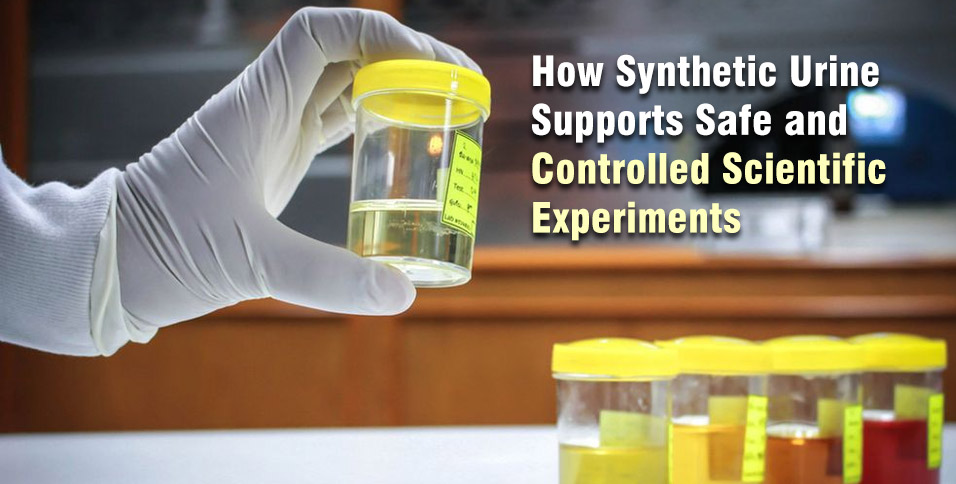
Control and consistency are the heart of scientific testing. In fields like product development, biomedical research, and absorbency testing, even the smallest chemical change can affect the accuracy of results. That’s why laboratories worldwide have shifted away from using biological urine samples, which break down quickly and vary naturally between individuals. Synthetic urine has become a reliable alternative because it provides predictable, repeatable data without the instability of real biological fluids.
This shift isn’t about novelty — it’s about improving the precision of experiments and creating safer working environments. Many scientific procedures require urine-like chemistry for calibration, prototype development, or simulation, and consistency is crucial for reliable outcomes.
With that in mind, let’s explore why synthetic urine is now a trusted component in laboratory workflows and how it contributes to safe, sustainable, and controlled testing environments.
Why Accuracy and Repeatability Matter in Laboratory Settings
A scientific experiment is only useful when it can be replicated, and biological urine makes that difficult. Natural urine varies based on hydration, diet, medication, and health conditions. Even when collected on the same day, two samples may not have identical pH levels, specific gravity, creatinine, or urea concentration.
Synthetic urine solves that challenge by maintaining a stable chemical composition that mimics urine without the natural inconsistency. When researchers calibrate sensors, test absorbent materials, evaluate protective textiles, or assess cleaning products, they need a sample that behaves the same on Monday as it does on Friday — and that stability allows results to be trusted across multiple trials.
This predictability has reshaped how testing environments operate, because controlled samples protect the integrity of the entire data pipeline rather than forcing scientists to account for biological variability.
Where Synthetic Urine Fits Into Controlled Scientific Testing
Many labs rely on synthetic urine when running long-term experiments or validating equipment that must respond consistently to human urine chemistry. Sample degradation, contamination risk, and lack of uniformity can create setbacks when real urine is used — which is why high-grade formulas that retain predictable chemical properties are now a preferred option.
For this reason, professionals searching for formulas designed specifically for laboratory reliability often use Quick Fix synthetic urine because its composition supports repeatable testing cycles and eliminates the unpredictability that comes with donated biological samples. The convenience of a pre-mixed unisex formula that’s ready to use out of the box also helps researchers streamline setup, while the long shelf life of up to two years ensures test materials remain stable across multiple research phases without frequent replacements.
This predictability gives labs more than convenience — it strengthens scientific outcomes. When every test begins from the same starting point, the focus stays on the product being evaluated rather than the fluid interacting with it. That consistency helps scientists track improvements, identify issues faster, and develop results that stand up to peer review and industry standards.
How Synthetic Urine Enhances Safety in Scientific Workspaces
Handling biological fluids requires strict safety protocols. Real urine can contain pathogens, pharmaceuticals, or contaminants, and must be treated as a biohazard at every stage — collection, transport, storage, and disposal. These steps are necessary but resource-intensive, increasing operational costs and creating environmental strain.
Synthetic urine removes these concerns. Since it contains no biological material, it does not require specialized disposal, temperature-controlled storage, or protective handling procedures. Laboratories can conduct more experiments in shorter timelines without compromising workplace safety.
This shift has been especially helpful in:
- Universities are training new scientists
- Product manufacturers running rapid prototyping cycles
- Medical device companies are testing wearable health sensors
- Cleaning product developers validating stain-removal performance
Safety improvements don’t replace scientific rigor — they make it easier to achieve.
Supporting Sustainable and Scalable Scientific Research
Sustainable research isn’t only about energy and materials — it also concerns operational efficiency. When testing workflows need fewer biohazard controls and fewer repeat experiments caused by unstable samples, the overall resource footprint decreases.
Synthetic urine contributes to more sustainable research by:
- Reducing the need for refrigeration and specialized disposal
- Cutting repeat testing caused by sample degradation
- Lowering laboratory waste output
- Minimizing shipping requirements for biological samples
As more industries adopt greener operational practices, synthetic alternatives provide a way to maintain scientific rigor while reducing environmental impact.
Why Its Role Will Continue to Grow
Scientific tools evolve based on demand, and the demand for controlled, safe, and repeatable testing continues to rise. New product categories — from smart-textile sensors to AI-powered healthcare devices — depend on accurate interaction testing with urine-like chemistry. At the same time, labs are under increasing pressure to maintain sustainability targets and reduce safety risks.
With these needs expanding year after year, synthetic urine is no longer a temporary substitute — it has become a foundational resource for modern experiments.
Conclusion
Synthetic urine has earned its place in laboratory ecosystems because it protects what matters most: reliable data. Biological samples, even when freshly collected, introduce variation that disrupts testing workflows and demands extra allocation of time, cost, and safety resources. Controlled synthetic formulas support accuracy, repeatability, and safety without compromising scientific standards.
By allowing researchers to run experiments from an identical starting point every time, synthetic urine strengthens product development, reduces biohazard risk, and supports more sustainable research practices. As scientific innovation scales, the need for stable and dependable testing components will only grow — and synthetic urine is positioned to support that progress confidently and consistently.