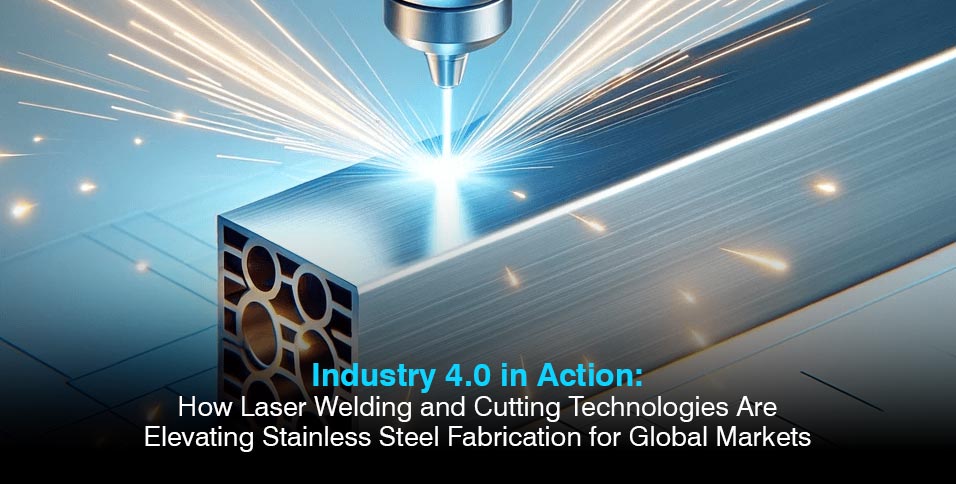
Manufacturing undergoes massive shifts with every new industrial revolution. Industry 4.0 brings a wave of smart technology, connecting physical machinery to digital networks. This connectivity transforms raw data into actionable insights, allowing factories to operate with unprecedented efficiency. Within this modernization, stainless steel fabrication sees remarkable improvements.
Laser welding and cutting technologies sit at the forefront of this shift. They replace slow, manual processes with rapid, highly automated systems that communicate directly with factory networks. By combining smart sensors, real-time data analysis, and advanced photonics, fabricators produce higher quality parts in less time. This article explores how modern laser systems drive stainless steel manufacturing forward and help businesses compete on a global scale.
Industry 4.0: Revolutionizing the Manufacturing Landscape
Industry 4.0 represents the fusion of digital technology with traditional manufacturing. It relies heavily on the Internet of Things (IoT), artificial intelligence (AI), and advanced automation. Rather than operating in isolation, modern machines share data constantly. Sensors monitor temperature, speed, and material alignment, feeding this information back to central control systems.
In stainless steel fabrication, this connectivity solves common production hurdles. Fabricators use AI algorithms to predict machine wear before a breakdown occurs, saving hours of costly downtime. IoT-enabled systems track metal sheets as they move through the facility, ensuring exact inventory control.
Automation also takes over repetitive tasks. Robotic arms handle heavy metal parts, while software adjusts cutting parameters instantly based on the material’s exact thickness. This synergy between hardware and software creates a highly agile production environment. Factories can switch between different product runs quickly, meeting client demands with exact precision and minimal human error.
The Role of Laser Welding in Stainless Steel Fabrication
Laser welding uses a focused beam of light to melt and fuse metal pieces together. Traditional methods like TIG (Tungsten Inert Gas) welding require high skill levels and often introduce excessive heat into the metal. Laser welding solves this problem by delivering concentrated energy precisely where the joint needs it.
This localized heat transfer prevents the stainless steel from warping or discoloring. It maintains the metal’s structural integrity while creating a strong, clean seam. Because the process is so controlled, fabricators drastically reduce material waste. They spend less time grinding down messy welds or scrapping parts damaged by heat distortion.
Furthermore, laser welding operates at incredible speeds. Facilities output parts up to five times faster than they could with older manual techniques. When integrated into an Industry 4.0 setup, robotic laser welders adjust their speed and power dynamically. This automated precision ensures every single weld meets exact specifications, making it the preferred method for high-volume modern fabrication.
Laser Cutting: Precision Meets Efficiency in Stainless Steel
Cutting stainless steel accurately forms the foundation of any successful fabrication project. Laser cutting technologies slice through dense metal using high-powered beams guided by computer numerical control (CNC). The laser melts, burns, or vaporizes the material, leaving an edge with a high-quality surface finish.
Fabricators generally rely on two main types of lasers: CO2 and fiber. While CO2 lasers served as the industry standard for decades, modern facilities increasingly favor fiber lasers. Fiber lasers channel light through flexible optical fibers, amplifying the beam to create a vastly more powerful and concentrated cutting tool.
This concentration allows the laser to pierce thick stainless steel sheets effortlessly. The tight focal point ensures a narrow kerf (the width of the cut), allowing engineers to nest parts closely together on a single sheet. By maximizing material usage, businesses save money and reduce scrap. The accuracy of these cuts eliminates the need for secondary finishing processes, pushing parts down the assembly line much faster.
How Advanced Fiber Laser Marking and Cutting Systems Are Transforming the Industry
The shift toward modern photonics has revolutionized part identification and processing. Facilities now rely heavily on advanced fiber laser marking and cutting systems to handle complex production requirements. These setups do more than just slice metal; they engrave essential barcodes, serial numbers, and QR codes directly onto the stainless steel surface.
Integrating marking and cutting into a unified system streamlines operations. A single machine can cut a bracket out of a steel sheet and immediately etch tracking data onto it. This traceability is a cornerstone of Industry 4.0, allowing manufacturers to track the lifecycle of a specific part from the factory floor to the end user.
Additionally, advanced fiber laser marking and cutting systems lower overall operational costs. Fiber lasers use significantly less electrical power than older models and require virtually no maintenance, as they lack moving mirrors and laser gases. They provide higher processing speeds and unmatched reliability, allowing fabrication shops to run lights-out operations well into the night.
Decorative Stainless Steel Sheets and Custom Metal Fabrication
Stainless steel offers incredible aesthetic appeal alongside its structural durability. Industries ranging from commercial architecture to luxury automotive design demand visually striking metal components. Fabricators answer this demand by producing decorative stainless steel sheets and custom metal fabrication solutions tailored to unique project needs.
Decorative finishes include brushed, mirrored, embossed, and etched surfaces. Creating these intricate designs requires tools that will not damage the delicate finish of the metal. Laser technology excels here. It cuts complex geometric patterns into decorative panels without leaving jagged edges or heat marks.
Custom fabrication relies on the flexibility that laser systems provide. Whether a client needs a bespoke elevator interior, a branded architectural facade, or custom kitchen exhaust hoods, smart laser machines switch between designs instantly. Fabricators simply upload a new CAD file, and the machine adapts. This agility empowers shops to offer highly personalized products without the massive lead times traditionally associated with custom metalwork.
Global Market Impact: How Laser Technologies Are Enhancing Competitive Advantage
The global marketplace for stainless steel goods is highly competitive. Buyers constantly seek faster delivery times, tighter tolerances, and lower prices. Fabricators who rely on outdated machinery struggle to meet these demands and risk losing contracts to more agile competitors.
By adopting laser welding and cutting technologies within an Industry 4.0 framework, businesses gain a crucial competitive edge. Smart factories produce high-quality parts consistently, reducing the defect rate to near zero. This reliability builds trust with international clients who require strict adherence to quality standards like ISO 9001.
Moreover, the efficiency of laser automation lowers the cost per part. Companies can offer more aggressive pricing in international bids without sacrificing their profit margins. The ability to monitor production remotely also means global management teams can oversee operations across multiple continents, standardizing quality and output worldwide.
Conclusion
Industry 4.0 fundamentally changes how we manipulate metal. By connecting intelligent software with powerful hardware, factories achieve unprecedented levels of efficiency and quality. At the heart of this transformation, laser welding and cutting technologies elevate stainless steel fabrication from a manual craft to a highly optimized digital process.
Through the integration of smart sensors and advanced fiber systems, fabricators achieve exact precision while dramatically reducing waste. The technology enables rapid production of everything from heavy industrial parts to highly detailed decorative panels. As businesses continue to adopt these smart systems, they secure their position in a demanding global market. The future of stainless steel fabrication belongs to those who embrace the speed, accuracy, and connectivity of the modern laser revolution.