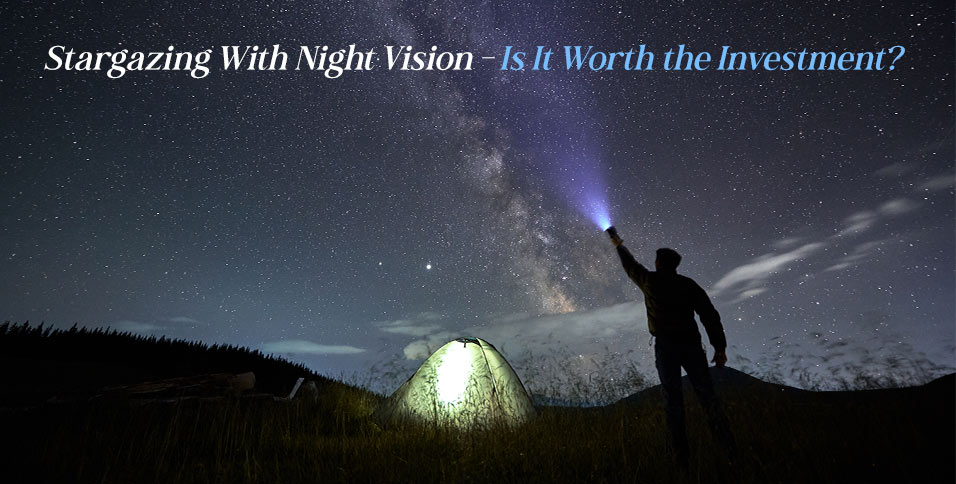
There’s a growing segment of night vision users who have nothing to do with tactical gear or hunting. These are the stargazers — people drawn to NVGs because they want to see the Milky Way’s structure with their own eyes rather than through long-exposure photography, or because they’re curious about what’s crossing the sky at 2 a.m. that doesn’t appear on any chart. Retailers like USANightVision.com have been expanding their astronomy-compatible NV offerings alongside the wider astronomy equipment market, and the question deserves a straightforward answer: does night vision for stargazing actually deliver what people expect, and what does entry really require?
Short version: it can be genuinely striking. The equipment threshold and the learning curve are both higher than most beginners want to hear.
What NV Actually Does in an Astronomical Context
Image-intensified night vision amplifies available light significantly — Gen3 intensifier tubes typically achieve gains in the range of 20,000 to 50,000 times or more depending on tube grade, according to published specifications from major tube manufacturers such as L3Harris and Photonis. At a Bortle Class 1 or 2 dark sky site, that amplification makes structure visible that your unaided eyes simply cannot resolve: the Milky Way’s dust lanes, open star clusters, large emission nebulae like the North America Nebula. These become accessible to handheld observation rather than requiring long-exposure camera work.
The form factor that works best for sky scanning is a Gen2 or Gen3 monocular used at 1x — the widest possible field of view. Tele Vue notes that a PVS-14 used handheld at 1x provides approximately 40 degrees of field. That’s wide enough for comfortable Milky Way sweeping and sky navigation. TNVC (Tactical Night Vision Company) maintains a dedicated astronomy section in their product catalog, recognizing that sky observation has become a legitimate use case — they document specific adapter configurations and technique guidance for it.
The experience of sweeping a genuinely dark sky with Gen3 equipment at 1x is different from anything a standard telescope provides. You’re moving through the sky continuously, watching it reveal structure as you scan, rather than observing a fixed object in an eyepiece.
Where the Disappointments Come
Field of view is the primary limitation for casual astronomical use. At higher magnifications, the window into the sky narrows significantly. A 3x or 4x monocular that works fine for terrestrial use becomes difficult to use comfortably for sky sweeping — you’re looking at a small patch of sky and trying to mentally stitch together what you’ve seen. Mounting on a tripod and working a specific region methodically addresses this, but it shifts the experience from relaxed exploration toward something more structured and deliberate.
Digital night vision, which represents the more accessible end of the price range, struggles specifically in astronomical applications. The issue is signal-to-noise performance. Less expensive image amplification systems increase noise along with available light. What you see through the eyepiece at a dark sky site is often more grain than stars — the opposite of the experience you were anticipating. This is why the astronomy NV community consistently steers toward intensified Gen3 for this use case. Price categories reflect that hierarchy, and the difference in performance is real enough to matter.
Skip precise price ranges here — this market segment shifts frequently enough that specific figures date quickly. What holds: intensified Gen3 performs meaningfully better than digital for stargazing, Gen2+ falls between them, and the cost follows accordingly.
Who This Actually Makes Sense For
Look — if your primary goal is astronomical observation and you’re starting from zero on night vision equipment, you’re facing a real cost-to-value question. The people who’ve made this purchase and report genuine satisfaction are typically those who had other reasons to own quality NV equipment and discovered astronomy as an additional application. The investment spreads across multiple uses.
Buying specifically for stargazing: visit the darkest possible location — Bortle Class 1 or 2, no moon, no haze — before forming a judgment. The gear performs dramatically better in genuine dark sky conditions than in suburban or semi-rural backyards, and that delta matters enormously to whether you feel the purchase was justified.
There’s a specific scenario where the investment calculation reframes entirely. For individuals with medical night blindness — significantly reduced sensitivity to low-light conditions — a standard dark sky site is largely inaccessible. Their unaided eyes may resolve only the brightest stars regardless of location. Intensified NV amplifies available light sufficiently to change that: Milky Way structure becomes visible, star clusters resolve, objects others are discussing become part of the experience rather than something taken on faith. For that use case, NV isn’t an upgrade — it’s access to something otherwise unavailable. The cost question looks different from that angle.
Matching Expectations to Equipment and Conditions
The sky doesn’t make bad optics better. A mediocre monocular at a Bortle 2 site is still a mediocre monocular. Quality matters more in astronomical NV use than in most other applications because you’re trying to resolve faint structure against true darkness — exactly where the difference between capable and adequate tubes becomes visible.
Go in with calibrated expectations, access the best possible conditions for evaluation, and be honest with yourself about whether the primary use case is genuinely astronomical or whether you’re hoping the equipment will reveal that interest through use. The people most satisfied with NV for stargazing are usually the ones who knew exactly what they were after before they bought it .