ot so long ago, the typical office setup looked the same everywhere: a fixed desk, a chair, a computer, and eight hours of sitting. That was the norm. No one questioned it.
Today, things are changing fast. More and more modern businesses are switching to a stand-up desk, which is also known as an adjustable or sit-stand desk. Health and productivity are the main reasons why so many companies started using them as standard office furniture, rather than simply following trends or office aesthetics.
Let’s investigate deeper why this shift is happening today and why it makes sense.
Sitting All Day Is a Real Problem
We’ve all heard the phrase “sitting is the new smoking.” People don’t say that without any reason, and that’s why it might sound even more dramatic.
When employees sit for 7-9 hours per day:
- circulation slows down
- posture gets worse
- back and neck pain become common
- energy drops by the afternoon
- focus becomes harder
And we’re talking here about constant repetition of such a routine. Sitting becomes a habit, and over time, it affects how people feel at work and afterward. Modern companies are realizing something simple: if your team feels physically uncomfortable, productivity suffers noticeably. It’s hard to think clearly when your lower back hurts.
Stand-up desks help solve that problem by giving employees a choice to sit and stand when they want or need. In most modern offices, this flexibility comes from an electric desk frame, which allows users to adjust the height of their desk with the push of a button. That kind of control makes it easier to change positions throughout the day instead of staying stuck in one posture. That’s the kind of flexibility people are looking for in everything.
Energy and Focus Improve
Have you ever noticed how standing naturally makes you more alert?
When you stand:
- blood flow improves
- muscles engage
- your brain gets more oxygen
- you feel less sluggish
There is nothing magical about it, just a biological fact.
Many businesses report that employees using sit-stand desks feel more awake in the afternoon. That 3 PM crash? It becomes less dramatic when people switch positions instead of staying glued to a chair.
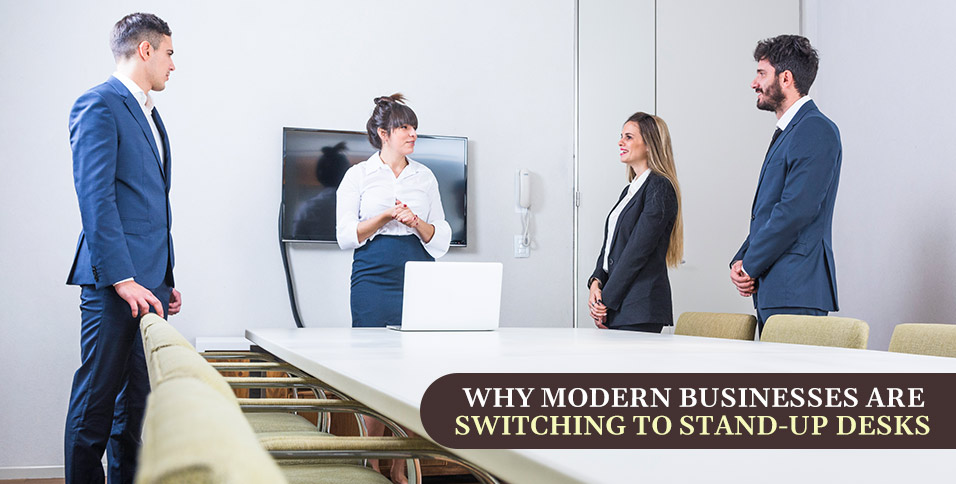
Standing during calls, brainstorming sessions, or short tasks can boost engagement. Some teams even say meetings are more dynamic when everyone is on their feet. Modern companies value mental sharpness, and something as simple as changing posture can support that.
Productivity Is Tied to Comfort
There’s a common misconception that productivity is only about software tools, automation, or performance metrics. But physical comfort plays a huge role.
If an employee:
- constantly adjusts their chair
- stretches their neck every 10 minutes
- shifts because their back hurts
… they’re distracted, even if they don’t consciously notice it.
Adjustable desks reduce that friction. You simply press the button, and the desk adjusts its height to your individual requirements. In other words, the workstation adapts to the person, not the other way around.
Today’s businesses understand that small daily improvements lead to long-term performance gains. It’s not about a dramatic transformation. It’s about removing discomfort so people can focus on actual work.
Employee Retention and Workplace Expectations
The conversation around office furniture has changed because expectations have changed. A few years ago, employees were grateful just to have a stable job and a decent chair. Today, workplace standards are different. People pay attention to how a company treats them, and that includes the physical environment they work in every day.
According to several workplace well-being studies, younger professionals, especially Millennials and Gen Z, place a high value on health-conscious office environments. They associate ergonomic furniture with a company that thinks long-term. When businesses invest in adjustable desks, better lighting, and flexible workspaces, employees interpret it as a signal: “This company plans to keep people healthy and productive, not just busy.”
Retention is no longer only about salary. It’s about experience. When someone spends eight hours a day in one place, that space directly affects their mood and energy. If a company ignores that, employees eventually look elsewhere.
There’s also a psychological layer here. Giving employees control over their environment increases their sense of autonomy. An electric desk frame may seem like a small technical detail, but it allows a person to decide how they want to work in that moment. Sitting during deep focus tasks. Standing during calls. Adjusting height to match their body properly. That autonomy contributes to overall job satisfaction.
Hybrid work has made this even more visible. Many people upgraded their home offices during remote work periods. They bought better chairs, larger monitors, and in many cases, adjustable desks. When returning to corporate offices, they expect at least the same level of comfort. Businesses that ignore this gap risk creating friction between home and office experiences.
Modern companies understand that workplace design is part of employer branding. Stand-up desks are not a luxury anymore; they are quickly becoming a baseline expectation in progressive offices.
Long-Term Health and Business Sustainability
There is also a practical, long-term reason behind the switch. Prolonged sitting has been linked to musculoskeletal disorders, reduced metabolic activity, and increased risk of chronic pain conditions. These are not abstract risks. They translate into sick days, lower engagement, and healthcare costs.
Research from occupational health organizations shows that alternating between sitting and standing throughout the day can reduce lower back discomfort and improve overall physical well-being. The keyword here is alternating. The goal is not to stand all day, but to avoid staying in one static position for hours.
From a business perspective, even small improvements in employee well-being compound over time. If fewer people experience chronic discomfort, fewer productivity hours are lost. If employees feel physically better at the end of the workday, they are less likely to associate their job with exhaustion or pain.
Sustainability in business is often discussed in terms of environmental impact or financial stability. But human sustainability matters just as much. A company that designs its workspace to support healthy habits is investing in its most valuable asset, its people.
What makes adjustable desks particularly practical is that they do not require dramatic behavior change. They gently encourage movement. A person does not need to schedule workouts during office hours. They simply press a button and change position. That small action, repeated daily, builds a healthier routine over time.
Stand-up desks alone will not solve every health issue in modern offices. However, they represent a broader shift toward smarter, human-centered design. Instead of expecting people to adapt to rigid furniture, companies are adapting the workspace to real human needs.