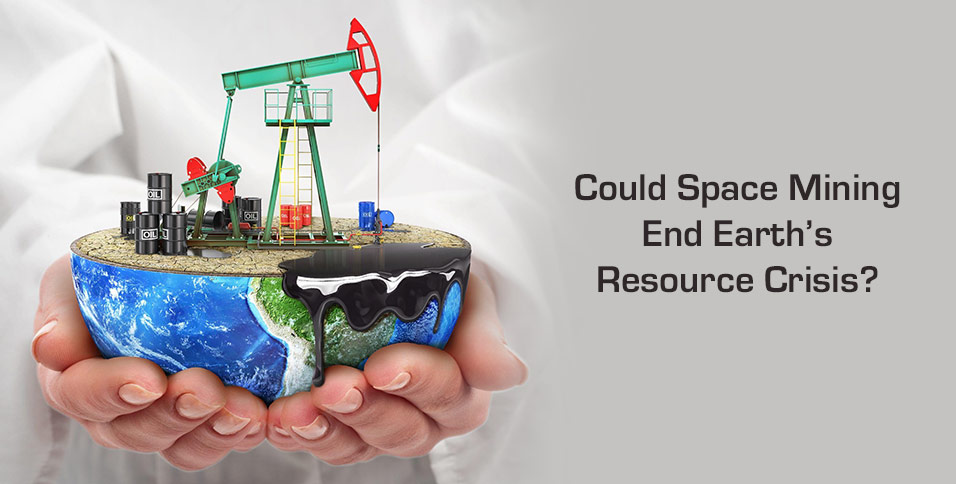
We’re running out. Not tomorrow, not next year – but slowly, steadily, the Earth’s supply of key resources is shrinking. From rare earth elements and clean water to fossil fuels and precious metals, humanity’s appetite for materials is beginning to outpace what our planet can safely give.
So, where do we go when we need more than Earth can offer? For some scientists and entrepreneurs, the answer lies far beyond our atmosphere. Enter space mining – the bold idea that we could harvest what we need from the Moon, asteroids, or even Mars.
You see, space mining isn’t just about launching rockets and picking up rocks. It could fundamentally reshape our relationship with the planet – and maybe even save it.
The Problem: A Planet Under Pressure
Modern life runs on mined materials. Your phone? It likely contains cobalt, lithium, and rare earths. Your electric car? It needs nickel, graphite, and more. Even renewable energy – like wind turbines and solar panels – depends on materials like neodymium and tellurium.
But here’s the problem: these resources are becoming harder to find, costlier to extract, and more destructive to the environment. Many are concentrated in just a few countries, creating political bottlenecks. Others involve high-emission mining practices or toxic waste.
And the demand keeps rising. As more people join the global middle class and countries race to electrify their infrastructure, the strain on Earth’s supply chains grows.
We need an alternative – or at least a backup plan.
The Promise of Space Mining
Space is vast. Really vast. And it’s full of untapped resources. Some asteroids, for example, are rich in iron, nickel, platinum, and even water. Scientists have identified certain metallic asteroids that could contain more platinum-group metals than we’ve ever mined on Earth.
The Moon also holds promise. It has water ice at its poles, helium-3 embedded in its surface, and metals like titanium and aluminium in its dusty soil.
In theory, space mining could help:
- Meet growing demand for critical minerals
- Reduce environmental damage caused by Earth-based mining
- Decentralise supply chains, avoiding geopolitical hotspots
- Support sustainable space infrastructure, like fuel depots or habitats
That’s not just useful – it’s potentially transformational. If we can tap into even a fraction of the materials floating in near-Earth space, we could relieve some of the pressure on Earth’s ecosystems and give developing nations access to previously unattainable resources. The ripple effects could reshape everything from tech manufacturing to international trade.
How Would It Work?
Let’s be clear: we’re not sending humans with pickaxes into orbit. Space mining will be robotic, remote, and highly automated – at least at first.
Here’s a simplified version of how it could play out:
- Prospecting missions identify targets rich in specific materials.
- Robotic landers map and sample the site.
- Mining robots extract ore or scoop up regolith (loose soil).
- On-site processing converts material into usable forms.
- Transportation systems return high-value goods to Earth – or use them in space.
Some materials, like water or metals, may never even make it home. They’ll be used right where they’re mined to build space habitats, fuel spacecraft, or support lunar or Martian outposts.
Why It’s Not Just Fantasy Anymore
A decade ago, space mining felt like a long shot. Today, it’s still early – but the pieces are coming together:
- NASA and ESA are investing in missions to the Moon and asteroids, collecting vital data on composition and terrain. These space agencies are leading the way in understanding where resources are located and how accessible they may be, using missions like NASA’s OSIRIS-REx or ESA’s Hera to test landing and sampling methods.
- Private companies like AstroForge and OffWorld are developing mining robots designed for extreme environments. These machines are being engineered to operate in harsh, remote conditions – navigating rough terrain, working autonomously, and handling materials with minimal human intervention.
- Reusable rockets from SpaceX and other firms have slashed launch costs, which is making the space industry more realistic. With rockets like Falcon 9 and Starship being launched, landed, and reused, it’s now cheaper and more efficient to send missions into space repeatedly – a huge breakthrough for industrial ventures.
- Autonomous tech and AI are advancing rapidly – exactly what we need for remote extraction and processing. These technologies are being trained to identify, manipulate, and even refine materials without real-time human input, enabling future mining missions to operate far from Earth for long periods.
Even governments are paying attention. The U.S., Luxembourg, and the UAE have passed or proposed laws to clarify the legal status of space resources, signalling growing support for commercial activity beyond Earth.
The Challenges (Because There Are Plenty)
Let’s not sugar-coat it. Space mining is hard. As exciting as the concept sounds, the obstacles standing in the way are significant – and often underestimated.
Here are some of the main challenges:
- Distance and time: Missions can take months or years just to reach a target. A mining operation might require multiple trips, careful coordination, and the ability to survive in isolation for extended periods of time.
- Extreme environments: Cold, radiation, microgravity – it’s brutal out there. Equipment must withstand temperatures that swing hundreds of degrees, solar flares, and abrasive dust, all while functioning in low-gravity conditions.
- Cost: Development and launch expenses remain enormous, even with cheaper rockets. Building specialised mining tech, getting it to space, and maintaining it are still financially daunting tasks for most companies and countries.
- Legal uncertainty: Who owns an asteroid? What about Moon land? The answers aren’t settled. Current international treaties don’t clearly define property rights, making investment riskier until regulations catch up.
- Unknowns: We haven’t mined anything in space yet. There’s a lot we still don’t know. From how regolith behaves under excavation to how materials hold up in deep space, we’re still gathering data and testing theories.
So while space mining is promising, it’s not an overnight solution. It’s a long game – and success depends on steady, incremental progress built on research, collaboration, and trial-and-error.
Could It Really Help Earth?
Yes – but not by itself. Space mining won’t instantly solve the climate crisis or stop pollution. But it could reduce our reliance on some of the most harmful Earth-based practices.
By shifting the extraction of certain minerals off-world, we could:
- Protect ecologically sensitive areas
- Reduce toxic runoff and emissions
- Create a circular space economy, where materials are reused in orbit
And perhaps most importantly, space mining forces us to think bigger. It encourages investment in green technologies, autonomous systems, and international cooperation. It opens the door to doing things differently – not just in space, but here at home too.
Why Space Mining Might Be Our Best Backup Plan
Space mining won’t fix everything. But it might just help us build a better path forward – one that respects the limits of our planet while reaching for something greater.
As Earth faces mounting pressure, we’ll need bold ideas and careful execution. And when it comes to saving our industries, supporting off-world colonies, or just making the best use of what the universe offers, space mining could play a key role.
Because the future isn’t just out there – it’s above us.
Also Read: How Heptane Drives Innovation in the Automotive and Aerospace Sectors