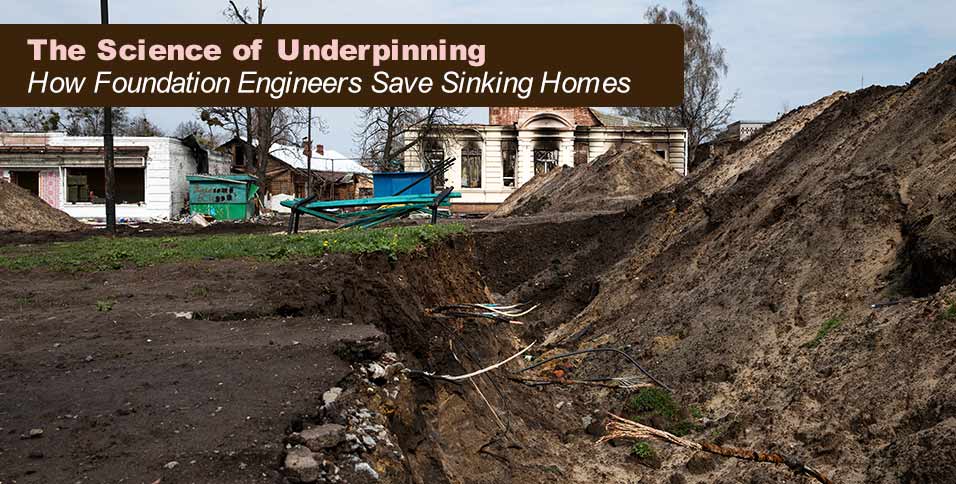
When a home begins to settle unevenly, the solution is rarely found on the surface. While many homeowners hope a few tubes of caulk or a new layer of concrete will fix the cracks in their walls, structural issues usually run much deeper. To truly stabilize a failing structure, engineers must perform a process known as underpinning. This technique involves extending the house’s foundation down into a more stable soil layer or onto solid bedrock.
Understanding the mechanics of foundation piering can help homeowners make informed decisions when their property faces the threat of structural failure.
Why Surface Soils Fail
The earth beneath our feet is not a static platform. It is a living, breathing collection of minerals and organic matter. Most residential foundations are built on “shallow” footings, meaning they sit just a few feet below the surface. This area is highly susceptible to the weather.
When heavy rains saturate the ground, the soil loses its bearing capacity. Conversely, during a heatwave, the soil loses moisture and shrinks. Over decades, this constant shifting creates “voids” or empty pockets beneath the concrete. Without the soil there to support the weight, the concrete slab or perimeter wall snaps under the pressure of the house. This is what leads to the leaning chimneys and sloping floors that haunt property owners.
The Anatomy of a Push Pier System
The most common and effective form of underpinning today is the steel push pier system. Unlike older methods that involved pouring even more heavy concrete under the house, push piers use the house’s own weight as a tool for its rescue.
The process begins by excavating small sections of the foundation to reach the “footing.” A heavy-duty steel bracket is then attached to the concrete. Using high-pressure hydraulic rams, installers drive sections of galvanized steel pipe into the earth. These pipes are pushed deep past the unstable “active zone” of the soil. They only stop moving once they hit a refusal point, which is typically a layer of rock or incredibly dense soil that can handle the massive load of a building.
Choosing the Right Specialist in a Shifting Landscape
Foundation repair is a highly specialized field that sits at the intersection of geology and structural engineering. In a region like Southern California, the stakes are particularly high due to the presence of steep hillsides and frequent tectonic shifts. These factors can turn a minor settlement issue into a major liability in a matter of months.
If your home is showing signs of distress, such as windows that no longer lock or cracks that span across your ceiling, it is essential to consult an expert. Reaching out to a seasoned Foundation repair company such as Sunshine Foundation Repairs can provide the technical clarity you need. A professional will use laser levels and soil probes to determine the exact depth of the problem. By opting for a permanent piering solution rather than a temporary “slab jack,” you ensure your home remains stationary regardless of how much the surrounding California soil moves.
Helical Piers vs. Push Piers: Which is Better?
While push piers use the weight of the house to drive the steel into the ground, helical piers are slightly different. These piers feature screw-like plates at the bottom and are twisted into the ground using a hydraulic torque motor.
Engineers typically specify helical piers for lighter structures, such as decks, porches, or newly built room additions. Because they don’t rely on the weight of the building to be installed, they are also perfect for stabilizing a foundation before the house is even built. This is known as “pre-construction piering,” and it is becoming a standard practice for luxury homes built on unstable slopes.
The Lifting Process: Restoring the Level
The final and most impressive stage of underpinning is the lift. Once all the piers have reached the necessary depth, they are connected to a unified hydraulic manifold. This allows the team to lift the entire side of the house at once, slowly and carefully.
As the pistons move, you can often hear the house “sigh” as the pressure is relieved. Cracked drywall begins to close, and doors that have been stuck for years suddenly swing open with ease. This is the moment the structure is returned as close as possible to its original design.
Conclusion
Underpinning is often described as the most significant repair a homeowner can undergo. While the process may seem daunting, it is the only way to truly “fix” a home that has been compromised by the earth beneath it. By bypassing the volatile surface soil and anchoring your investment to the bedrock, you are making a choice that protects your family for the next century.
The cost of waiting is always higher than the cost of a timely repair. Structural damage is progressive; a half-inch of settlement today can easily become three inches of settlement after a single rainy season. When you choose to underpin your foundation, you aren’t just repairing a building. You are restoring the peace of mind that comes with knowing your home is literally on solid ground. In the long run, the stability of your foundation is the stability of your financial future. It is worth the investment to do it correctly the first time.