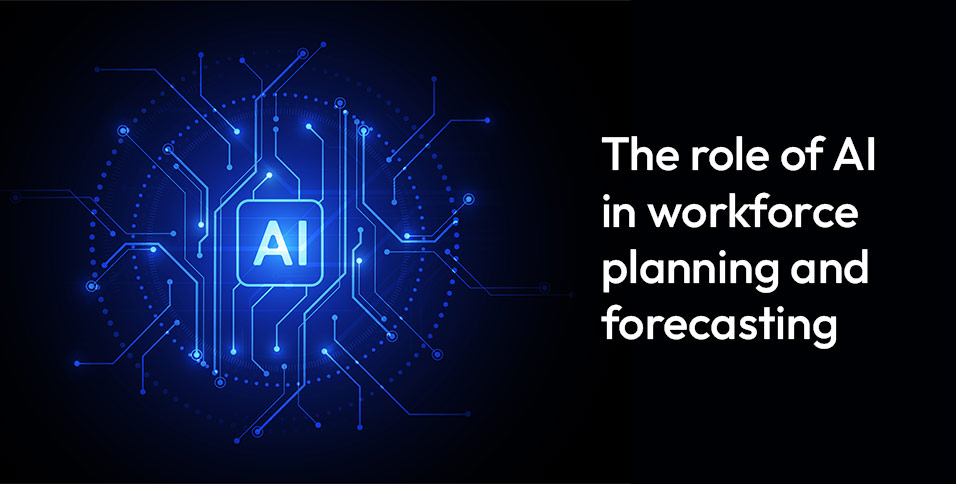
Workforce planning sounds orderly. Forecast demand, match it with supply, fill the gaps. On paper, it’s neat. In practice, it’s messy. Markets shift in months, skills go stale in years, and employee expectations change even faster. Traditional planning, with its annual cycles and rigid spreadsheets, struggles to keep up.
This is where AI enters the picture. Not as a silver bullet, but as a sharper lens. AI promises to spot patterns humans miss, process vast data sets in seconds, and test scenarios leaders could never model by hand.
But the question isn’t whether AI can forecast better — it’s whether organizations are ready to use it wisely. Because the risk isn’t the failure of the tech. It’s over-reliance on it.
So before we celebrate algorithms as the savior of workforce planning, leaders have to ask: What’s the promise, and what’s the price?
The promise of AI: Precision in a messy world
AI in workforce planning lies in its ability to bring clarity to chaos. For decades, HR teams relied on gut feel, trend lines, or at best, regression models built on last year’s data. AI changes the scale and speed.
- Forecasting demand. By combining external signals — like market shifts, customer demand, economic data — with internal workforce data, AI models can project future talent needs far more precisely.
- Mapping skills in real time. Instead of static job descriptions, AI can scan employee profiles, training records, even project histories, to surface what skills an organization actually has.
- Scenario modeling. What if a major client cuts spending by 20 percent? What if a new technology reduces demand for one role but spikes demand for another? AI can run dozens of scenarios in seconds, something most HR teams couldn’t model once.
- Turnover prediction. Using patterns of engagement, career movement, and external benchmarks, AI can flag employees at high risk of leaving long before exit interviews reveal the problem.
The promise is attractive on a lot of levels — fewer surprises, better alignment, smarter decisions. In a business environment where talent shortages can derail strategy overnight, that precision is hard to ignore.
The risks of over-optimism — when algorithms mislead
Every new tool in HR arrives with a wave of hype. AI is no exception. Vendors talk about 95% accuracy, seamless forecasting, talent strategies that finally align with the business. Leaders want to believe it. But optimism can slide into blind faith, and that’s where the danger lies.
The first trap is data quality. AI doesn’t invent truth; it amplifies whatever you feed it. If job titles are outdated, if skills taxonomies are inconsistent, if exit interview data is patchy — the model will still deliver forecasts, only they’ll be polished versions of bad assumptions.
The second is over-reliance. An algorithm might predict that attrition risk is high in one group. Does that mean the manager should stop investing in them? Or that HR should start designing replacements? Without human judgment, AI forecasts can become self-fulfilling prophecies, pushing people out instead of keeping them in.
There’s also bias baked in. If the data reflects historical inequities — fewer women in leadership, certain schools overrepresented in hiring — then the model will faithfully project that pattern into the future. AI doesn’t ask whether the system is fair. It just optimizes what already exists.
And then there’s the cultural fallout. When employees sense they’re being “scored” for mobility or retention risk, trust erodes. AI turns from a tool into a surveillance system. Instead of helping people grow, it makes them wonder who’s watching and what the data will be used for.
The point isn’t that AI is dangerous. It’s that optimism without checks — without human judgment, without cultural guardrails — creates more risk than resilience.
What can AI do better?
For all the caution, dismissing AI outright would be shortsighted. It has strengths no human team, however skilled, can match.
- Forecasting at scale. HR analysts can project headcount needs based on simple growth curves. AI, by contrast, ingests thousands of variables — market data, hiring trends, demographic shifts, attrition patterns — and delivers forecasts that adjust as conditions change. It’s not perfect, but it’s faster and often sharper.
- Scenario modeling. Business leaders constantly ask “what if” questions: What if a new regulation slows expansion? What if automation cuts demand for a role by half? Running those models manually takes weeks. AI can produce them in hours, allowing strategy to shift while the window of opportunity is still open.
- Skill visibility. Most organizations don’t know what skills they already have. Job titles don’t capture it. Performance reviews rarely track it. AI can scan resumes, project records, and even training activity to build a living map of workforce capabilities. That visibility turns workforce planning from guesswork into strategy.
- Predicting movement. AI doesn’t just flag who might leave. It can also suggest who is likely to move internally, and what roles they could thrive in. That changes mobility from ad hoc to proactive.
These are the sharp tools. They don’t replace strategy, but they give leaders data they’ve never had access to at this speed or scale.
What are the things that only humans can judge?
But let’s be clear: not everything that matters can be modeled. Some judgments remain firmly in human hands.
- Culture. AI can show you skills, but it can’t tell you whether a team dynamic will welcome someone from a different background. Fit, belonging, trust — those are human judgments, shaped by leadership and culture.
- Context. An algorithm might flag high attrition risk in one department. Only leaders know that it coincides with a major reorg, or a recent product failure. Without context, the data risks being misread.
- Values. AI doesn’t decide what “good” looks like. If a forecast shows fewer women in technical leadership five years out, the model isn’t telling you to fix bias — it’s just projecting history forward. Leaders have to set the standard: do we accept that outcome, or do we act differently?
- Trust. Employees don’t buy into models; they buy into leaders. If HR or management can’t explain why data is being used, or how forecasts support growth rather than surveillance, the system won’t stick.
This is where many organizations stumble. They assume more precision automatically means better planning. But without human judgment to interpret and challenge the output, AI risks becoming an oracle — and oracles are dangerous when leaders stop questioning them.
Finding the right balance for leaders
The challenge isn’t choosing between AI and human judgment. It’s learning how to use both without letting either dominate. That balance doesn’t come from a single rollout plan — it comes from habits leaders build over time.
- Start small. Pilot AI in one area, like attrition prediction or skill mapping. Test whether the data improves decisions before scaling it across the enterprise.
- Keep humans in the loop. Make it explicit that forecasts are inputs, not verdicts. Require managers to challenge predictions, not just accept them.
- Audit for bias. Don’t assume fairness. Run regular checks: Are certain groups being underrepresented in talent forecasts? Are promotion paths skewed? If the numbers reinforce inequity, leaders need to intervene.
- Make it transparent. Explain to employees how data is collected and why it’s used. Secrecy breeds distrust; clarity builds confidence.
- Measure outcomes, not adoption. Success isn’t the number of dashboards used. It’s whether turnover falls, skill gaps close faster, or internal moves increase. If those don’t shift, the AI hasn’t added value.
Balance isn’t about splitting the work 50/50 between humans and machines. It’s about knowing what each does best, and designing processes that force both to show up.
Conclusion
Workforce planning AI Platform doesn’t erase that uncertainty. It sharpens the picture, but it can’t replace judgment, values, or trust.
The risk is believing too much in the promise — letting algorithms dictate futures without questioning them. The bigger risk is ignoring the tools altogether and relying on the same outdated cycles while competitors plan faster and smarter.
The organizations that will win aren’t the ones that treat AI as magic, or the ones that resist it out of fear. They’re the ones that use AI as a partner — to run the numbers, test the scenarios, and surface insights — while leaders still make the calls.
Because at the end of the day, planning for people isn’t math alone. It’s culture, it’s context, and its choice. And no algorithm can decide those for you.