The Upward Spree in Minor Metal Prices
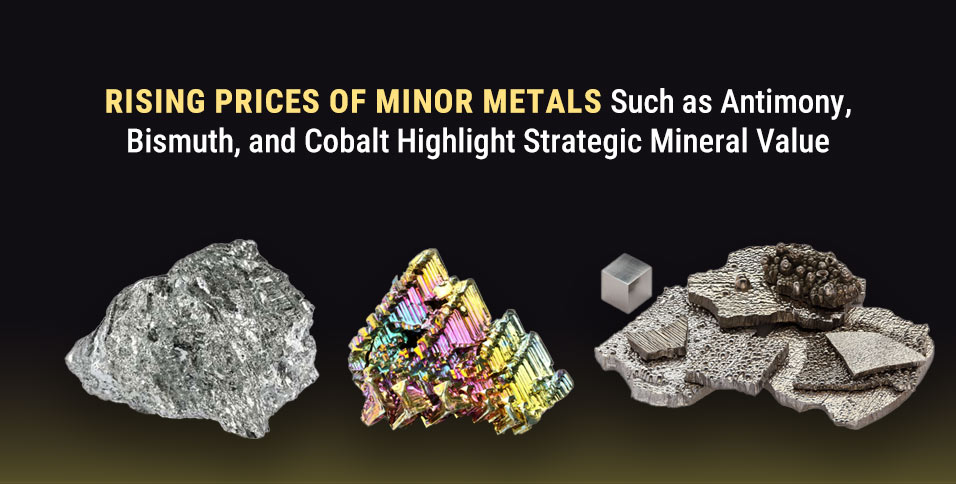
In recent years, minor metal prices such as antimony, bismuth, and cobalt have been consistently on an upward spree. They have emerged as the “eye of the storm” in industrial chains across the world. The price of antimony surged from $12,500 per ton in early 2024 to $25,400 per ton by March 2025, representing a 100%+ increase. Prices of bismuth jumped by 28% in one day, and cobalt prices went through the roof following a ban on exporting from the Democratic Republic of Congo (DRC). This seemingly at-random price surge is, nonetheless, a necessary consequence of connected variables such as resource deficiency, geopolitical instability, and industrial transformation, which unmask underlying crises in global supply chains.
Analysis of Price Increase Drivers
The minor metals market has seen brisk activity recently, with prices trending upward. The key drivers are the limited reserves of strategic minor metals, the high cost of extraction, and low elasticity of supply, paired with fast-growing downstream demand from such industries as new energy, semiconductors, and defense. Geopolitical tensions have also disrupted supply chains, and China’s export ban on tungsten, antimony, and rare earths has widened domestic-international price differentials, sharpening supply-demand mismatches. In view of the rising significance of scarcity of resources, improved patterns of demand, and policy measures, minor metal prices are bound to increase further in the coming times. Companies with superiority of resource deposits, technology barriers, and compliant export streams will accrue gains uninterrupted.
Soaring Prices of Minor Metals Have Spurred Chain Reactions
Price fluctuations of cobalt have become a “barometer” for the new energy vehicle industry. Estimates of information reveal that for every $1,000 per ton increase in cobalt prices, ternary lithium battery production costs increase by approximately 0.36%. In order to resist cost pressures, companies like Tesla are accelerating the shift to lithium iron phosphate (LFP) batteries. Through the application of LFP batteries launched in 2020, Tesla reduced costs by 19%. Whereas demand for cobalt has eased short term with the nickel content trend (e.g., cobalt contribution to NCM811 batteries dropped to 29%), global cobalt supply continues to be highly concentrated in the DRC (70%), leaving supply chains vulnerable.
The photovoltaic industry is also under cost pressures. The portion of antimony costs in the production of solar glass has risen from 5% to 12%, and some are already experimenting with substitute materials such as cerium and titanium. The deeper impact is typically in the military context: antimony alloy is a ubiquitous material in armor-piercing bullets, and bismuth is used in nuclear submarine reactor shielding coats. Supply chain actions directly mirror national defense security.
Also Read: How Do Mineral Rights Brokers Assess the True Value of Your Property? Key Factors Explained