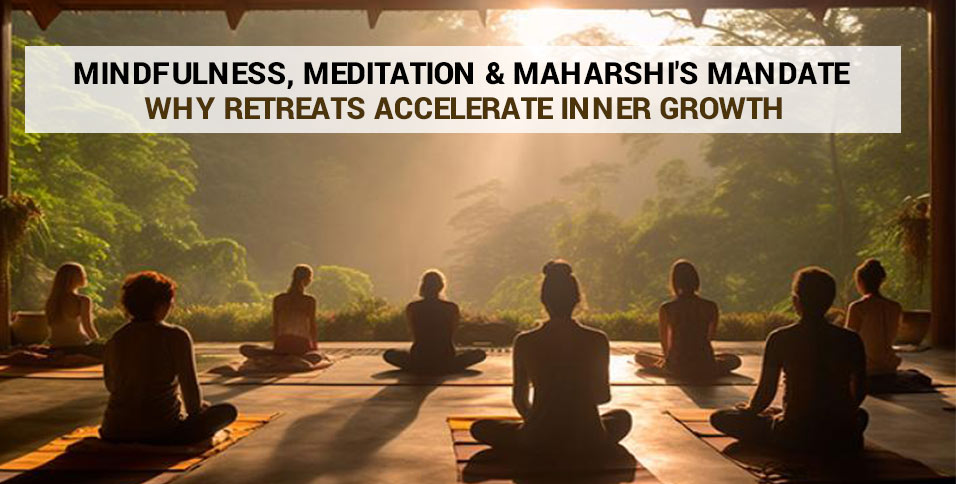
The Executive Search for Inner Capital
In the modern business landscape, a new understanding of performance is emerging. The global wellness market, valued in the trillions of dollars, signals a strategic search among leaders for more than fleeting relaxation. Effective leadership in a volatile world requires a deep reservoir of inner resources—resilience, cognitive clarity, and emotional equilibrium—a form of “inner capital.” While daily mindfulness is beneficial, the immersive retreat offers a more potent, targeted intervention to cultivate this essential asset. By combining the wisdom of sages like Sri Ramana Maharshi with modern neuroscience, the retreat model provides a high-yield investment in the one asset that underpins all others: the self.
The Science of Stillness: Rewiring the Brain for Peak Performance
The clarity reported by meditators is the result of tangible changes in the brain’s structure and function. Neuroscience reveals that meditation is a form of practical neuroplasticity—the brain’s ability to reorganize itself. For a strategic leader, this is an active training regimen for optimizing the mind.
Key brain regions are transformed through this practice. The Prefrontal Cortex (PFC), the brain’s CEO responsible for executive functions like decision-making and emotional regulation, shows increased gray matter density with meditation. This enhances the very skills that define effective leadership. Concurrently, the
Amygdala, the brain’s fear center, shrinks and becomes less reactive, reducing the “fight or flight” response and allowing for a more measured approach to stressors. Finally, meditation quiets the
Default Mode Network (DMN), the “Me Center” responsible for mind-wandering and rumination, leading to greater presence and focus.
Crucially, meditation strengthens the neural pathways between the regulatory PFC and the reactive amygdala, fostering a fundamental shift from mindless reaction to mindful response. This neurological re-engineering is supported by physiological practices integral to yoga. Disciplines such as
pranayama (controlled breathing) and savasana (deep relaxation) directly influence the autonomic nervous system, enhancing the “rest and digest” state, reducing cortisol, and shifting brainwave patterns toward deep relaxation. This evidence reframes meditation as a proactive regimen for cognitive and emotional enhancement, building neurological resilience for peak performance.
Maharshi’s Mandate: The Direct Path of Self-Enquiry
While neuroscience explains the “how” of transformation, wisdom traditions provide the “why.” Among the most direct paths is the one articulated by the 20th-century sage, Sri Ramana Maharshi. His central teaching, Self-enquiry (atma vichara), centers on a single, persistent question: “Who am I?”.
This is not an intellectual exercise but a tool to turn the mind’s attention away from the stream of thoughts and back toward its source—the subjective feeling of “I”. Maharshi taught that the “I”-thought is the root of all other thoughts. By holding steadfast attention on this primary thought, its power begins to dissolve, and with it, the entire structure of the egoic mind. What remains is a silent, unbroken awareness—the direct experience of the true Self, untouched by external fluctuations. For a modern leader, this method is the ultimate application of first-principles thinking to the self, offering a path not just to solving problems, but to transcending the very framework in which they arise.
The Retreat Environment: A Crucible for Accelerated Transformation
If daily meditation charges a battery, attending a yoga retreat upgrades the entire electrical grid. The immersive environment of a retreat creates a powerful synergistic effect that dramatically accelerates inner growth. This is achieved through several key factors.
First is immersion through disconnection. A retreat is a conscious act of stepping away from the “day to day hectic life,” including a digital detox that allows the brain’s Default Mode Network to quiet down. This external silence is the necessary precondition for cultivating internal stillness. Second is the power of
Satsang, a Sanskrit term meaning “company of truth”. A retreat brings together a community of like-minded individuals, creating a potent energetic field that supports and amplifies each person’s efforts. Third is the momentum of
Sadhana, or structured spiritual practice. A consistent daily schedule of meditation and yoga, free from interruption, allows practitioners to access deeper states of consciousness. Finally, the serene natural settings of most retreats allow participants to reconnect with the healing rhythms of the earth.
These elements combine to create a “liminal space” outside the structures of ordinary life. By temporarily suspending our familiar roles, we are freed to engage in the process of self-discovery, making the retreat a meticulously designed laboratory for personal and professional recalibration.
A Blueprint for Holistic Growth: The Sivananda Model in Practice
The Sivananda Yoga tradition offers a time-tested and comprehensive blueprint for translating theory into lived experience. It is a holistic model structured around the Five Points of Yoga, a set of principles designed to create a balanced lifestyle conducive to spiritual growth :
- Proper Exercise (Asana): Yoga postures are practiced slowly and consciously to prepare the body for meditation, focusing on the health and flexibility of the spine.
- Proper Breathing (Pranayama): Yogic breathing techniques are used to control vital life force energy, balance the brain, and calm the nervous system.
- Proper Relaxation (Savasana): Deep, conscious relaxation is taught as a vital skill to recharge the body’s energy and teach the art of surrender.
- Proper Diet (Vegetarian): A simple, pure vegetarian diet is emphasized, recognizing that food has a subtle effect on the mind.
- Positive Thinking (Vedanta) and Meditation (Dhyana): This is the pinnacle of the practice. The first four points create the ideal conditions for meditation to occur naturally, supported by a philosophical framework for reframing life’s challenges.
This integrated system embodies a crucial insight: the body is the primary vehicle for spiritual life. By systematically balancing the physical and energetic systems first, the Sivananda model creates a stable vessel in which the mind can naturally become still. For those new to these practices, a structured meditation retreat for beginners based on such a model provides an invaluable foundation, offering the essential tools and supportive environment necessary to begin the path with confidence.
Conclusion: Returning to the World, Transformed
The ultimate purpose of a spiritual retreat is not to escape the world, but to fundamentally transform one’s relationship to it. The silence and deep practice cultivated in an immersive environment forge the inner capital required to engage with life more effectively, compassionately, and peacefully. Research confirms that the psychological and neurological benefits of retreats are not fleeting, with participants experiencing sustained improvements in emotional regulation and cognitive function long after returning home.
In this light, attending a retreat transcends self-care; it is a profound act of self-leadership. It is a strategic investment in developing the focus, resilience, and wisdom necessary to succeed in a complex world and contribute to it from a place of centeredness and integrity. By answering the mandate to look within, we gain the power to act in the world with greater purpose and clarity.
Also Read: Discover the Ultimate Yoga Retreat in Rishikesh: Experience the Best Yoga Retreat in Rishikesh