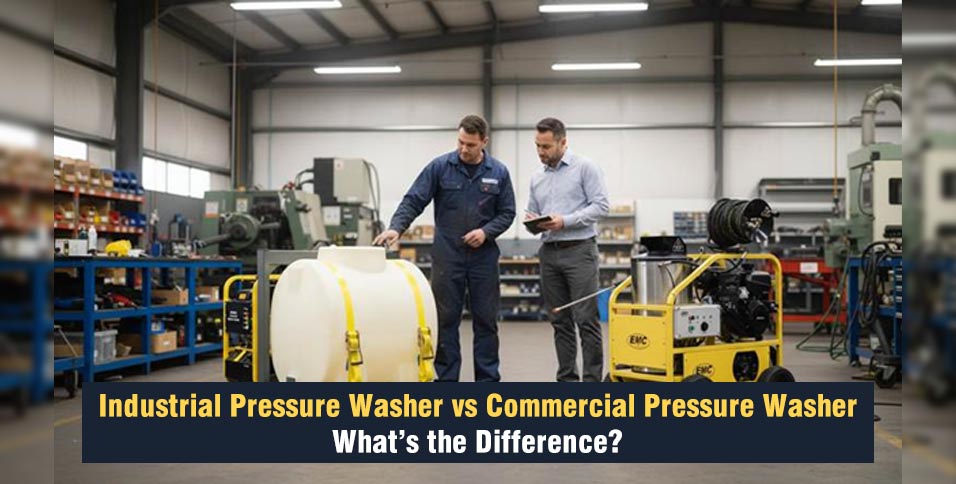
When someone first starts shopping for a pressure washer, it’s easy to get overwhelmed by the jargon and model numbers. But the real mistake many people make isn’t just not knowing the difference between machine types it’s buying the wrong one for the job. I’ve spent years dealing with pressure washers on job sites, and I want to clear things up in plain, useful terms.
Whether you’re cleaning heavy equipment every day or managing a fleet of vehicles, knowing the difference between a commercial pressure washer and an industrial pressure washer will save you time, money, and frustration.
Start with the Problem You’re Trying to Solve
People often ask: “Can’t I just use a powerful residential washer and upgrade later?” The quick answer is no, not if your cleaning needs are tough and recurring. Residential washers are designed for patios or light dirt, while commercial and industrial machines have very different build expectations and capabilities. Choosing the wrong one leads to premature failure, lost hours, and equipment that doesn’t keep up with demand.
A well-matched machine, on the other hand, becomes an asset it helps you finish jobs faster, reduces manual labor, and in many cases extends the lifespan of your cleaning crew’s tools.
What “Commercial” Really Means
In everyday terms, a commercial pressure washer is what people use when they’ve moved beyond home use but are not yet in a full industrial environment. Service businesses, property maintenance teams, landscapers, and auto-detail shops rely on these machines regularly.
A commercial unit is designed to handle hours of demanding work, but it’s not built to run 24/7. You’ll see commercial models commonly rated around 3000–4000 PSI enough to remove stubborn mud, grease spills, or dirt from a medium-size surface without damaging surfaces if used correctly.
If you’re looking for a Pressure Washer in Canada, this is typically the category you’ll want to explore. These machines give a perfect balance between power, portability, and affordability, making them ideal for professional service businesses.
Two things stand out about commercial washers:
- Balance of power and portability. They’re strong enough for most professional tasks but still manageable in size.
- Affordability for businesses. You’re not paying for extreme output when you don’t need it.
Then There’s “Industrial”
Industrial pressure washers are in an entirely different category. These are machines meant for continuous, heavy-duty environments like manufacturing plants, food processing facilities, oil and gas yards, or mining sites.
Industrial units live up to their name:
- They can often run all day, every day without overheating.
- They typically generate significantly higher pressure often 4000 PSI and up and robust thermal systems, especially in hot water units.
- They use heavy-duty pumps, upgraded components, and stronger frames designed to take a beating.
People who invest in industrial-grade washers do so because regular commercial models simply can’t sustain their cleaning cycles or the level of grime they face.
When You Should Pick One Over the Other
I like to explain the difference in terms of how you work every week.
- If your job involves regular cleaning of vehicles, tenants’ walkways, building exteriors, or routine maintenance tasks, a commercial pressure washer gives you strong performance without excessive complexity. It’s like choosing a commercial van: functional, reliable, and built for professional daily usage.
- If you’re dealing with industrial furnaces, grease pits, food-processing floors, or machinery with baked-on grime that must be blasted away multiple times a day, an industrial pressure washer is more like choosing a heavy-duty truck you need something engineered for nonstop work.
In short, it’s not just about power. It’s about durability, expected workload, and the environment you’re cleaning in.
Why This Really Matters
Making the wrong choice isn’t just an inconvenience it impacts your bottom line. That means:
- A cleaning machine that can’t keep up will cost more in maintenance and repair.
- A cleaning machine that’s underpowered will take longer to clean and cost more in labor.
- A cleaning machine that’s overpowered and being used on the wrong setting will waste energy and potentially damage the surface being cleaned.
That’s why content like this isn’t just theory it’s common knowledge based on the way these machines perform in the field.
If you’d like some assistance in choosing the perfect cleaning machine for your needs or the needs of your team, just Contact US and we’d be happy to walk through your requirements and match you up with the perfect solution.
Final Thoughts You Can Use Today
So, the final thoughts that you should take away today are these:
- Commercial pressure washers are perfect for service industries and maintenance teams that need reliable cleaning on a regular basis.
- Industrial pressure washers are perfect for environments that need cleaning on an ongoing and intense basis.
There’s no shame in choosing the one that’s right for your needs and no benefit in choosing the more expensive one if it’s just overkill. Knowing how your workload will be and how the cleaning machine will be used will help guide you to the perfect choice. When the cleaning machine is working for you and not against you, that’s a win-win situation regardless of the industry that you’re in.