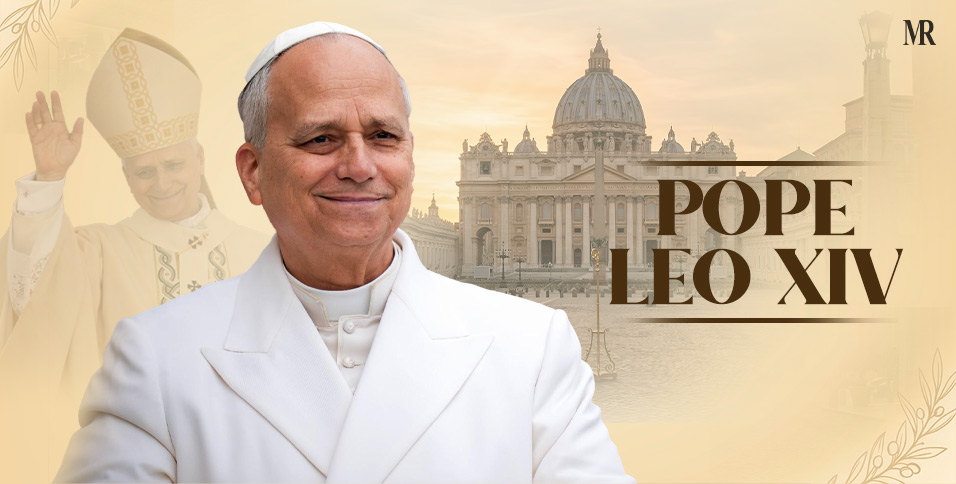
As the first American-born pope and the leader of the Roman Catholic Church, Pope Leo XIV stands out for how he engages directly with real-world issues.
His choice of the name “Leo” itself signals that intent.
The name connects the social justice focus of Pope Francis with the intellectual legacy of Pope Leo XIII, suggesting a papacy that is both grounded and forward-looking.
Since 2025, the Pope’s stance on LGBTQ+ rights, geopolitics, artificial intelligence, poverty, and war has started to shape how the Vatican represents itself globally.
So join us as we break down the political views of Pope Leo XIV across these issues by stating what he’s said, what he’s done, and what it all means in 2026.
The Different Political Views Of Pope Leo XIV
1. Views On LGBTQ+ Rights
When analyzing Pope Leo XIV’s political views on LGBTQ+ rights, observers consistently describe his approach as “welcoming but formal.”
Since his election in May 2025, the Head of the Catholic Church has reaffirmed the Church’s traditional definition of marriage, while simultaneously altering its pastoral tone toward inclusion, dignity, and real-world engagement.
- Endorsement of Fiducia Supplicans (2025–2026):
Throughout 2025 and into early 2026, Pope Leo XIV continued the implementation of Fiducia Supplicans, allowing non-liturgical blessings for same-sex couples.
In multiple remarks to clergy, he has clarified that these blessings are acts of pastoral charity, not recognition of marriage or doctrinal change.
- The “LGBTQ Poor” (2025 Pastoral Address):
In a mid-2025 address to social ministries, the pope highlighted how LGBTQ+ individuals often face double marginalization, both social and economic, urging the Church to act as a sanctuary for those excluded from both society and opportunity.
- Linguistic Clarity (Late 2025 Clergy Guidance):
In contrast to Pope Francis, the current Bishop of Rome, Pope Leo XIV, emphasized the need for doctrinal precision, warning against “semantic ambiguity” in Church language.
He argued that inclusion must remain anchored in objective truth to prevent confusion and ideological misuse.
2. Views On Geopolitics And Global Diplomacy
A key part of Pope Leo XIV’s geopolitical views is his evolving relationship with the United States and his role in global diplomacy.
His earlier criticism of nationalist policies in the late 2010s and early 2020s still shapes how he is seen today, as a counterweight to hardline ideologies.
- Mediator in the Middle East:
In his March 22, 2026, Angelus address, Pope Leo XIV issued a direct appeal for peace amid escalating tensions involving Iran, Israel, and Lebanon.
He warned that the “thunderous sound of bombs” risks creating an “irreparable abyss,” positioning the Vatican as a moral advocate for ceasefire and dialogue.
- Return to the Apostolic Palace:
Shortly after his election, Pope Leo XIV chose to live in the Apostolic Palace (the traditional residence of past popes) rather than opting for a more informal setting.
This decision showed a return to a more structured and diplomatic style of leadership. It reinforced the Vatican’s role as an established global institution that influences world affairs through dialogue, moral authority, and long-standing relationships and not political power alone.
- Opposition to Nationalism:
In his major address to diplomats corps on 9 January 2026, drawing on Saint Augustine, Pope Leo criticized “excessive nationalism” and “prideful leadership,” advocating for a global order rooted in the common good rather than partisan interests.
3. Views On Technology And Artificial Intelligence
Pope Leo XIV’s political views on artificial intelligence and technology have rapidly become a defining feature of his papacy, earning him the label of the world’s first “AI Pope.”
Since 2025, he has elevated AI from a niche concern to a central ethical issue for the Church.
- Magnifica Humanitas (Expected Late 2026):
The Pope’s forthcoming social encyclical is anticipated to build on the legacy of Rerum Novarum-style social teaching for the digital age.
Early Vatican signals suggest it will focus on three pillars:
- Human dignity in automated systems
- Ethical limits of AI decision-making
- Economic exclusion created by algorithm-driven economies
It is also expected to address labor displacement, data ownership, and the moral responsibility of tech corporations, framing AI as a justice issue of the 21st century.
- The “Chatbot” Warning:
In a June 2025 address to clergy at the Vatican’s pastoral communications gathering, the Pope explicitly warned priests against relying on AI-generated homilies.
He argued that preaching must come from lived human experience and spiritual authenticity, stating that outsourcing sermons to machines risks eroding the “God-given uniqueness” of both the priest and the message.
- Algorithmic Fairness:
During discussions with global leaders at the World Economic Forum Annual Meeting 2026 in Davos, the Pope warned against what he termed “digital colonialism.”
He cautioned that AI systems, if left unchecked, could concentrate wealth and decision-making power within a small group of corporations, while deepening inequality in the Global South.
His remarks made the Vatican a new voice in global tech ethics and governance.
4. Views On Poverty And Inequality
Pope Leo XIV’s political views on poverty and inequality are deeply rooted in his decades-long missionary work in Peru, which continues to shape his policy priorities as pope.
Since 2025, he has consistently framed poverty as a global issue rather than a regional one.
- Exclusion as Injustice:
In a major address marking the World Day of the Poor in November 2025, he declared that “exclusion is the new face of social injustice.”
He highlighted the growing disconnect between digital access and the continued lack of housing, land, and dignified work, arguing that modern inequality is structural and not accidental.
- Clerical Humility:
In a series of communications to bishops throughout late 2025 and early 2026, Pope Leo called on Church leaders to “walk with the people” and “suffer with them.”
These directives reinforce a leadership model grounded in solidarity, presence, and shared experience, rather than institutional distance.
- Cutting Costs to Reflect Simplicity:
In late 2025, Pope Leo XIV introduced cost-cutting steps inside the Vatican by merging departments and reducing spending linked to maintaining multiple papal residences.
This move showed his intent to make the Church’s operations simpler and more aligned with his message on fairness and responsible use of resources in a world facing inequality.
5. Views On Wars And Peacebuilding
Pope Leo XIV’s political views on war and peacebuilding are a consistent moral critique of modern conflict.
From his first public messages in 2025 to his ongoing diplomatic interventions in 2026, he has framed war as a failure of global leadership and human solidarity.
- Disarming Peace:
In his first Urbi et Orbi address on May 8, 2025, the Pope called for a “disarming peace,” making it clear that peace is not just about stopping violence. It requires justice, healing, and long-term change.
This set the tone for his papacy as one rooted in proactive peacebuilding rather than passive neutrality.
- War Warnings:
In his first annual address to the diplomatic corps in early 2026, he warned that “war is back in vogue,” criticizing global systems that rely on deterrence, militarization, and power politics instead of dialogue and cooperation.
- Humanitarian Law:
Throughout late 2025 and early 2026 (including remarks during his March 22, 2026 Angelus), the Pope strongly condemned attacks on civilian infrastructure in conflicts such as Ukraine and Gaza, calling them serious violations of human dignity and international humanitarian law.
- Refusal of Service:
In his 2026 ethical guidance to Catholic institutions and global observers, Pope Leo XIV reaffirmed support for conscientious objection, defending individuals who refuse military service or medical practices that conflict with their moral or religious convictions.
Mirror Review Analysis: Is Pope Leo XIV Liberal, Conservative, Or Centrist?
As the head of the Catholic Church and Bishop of Rome, the influence of Pope Leo XIV extends to over a billion Catholics worldwide.
This makes him one of the most powerful people in the world, with a global voice that shapes moral, social, and even geopolitical conversations.
So, where does Pope Leo actually stand in today’s political spectrum?
- Conservative on doctrine
On issues such as LGBTQ+ teachings and life ethics, Pope Leo maintains traditional Catholic positions, emphasizing continuity and doctrinal clarity.
- Progressive on social justice
On migration, poverty, and inequality, he advocates strongly for inclusion, dignity, and structural reform and aligns with global social justice priorities.
- Critical modernist
On artificial intelligence and globalization, the Pope adopts a forward-looking but cautious stance, supporting innovation while warning against ethical risks like inequality and “digital colonialism.”
End Note
The Supreme Pontiff’s political views reflect a leadership style that resists simple labels.
Across issues like LGBTQ+ inclusion, geopolitics, artificial intelligence, poverty, and war, his position returns to one clear idea: human dignity should guide decisions and policies.
By holding on to doctrine while actively engaging with modern social and technological challenges, Pope Leo XIV has positioned the Vatican as both a spiritual authority and a moral voice in global affairs.
In a time of growing division, his approach focuses on balance, responsibility, and a more unified global outlook.
Maria Isabel Rodrigues