Mirror Review
October 15, 2025
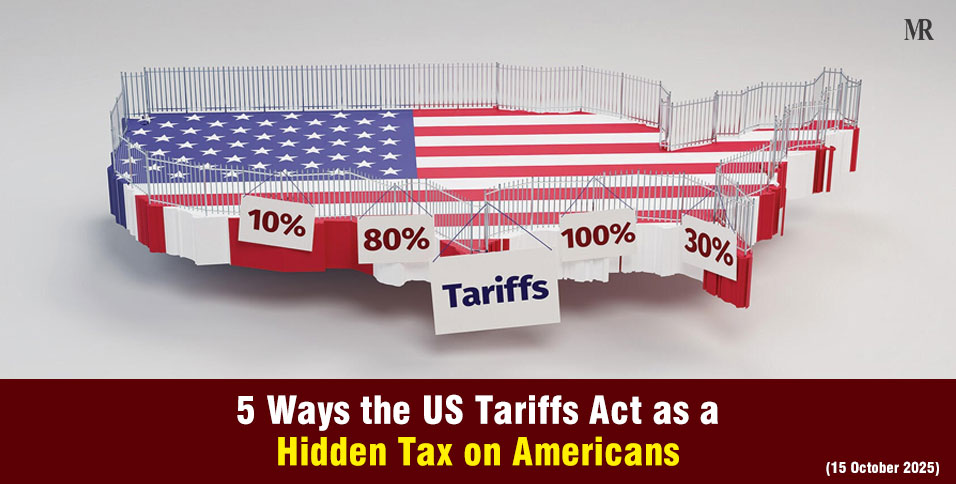
The US Tariffs were meant to protect American jobs and boost local production.
But new data shows they’re quietly acting like a hidden tax on ordinary Americans.
Prices are rising, supply chains are changing, and many families are paying more without realizing why.
Here are five clear ways tariffs are costing Americans money, even when they don’t see it on their tax bill.
1. Tariffs collect government money — just like taxes
Every time an imported product enters the US, a tariff adds to its cost. That extra money goes straight to the government, similar to a sales tax.
According to federal customs data, tariff revenue in 2025 has jumped to one of the highest levels in decades.
The US government now earns billions of dollars monthly from import duties. This is all paid by importers who pass most of those costs down the line.
So even if you don’t write a check to the IRS for tariffs, you’re still paying them every time you buy something imported.
2. The cost gets passed down to consumers
Recent research from Goldman Sachs shows that by the end of 2025, US consumers will bear about 55% of all tariff costs. That’s up sharply from earlier this year, when most of the pain was felt by businesses.
Prices for imported goods like electronics, appliances, and furniture have increased by around 4%, while domestic goods saw smaller increases, about 2%.
The average effective tariff rate has jumped from ~2.5% to 15–20%, meaning shoppers feel the pinch every time they buy imported items.
In other words, the US tariffs are invisible price hikes. You don’t see them on the receipt, but you pay them at checkout.
3. Tariffs fuel inflation and shrink spending power
Tariffs make imported goods more expensive. Those higher costs ripple through the economy and add pressure to overall inflation.
Analysts estimate that tariffs could add up to 0.75 percentage points to core inflation this year. That means higher grocery bills, rising energy prices, and more expensive everyday products.
The result? Americans’ purchasing power drops, much like when taxes rise. Even if wages go up, inflation from tariffs often cancels out those gains.
4. Tariffs distort the market and raise business costs
When tariffs hit, businesses try to adapt, often by changing suppliers or moving parts of production back home. But that shift isn’t cheap.
Companies face higher input costs, delivery delays, shortages, and less efficient sourcing, especially in industries like electronics and auto manufacturing.
A recent analysis showed that delivery delays for imported materials rose by 21 days, causing output price increases of roughly 0.4%.
These delays and extra costs distort production decisions, just like taxes can distort business spending. Moreover, the industries most affected include electronics, auto manufacturing, and furniture.
JPMorgan Chase is trying to fill in the gaps by investing in domestic supply chains and advanced manufacturing to offset some of the costs and disruptions caused by tariffs.
5. US Tariffs hit lower-income Americans the hardest
Low-income families spend a larger share of their income on goods, not services. That means they feel tariff-driven price hikes first and most painfully.
When furniture, clothes, or kitchen appliances rise in price, those increases act like a regressive tax, hitting people who have less flexibility in their budgets.
Surveys show more than 50% of U.S. firms plan to raise prices to cover tariffs.
Meanwhile, studies last year estimated Americans lose up to $78 billion in annual spending power under some tariff schemes.
In effect, tariffs act as a regressive hidden tax, squeezing those who can least afford it.
The takeaway: US Tariffs are taxes by another name
Whether you call them tariffs, duties, or trade fees, the outcome is the same — Americans pay more.
These policies might aim to protect domestic industries, but in the short term, US Tariffs act as a hidden tax on the broader economy, consumers, and small businesses.
As Michael Pearce, Deputy Chief U.S. Economist at Oxford Economics, noted that “the burden of tariffs on the economy is creeping up. And the biggest impact (on consumers) is still to come.”
As costs rise and purchasing power shrinks, the question remains: how long can Americans afford this invisible tax?