Mirror Review
November 10, 2025
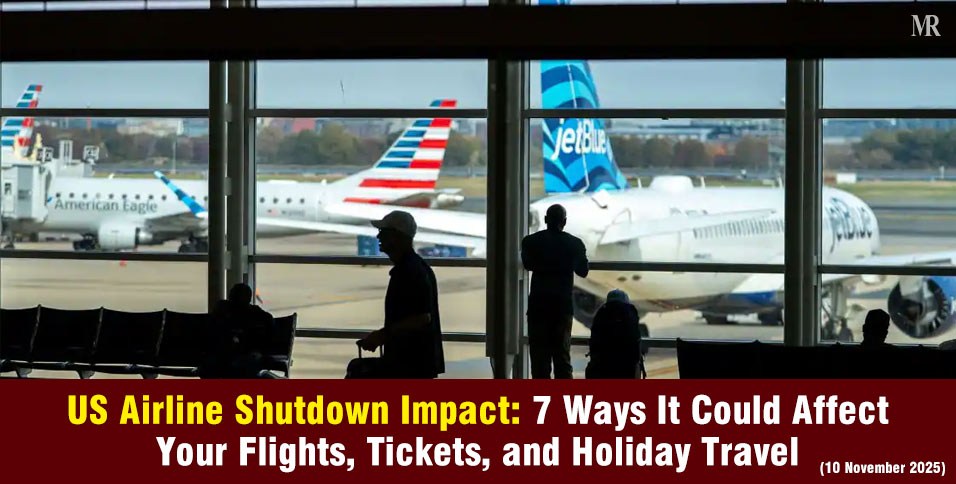
The ongoing 2025 United States federal government shutdown has triggered emergency action by the Federal Aviation Administration (FAA).
With air-traffic controllers and TSA staff working without pay, the FAA has ordered airlines to reduce domestic flights at 40 major airports, beginning with a 4% cut and targeting up to 10% (and possibly more) if the shutdown drags on.
FAA Administrator Michael Whitaker said the agency had “no choice but to reduce flight volumes to maintain safety because staffing levels cannot support normal traffic.”
For passengers and holiday-travel planners alike, the US airline shutdown impacts mean disruption beyond typical delays, and the ripple effects are real.
How the US Government Shutdown 2025 Is Disrupting Airlines
- The shutdown in the US has forced roughly 13,000 air-traffic controllers and 50,000 TSA officers to work unpaid.
- Furthermore, absenteeism is growing, with hundreds of controllers absent at some high-traffic airports.
- The FAA says the cuts are a safety measure responding to “stress points” in the system.
In short, US airline shutdown conditions = staffing gap = FAA capacity cuts = direct impact on flights.
7 Ways the US Airline Shutdown Is Affecting Flights and Passengers
1. More cancellations and delays across major airlines
The first and most visible impact is a sharp rise in cancelled and delayed flights.
The FAA has restricted capacity at 40 major airports, which include New York, Chicago, Atlanta, San Francisco, Dallas, and Denver. Airlines must reduce their schedules in order to fit inside the limited airspace capacity.
Federal Aviation Administrator Bryan Bedford said, “We are seeing signs of stress in the system, so we are proactively reducing the number of flights to make sure the American people continue to fly safely”.
Here is what happened in the last 72 hours alone:
- American Airlines cancelled about 220 flights a day as the cuts began. At one point, around 12000 American Airlines passengers were affected in a single day.
- United Airlines cancelled about 184 flights on Friday and continued reductions through the weekend.
- Southwest Airlines cancelled around 120 flights on Friday as part of the required cuts.
- Delta Air Lines confirmed that it is reducing flights at all affected airports to follow the FAA order.
Delta CEO Ed Bastian warned that “the strain on the aviation system is significant, and these cuts are not something carriers can simply absorb without affecting passengers.”
On the worst day so far, more than 2800 flights were cancelled and over 10000 were delayed across the United States. This is one of the largest single-day disruptions seen outside of a major weather event.
How this affects you:
Even if your flight is booked and confirmed, it can still be rescheduled or cancelled because the airline is required to comply with the FAA cuts. Midday and evening flights are more vulnerable because they depend on earlier flights arriving on time.
2. Lower reliability even for flights that still operate
Airlines normally build buffer time into their schedules. Those buffers allow the system to absorb small delays, such as late baggage loading or a slow boarding process.
- During the US airline shutdown, those buffers are disappearing because the reduced number of flights means there are fewer options to adjust aircraft and crew.
- At some airports, the average delay reached 45 to 52 minutes. A single delay early in the morning can affect multiple flights for the rest of the day.
How this affects you:
It becomes much harder to rely on tight connections. If you have a domestic to international connection, you should consider adding more buffer time than usual.
3. Reduced service on smaller and regional routes
When airlines face forced cuts, they preserve their most profitable and most essential flights first.
High-demand connections such as New York to Los Angeles or Atlanta to Chicago usually remain. But smaller routes are the first to suffer cuts.
This is already happening:
- Airlines are replacing some regional flights with fewer frequencies.
- Some cities that normally have three to six flights a day may temporarily drop to one or two.
- Airlines are retiring some aircraft rotations to free up crew for busier hubs.
How this affects you:
If you live in or are traveling to a smaller city, your route is more likely to be cancelled or merged with another departure. You might be rebooked on a completely different time or airport.
4. Refunds, rebooking, and ticket prices are becoming harder to manage
Under U.S. Department of Transportation rules, travelers must receive a full refund if the airline cancels the flight.
Airlines are following this rule. However, the remaining seats on other flights are limited because schedules are being cut.
As a result of this imbalance, prices on alternative options may rise.
How this affects you:
You will get your refund if your flight is cancelled, but you may need to pay more for a new ticket on a different flight or a different airline. Hotels and additional travel costs might not be covered because the airline was not at fault.
5. Higher holiday travel disruption as demand peaks
The shutdown is happening just before Thanksgiving and Christmas, which are the busiest weeks of the year in the United States.
It is during this period that the aviation system operates at near full capacity. When capacity is already reduced, the system has very little flexibility left.
How this affects you:
Expect longer waiting times at airports because TSA staffing is also affected. Aim to arrive earlier than usual. Book flights earlier in the day, which have a higher chance of operating on time.
6. Cargo delays and the UPS crash are increasing system pressure
The UPS Airlines cargo crash in early November has added new pressure on the aviation system. The aircraft involved was an older MD-11 cargo model.
- After the UPS Airlines cargo crash, the FAA started safety inspections for similar aircraft types. These inspections require staff time and regulatory attention.
- Unfortunately, the shutdown in the US has limited staffing, which slows down how fast the FAA can complete these reviews. A senior FAA spokesperson said the crash investigation “has added an unexpected oversight burden at a time when our workforce is already limited because of the shutdown.”
- Moreover, the United States relies heavily on cargo flights for holiday shipping, e-commerce deliveries, and medical supply transport.
- Thus, cargo hubs like Louisville and Memphis are already experiencing delays because of the shutdown and the additional review load after the UPS crash.
How this affects you:
If you are expecting holiday gifts, urgent packages, or planning international travel with checked goods, you may face delays. Cargo disruption also affects passenger airlines because many of them carry mail and packages in the lower deck of their aircraft. When cargo routes slow down, there is an indirect effect on passenger schedules.
7. A slow recovery even when the shutdown ends
Even if Congress ends the shutdown quickly, the airline system will not return to normal instantly.
- Air traffic controllers need time to return to full staffing levels.
- Crews need new schedules.
- Aircraft must be repositioned.
- Cargo operations must clear backlogs.
- Safety inspections related to the UPS crash must be completed.
How this affects you:
You may still see delays and reduced frequencies several days or even weeks after the shutdown ends. Plan with a backup option in mind.
Why is the US aviation network becoming less flexible?
Most reports talk only about flight numbers, but the deeper issue is the loss of flexibility inside the U.S. aviation network.
The system normally depends on spare capacity across crews, aircraft, and controllers. But the ongoing longest US government shutdown has removed those safety cushions.
Every part of the network is stretched at the same time.
Furthermore, the UPS cargo crash created more work for regulators at the worst possible moment.
As a result, the system cannot handle even normal levels of demand.
This is why you are seeing delays that continue through the entire day and cancellations that happen without major weather events.
Conclusion
The US airline shutdown impacts are more than a political story. It is now a nationwide travel problem that affects passengers, airlines, cargo companies, and the broader holiday season.
With flight cuts, staff shortages, airline-specific cancellations, and added complications after the UPS crash, the entire system is under strain.
Travelers should assume delays, expect sudden schedule changes, and plan extra time for all essential journeys.