Mirror Review
February 12, 2026
Rivian is an American electric vehicle manufacturer best known for its premium R1 trucks and vans. But its latest earnings show the real growth story is happening in software.
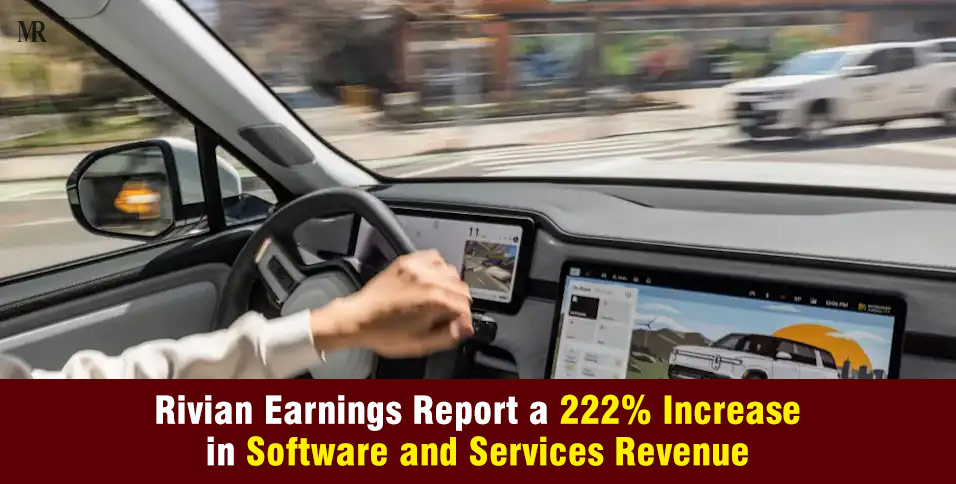
The Rivian earnings report a 222% year-over-year increase in software and services revenue, marking one of the most significant strategic shifts in the company’s business model.
Software Is Now Rivian’s Fastest-Growing Business
For the full-year 2025, Rivian generated $1.557 billion in software and services revenue, up from $484 million the previous year, which is a staggering 222% increase.
The surge was primarily driven by:
- Expanded vehicle electrical architecture and software development services from Rivian’s joint venture with Volkswagen Group
- Increased remarketing (vehicle trade-in) activity
- Growth in vehicle repair and maintenance services
Rivian
For Rivian Q4 2025 earnings alone, software and services revenue reached $447 million, up 109% year over year.
For a company once viewed strictly as an EV startup, that shift is critical
The Profitability Breakthrough Is Coming From Software
The Rivian earnings show that software and services generated $576 million in gross profit for full-year 2025, compared to just $7 million in 2024.
While automotive operations still posted a gross loss, software became the clear profit engine inside the company.
In Q1 2025 alone, gross profit reached $206 million amid tariffs, and again was at $206 million in Q2, fell to $24 million Q3, and again rose to $120 million in Q4.
Furthermore, Rivian reported $144 million in consolidated gross profit for 2025, a more than $1.3 billion improvement from the prior year, with software playing a major role.
This matters because software revenue is:
- Higher margin
- More scalable
- Less dependent on volatile regulatory credits
- Potentially recurring
That’s a very different financial profile than vehicle manufacturing alone.
Why the Volkswagen Joint Venture Is Key
A major driver behind the 222% surge was Rivian’s vehicle electrical architecture and software development services tied to its joint venture with Volkswagen Group.
This partnership validates Rivian’s technology stack beyond its own vehicles. Instead of just selling trucks and SUVs, Rivian is monetizing:
- Its proprietary electrical architecture
- Its in-house autonomy and AI systems
- Its vertically integrated software platform
That positions Rivian less like a traditional automaker and more like a mobility technology company.
A Shift Beyond Hardware
Rivian earnings also highlight heavy investment in autonomy and AI, including:
- Its proprietary RAP1 autonomy processor
- A next-generation Rivian Assistant
- A vertically integrated AI platform
These innovations aren’t just product features. They are long-term software monetization opportunities.
As Rivian expands its vehicle base and prepares for the R2 launch in 2026, each new vehicle becomes a potential node in its software ecosystem. More vehicles on the road mean more data, more services, and more recurring revenue potential.
That’s how software scales.
The Bigger Picture Behind Rivian Earnings
The real story behind the Rivian Earnings 2025 is what it signals:
- Rivian is diversifying revenue beyond vehicle sales.
- High-margin software is offsetting automotive volatility.
- Strategic partnerships are validating its technology.
- Gross profit has swung dramatically year over year.
For investors, Rivian earnings now hinge less on delivery counts and more on how fast its software ecosystem expands.
The company may still be known for its electric trucks but based on 2025 results, its future growth engine is increasingly digital.
And if software continues compounding at triple-digit rates, Rivian’s long-term valuation story could look very different from the one investors saw just a year ago.
Maria Isabel Rodrigues