Mirror Review
September 15, 2025
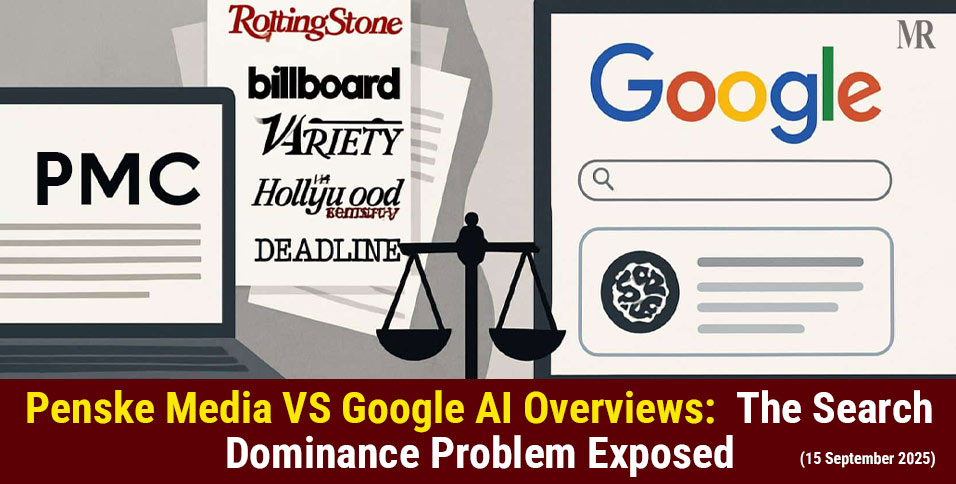
Penske Media, the owner of Rolling Stone, Variety, and Billboard, has filed a federal lawsuit against Google.
The charge: its “AI Overviews” repackage journalism, strip traffic, and cut into revenue.
This is the first time a major U.S. publisher has sued over Google’s AI summaries.
It marks a turning point in how content owners think about the web’s foundational bargain: links for visibility.
The Numbers Behind the Penske Vs Google Case
AI overviews are summaries that can satisfy a reader without a click.
- Penske Media says its sites attract 120 million visitors per month.
- Around 20% of Google searches that link to its sites now show AI Overviews.
- Affiliate revenue has dropped by more than a third from its peak — a decline blamed on fewer referrals.
Those numbers are the advantage behind the lawsuit.
Why This Goes Beyond One Publisher
This isn’t just about one publisher defending revenue. It’s a system problem.
For two decades, publishers traded content for discovery: let Google index your pages, and it will send readers (and ad dollars).
AI Overviews broke that deal. By giving direct answers sourced from publishers’ reporting, Google cut off the return flow of traffic.
A Short History of AI Overviews
- Google launched AI Overviews in 2024
- Soon after, it began adding ads into those summaries.
- Publishers and trade groups warned of traffic losses.
- The EU and independent publishers filed complaints.
- Authors, media companies, and creators launched lawsuits against AI firms for training on their work.
- Some publishers signed licensing deals instead, as seen with the OpenAI and Anthropic authors’ case.
It shows two paths publishers are taking to adapt to AI Overviews: litigation and licensing.
History Repeats With Higher Stakes
Google has followed this playbook before.
- It sidelined Yellow Pages with Google Maps.
- It cut into travel agencies with Flights and Hotels.
- It undercut price comparison sites with Shopping results.
Each time, Google absorbed an industry’s value by surfacing answers directly in search.
But journalism is different.
The ecosystem that fuels AI Overviews isn’t optional. It’s the foundation of credible information online.
That’s why this case feels less like a dispute and more like an inflection point.
The hidden leverage Penske brings
Penske Media isn’t just about magazines. It owns:
- Editorial brands (Rolling Stone, Variety, Billboard, THR).
- Events and awards (Dick Clark Productions).
- Data products (Luminate, which tracks music, streaming, and film).
This portfolio gives Penske an edge:
- It can show measurable financial harm across traffic, ads, and affiliates.
- It can propose alternative models like data licensing or event partnerships, proving it doesn’t rely solely on clicks.
Google’s Likely Defense
Google says AI Overviews help users and increase overall discovery. That defense has two lines:
- User benefit (faster answers)
- Distribution (Google sends billions of clicks daily).
But the core legal friction is leverage.
Publishers argue they’re forced to accept their work being reused in Overviews and AI Chatbots if they want to appear in search at all.
If courts see that as coercion or copyright misuse, Google could face damages, licensing requirements, or UI changes designed to push readers back to publishers.
The Google AI Overview Problem Exposed
Google built a near-monopoly by organizing links.
But the product that extended its control of answering questions for users now consumes the link economy itself.
That’s a structural contradiction: the same behavioral shift that made Google indispensable (instant answers) is what makes it the culprit.
Competitors and smaller publishers are watching and learning.
Some platforms license content from publishers proactively, while others delay and risk the legal and PR fallout.
In short: dominance breeds exposure when the business model flips.
The Advertiser Issues Nobody’s Talking About
This fight isn’t limited to publishers.
Advertisers, who rely on high-intent clicks from Google search, are also exposed.
If AI Overviews satisfy a user without a click, then both the publisher and the advertiser lose visibility.
For example, an e-commerce brand that once paid for placement next to a Rolling Stone product review now risks being bypassed if Google’s summary delivers the recommendation directly.
That weakens the broader digital ad ecosystem, where every skipped click reduces competition for ad slots.
In other words, the search dominance problem isn’t just about medi. It disrupts how brands, retailers, and entire industries connect with customers.
Why this is a What to Watch Next
- Licensing frameworks: Expect collective deals or standardized payments for publishers.
- Regulatory filings: More lawsuits and complaints, both in the U.S. and abroad.
- Product tweaks: Google may add clearer sourcing, paywalls, or click-through incentives, or double down and fight.
Bottom line
The Penske Media lawsuit against Google isn’t just about lost traffic.
It’s a market signal: publishers will no longer accept a system where their work fuels AI products without terms.
Whether this ends in deals, regulations, or a precedent-setting ruling, one thing is clear: the value of journalism in the AI era is about to be rewritten.