Mirror Review
October 03, 2025
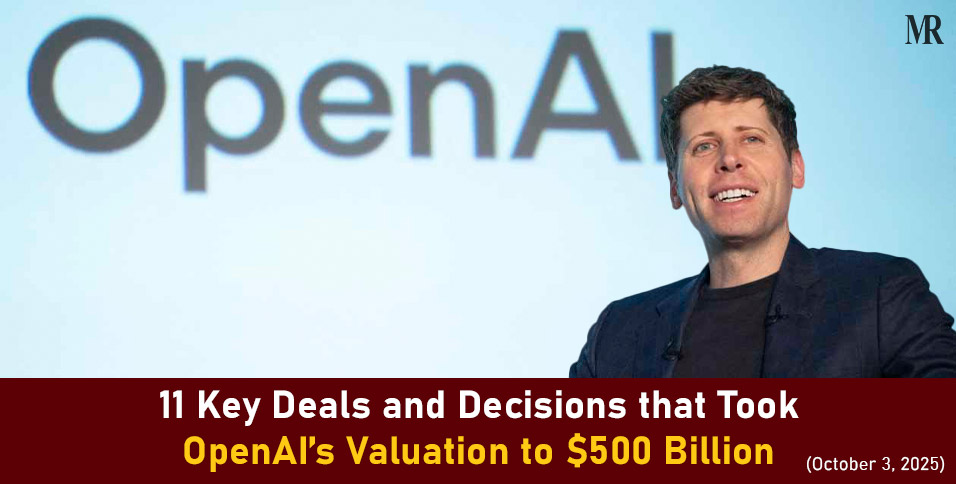
OpenAI reaches $500 billion valuation on October 2, 2025, after completing a secondary share sale worth $6.6 billion.
The sale allowed current and former employees to cash out equity and set the company’s official market value.
This milestone makes OpenAI the most valuable private company in the world, overtaking SpaceX.
OpenAI’s jump to $500 billion shows investor confidence in its leadership, technology, and ability to secure long-term resources.
From early strategic deals with Microsoft to the massive Stargate infrastructure project, every move built the financial and technical foundation needed for dominance in artificial intelligence.
The following 11 key deals and decisions explain how OpenAI’s valuation reached $500B and how it has positioned itself as the pillar of the AI economy.
1. The Foundational Deals: 2019–2023
These moves transformed OpenAI from a non-profit research lab into a market-dominant, capped-profit entity, making it investable.
| Date | Type of Deal | Partner(s) | Impact on Valuation (The ‘Why’) |
| July 2019 | Business Model Shift & Investment | Microsoft | Secures Cloud Infrastructure and $1 Billion.OpenAI shifts to a “capped-profit” model to attract capital and talent. Microsoft’s initial $1 billion investment makes Azure the exclusive cloud provider for training and deployment, solving the immense computing resource problem. |
| Nov 2022 | Product Launch | N/A | The Consumer Flywheel.The launch of ChatGPT, based on GPT-3.5, went viral, becoming the fastest-growing consumer application in history. This massive user base provided an invaluable, real-world data loop (Reinforcement Learning from Human Feedback – RLHF), making their models superior to competitors. |
| Jan 2023 | Strategic Investment | Microsoft | The $10 Billion Anchor.Microsoft extends its partnership with a multi-year, $10 billion investment at an estimated $29 billion valuation. This deal solidifies the Azure exclusivity and gives Microsoft a reported 49% stake in the for-profit subsidiary, providing long-term financial security. |
| March 2023 | Product Launch | N/A | Validates Technical Lead.The release of GPT-4 further cemented OpenAI’s lead, showcasing enhanced reasoning and reliability. Its capabilities fueled enterprise demand for the Azure OpenAI Service. |
2. The Hyper-Growth and Infrastructure Deals: 2024–2025
These deals focused on data acquisition, talent, and, most critically, building the physical infrastructure required to reach Artificial General Intelligence (AGI).
| Date (Approx.) | Type of Deal | Partner(s) | Impact on Valuation (The ‘Why’) |
| Early 2024 | Content Licensing Deals | Axel Springer, Financial Times, News Corp, and others | Secures High-Quality Training Data.Multi-million-dollar deals provide access to vast, verified journalistic archives. This is a defensive move to ensure future models are trained on credible, premium content, directly addressing “hallucinations” and intellectual property concerns. |
| March 2025 | Major Funding Round | SoftBank, Microsoft, and others | The Jump to $300 Billion.SoftBank leads a massive $40 billion Series F funding round, the largest private tech funding round in history, vaulting the valuation to $300 billion. This capital enables the immediate acceleration of infrastructure projects. |
| Jan 2025 | AI Infrastructure JV Launch | SoftBank, Oracle, MGX | Announcing Stargate ($500B commitment).OpenAI announces the Stargate Project, a commitment to invest up to $500 billion in building 10GW of AI supercomputing capacity in the U.S. This shift from simple cloud usage to building its own national-scale AI infrastructure is the ultimate signal of future dominance. |
| July 2025 | Stargate Implementation | Oracle | Securing Cloud Capacity and Energy.Oracle commits to developing up to 4.5 gigawatts of Stargate capacity, a $300 billion investment over five years, confirming the massive scale of the planned build-out. |
| Sept 2025 | AI Hardware Supply | NVIDIA | Locking Down the GPU Supply Chain.A letter of intent for a strategic partnership to deploy at least 10 gigawatts of NVIDIA systems (millions of GPUs). NVIDIA plans to invest up to $100 billion in OpenAI as the infrastructure is deployed, directly funding the company’s core technological need. |
| Oct 1, 2025 | Global Supply Chain | Samsung, SK Hynix | Secures Advanced Chip Supply.Partnerships with the world’s largest memory chipmakers commit them to accelerating production of crucial, advanced memory chips for the Stargate initiative, proactively locking up a vital component of the future AI supply chain. |
| Oct 2, 2025 | Secondary Share Sale | Thrive Capital, SoftBank, MGX | Achieving $500 Billion Valuation.A secondary share sale of $6.6 billion allows current and former employees to sell stock, formally establishing the $500 billion valuation. This move provides liquidity and is a crucial tool for retaining top talent against rival offers. |
Other Decisions that Built OpenAI’s $500 Billion Valuation
1. Product Superiority and Pace of Innovation
OpenAI’s valuation is also tied to its unmatched pace in releasing advanced models. Each release of ChatGPT, GPT-4, GPT-4o, gpt-oss, and now GPT-5 has expanded the company’s technical edge and real-world demand.
GPT-5 adds expert-level reasoning and multimodal abilities, moving beyond simple generation to functioning as a cognitive assistant.
This steady cycle of product improvements reassures investors that OpenAI is not standing still while competitors chase the market.
2. Retention of Key Talent
The secondary share sale that locked in the $500 billion OpenAI’s valuation also served a second purpose: rewarding and retaining employees.
This is a vital strategic move in the fierce war for top AI talent.
Rival tech companies, such as Meta, have been aggressively poaching elite researchers, often offering compensation packages that reach nine-digit figures.
By allowing employees to cash out some of their equity at such a high valuation, OpenAI effectively incentivizes its key researchers and engineers to stay, ensuring the firm retains the human capital necessary to keep innovating ahead of the competition.
3. Long-Term Market Vision
CEO Sam Altman and the leadership team have consistently emphasized AI’s role in reshaping global industries.
Despite ongoing concerns about an “AI bubble,” CEO Sam Altman has consistently projected confidence in the foundational nature of the technology.
Addressing market volatility, Altman remarked, “Between the ten years we’ve already been operating and the many decades ahead of us, there will be booms and busts… we are confident that this technology will drive a new wave of unprecedented economic growth.”
Conclusion
OpenAI’s valuation rising to $500 billion marks a turning point in the history of private technology companies.
The company is no longer just a pioneer in AI research—it is now a central force shaping the future economy.
Investors, employees, and competitors will measure the next phase of artificial intelligence against the scale OpenAI has set.