February 18, 2026
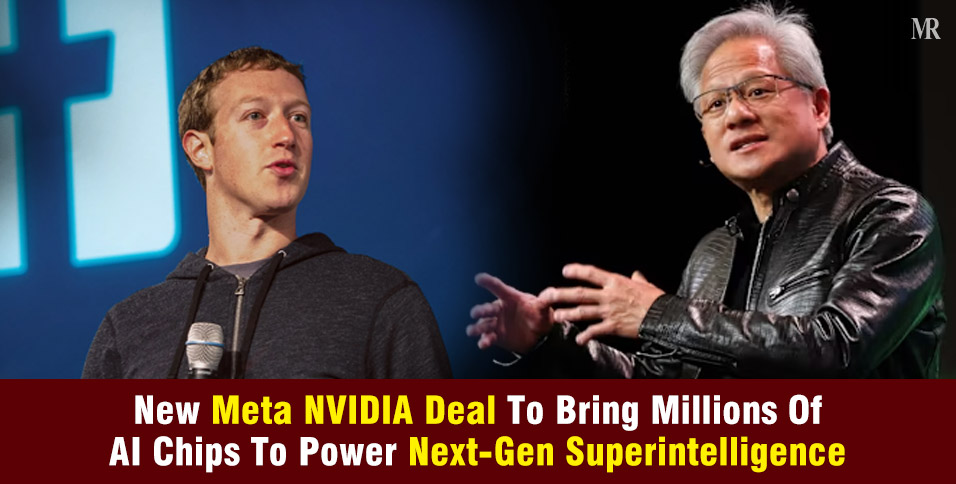
Meta, the social media titan known for connecting billions, and NVIDIA, the world leader in AI and accelerated computing, announced a multiyear, multigenerational strategic partnership.
This Meta NVIDIA Deal is a massive bet on the future of Personal Superintelligence.
By securing a pipeline for millions of current and future NVIDIA processors, including the highly anticipated Vera Rubin platform, Meta is positioning itself to own the hardware backbone required for the next frontier of AI.
The Meta NVIDIA Deal Involves “Millions” of NVIDIA Chips
At the heart of the new Meta NVIDIA chip deal is a staggering volume of hardware.
Meta has committed to the large-scale deployment of millions of NVIDIA GPUs, spanning the current Blackwell architecture and the upcoming Rubin generation.
Historically, Meta has been one of NVIDIA’s most voracious customers, but for the first time, Meta will also become a pioneer in deploying NVIDIA Grace CPUs as standalone chips at scale.
While the industry has long viewed CPUs as the “brain” and GPUs as the “muscle,” NVIDIA’s Grace (and the future Vera) chips are designed to work in a unified architecture.
For Meta, this means its data centers, like the massive 1-gigawatt “Prometheus” site in Ohio and the 5-gigawatt “Hyperion” facility in Louisiana, will be optimized for both training massive frontier models and the high-efficiency “inference” needed to serve those models to billions of users instantly.
Why Meta Partners With NVIDIA Now?
Mark Zuckerberg describes the goal of this new Meta NVIDIA partnership as delivering “personal superintelligence” to everyone.
| Feature | Strategic Impact |
| Vera Rubin GPUs | Powering “Avocado,” the successor to Llama 4, with 10x lower token costs. |
| Grace & Vera CPUs | Delivering massive performance-per-watt gains for backend database tasks. |
| Spectrum-X Ethernet | Creating a “unified fabric” that allows thousands of chips to act as one computer. |
| Confidential Computing | Ensuring AI features in WhatsApp remain private and end-to-end encrypted. |
Today, the “primary computing device” is shifting toward AI-integrated wearables, like smart glasses. To make those glasses “smart” enough to understand your world in real-time, Meta needs a backend that can process trillions of data points with near-zero latency.
NVIDIA’s x86 Dominance
One of the most fascinating “logical probabilities” arising from this new NVIDIA and Meta deal is the threat to traditional chip makers like Intel and AMD.
By choosing NVIDIA’s Arm-based Grace and Vera CPUs for its general-purpose server needs, Meta is signaling that the era of x86 dominance in the data center may be nearing its end.
If NVIDIA can prove, through Meta’s massive scale, that its CPUs are more energy-efficient and faster for AI-heavy workloads, other hyperscalers may follow suit.
This deal effectively transforms NVIDIA from a “GPU company” into a full-stack infrastructure provider that owns the network, the processor, and the accelerator.
Privacy at Scale: The WhatsApp Factor
A critical, though often overlooked, part of this Meta NVIDIA deal announcement is the adoption of NVIDIA Confidential Computing for WhatsApp.
As AI agents begin to handle more sensitive user data, the “trust gap” becomes a significant hurdle.
By using hardware-level security to isolate private data during AI processing, Meta is attempting to solve a logical paradox:
How to provide highly personalized AI without sacrificing the end-to-end encryption that defines WhatsApp.
Meta’s $600 Billion Roadmap
The sheer scale of Meta’s commitment is difficult to overstate.
Meta has pledged to invest $600 billion in U.S. infrastructure by 2028. This partnership with NVIDIA ensures that as Meta builds these “AI super-factories,” they are equipped with the most advanced silicon available.
Critics might argue that Meta is over-indexing on third-party hardware while its own internal chip program (MTIA) matures.
However, the logic is clear: in the race for superintelligence, being “fast” is more important than being “vertical.”
By locking in millions of Rubin GPUs for 2027, Meta has effectively bought itself a front-row seat to the future, while its competitors are still waiting in line for Blackwell.
Looking Ahead
The Meta-NVIDIA chip deal is a clear indication that the “AI boom” has transitioned from a period of experimentation to a period of industrial-scale build-out.
As Meta builds AI Infrastructure with NVIDIA, we are no longer just talking about chatbots; we are now talking about the physical infrastructure of global intelligence.
Maria Isabel Rodrigues