Mirror Review
February 19, 2026
Microsoft, the global technology leader known for its Windows operating system and cloud services, is currently reinventing how the world stores information by turning to one of the oldest materials known to man: glass.
This breakthrough, known as Microsoft Project Silica, aims to solve the growing global data crisis.
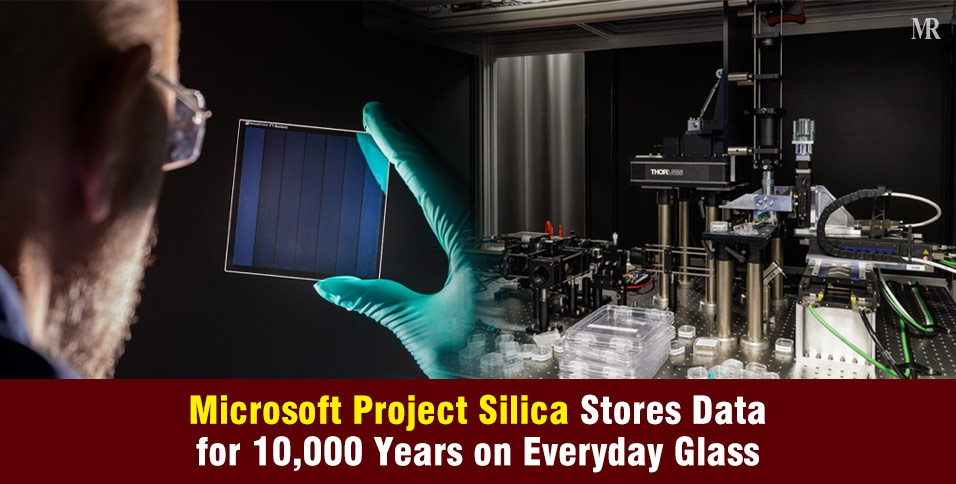
By using ultrafast lasers to etch data into quartz glass, the company has created a storage solution that can last for 10,000 years without degrading.
For decades, we have relied on hard drives and magnetic tapes to store our digital lives. However, these devices often fail after five to ten years.
This “digital dark age” threatens our historical records and personal memories.
Microsoft’s new glass storage technology offers a permanent fix, ensuring that today’s data remains readable for future civilizations.
How Laser Writing in Glass Works
The process behind Microsoft Glass storage is both complex and elegant. It does not use magnetic fields or ink. Instead, it relies on a process called femtosecond laser writing.
Here is a simple breakdown of how the technology functions:
- Voxel Creation: A high-speed laser creates tiny three-dimensional pixels, called voxels, inside a platter of quartz glass.
- Multilayered Storage: Unlike a DVD that only stores data on the surface, these lasers write in hundreds of layers throughout the thickness of the glass.
- Polarization: The laser changes the physical structure of the glass. It encodes data based on the orientation and size of these microscopic changes.
- AI Reading: To retrieve the data, a computer-controlled microscope shines polarized light through the glass. Artificial intelligence then decodes the patterns back into digital files.
This laser-etched glass storage method is incredibly dense. A small piece of glass, roughly the size of a drink coaster, can hold several terabytes of data.
Why Microsoft Project Silica Outperforms Traditional Media
The biggest data centers consume massive amounts of energy because hard drives need constant cooling and replacement. Microsoft Project Silica changes the economics of the cloud.
Glass is a “passive” storage medium, meaning it requires zero energy to maintain the data once it is written.
| Feature | Hard Drives/Tape | Project Silica Glass |
| Lifespan | 5 to 10 Years | 10,000+ Years |
| Durability | Sensitive to heat/magnets | Resists heat, water, and EMP |
| Maintenance | Requires “data scrubbing” | Zero maintenance needed |
| Sustainability | High electronic waste | Fully recyclable and durable |
Richard Black, a Research Director at Microsoft, noted the importance of this shift. He stated, “The goal is to move away from the cycle of constantly copying data from one generation of media to the next. We want a ‘write it and forget it’ solution for the world’s archives.”
Breaking Down Project Silica Storage Capacity and Costs
The Project Silica storage capacity is designed for “cold data,” which is information that is vital but not accessed every second, such as medical records, historical archives, and legal documents.
While a single glass pane can currently hold massive amounts of data, Microsoft is working to scale this to petabytes.
Regarding the Microsoft Glass storage price, the technology is currently in the experimental and industrial phase. It is not yet a consumer product you can buy for a home PC.
However, for large-scale data centers like Azure, the long-term cost is significantly lower than traditional methods.
Because glass does not need air conditioning or frequent replacement, the total cost of ownership over a century is a fraction of current costs.
Extreme Durability: The Hardest Test for Glass
One might worry that glass is fragile, but glass data storage technology uses high-purity quartz glass. Microsoft has put these glass samples through rigorous “torture tests” to prove their resilience.
- Heat Resistance: The glass was baked in ovens at high temperatures without losing data.
- Water Damage: It can be submerged in boiling water for hours.
- Physical Stress: It has been scoured with steel wool and microwaved.
- Magnetic Interference: Unlike hard drives, magnets cannot wipe the data stored in glass.
Scientists recently published findings in the journal Nature, highlighting that this method is the most stable way to preserve human knowledge against environmental disasters or solar flares.
The Future of Global Archives
Microsoft is already collaborating with organizations like Elire Group to use this technology for the “Global Music Vault” in Svalbard. This ensures that the world’s musical heritage is safe from any global catastrophe.
As we produce more data than ever before, the world needs a sustainable way to keep it.
By perfecting laser writing in glass, Microsoft is moving toward a future where our digital footprint is etched in stone, or rather, in crystal.
End Note
The development of Microsoft Project Silica represents a monumental shift in how we think about time and technology.
We are moving from a world of temporary gadgets to a world of permanent preservation.
By leveraging the stability of quartz and the precision of lasers, Microsoft has created a bridge to the distant future.
Maria Isabel Rodrigues