Mirror Review
October 27, 2025
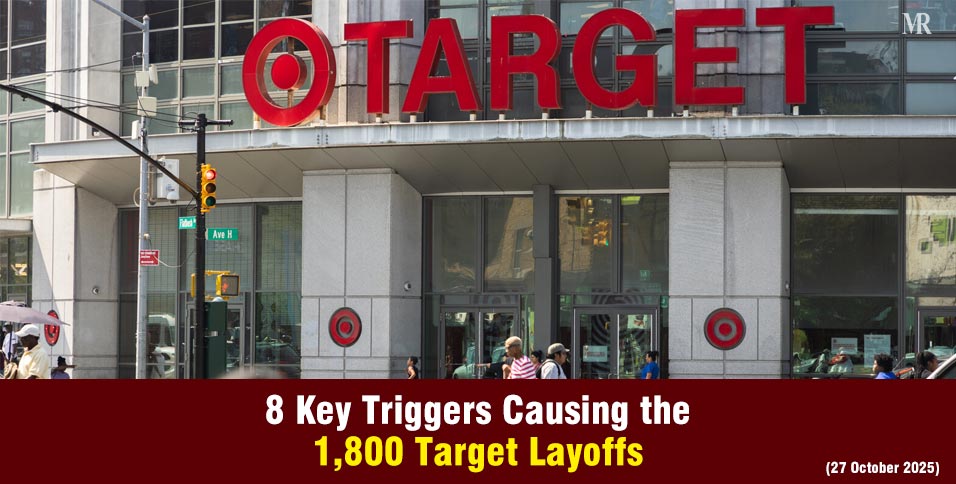
In its first major job cuts in nearly ten years, Target Corporation announced plans to eliminate around 1,800 corporate roles, including about 1,000 active positions and 800 vacant ones.
The Target layoffs mainly affect corporate employees at its Minneapolis headquarters and other offices, not store or warehouse staff.
Furthermore, the company said the restructuring is part of a broader turnaround plan to “simplify operations, reduce complexity, and accelerate decision-making.”
Target’s Chief Operating Officer, and incoming CEO, Michael Fiddelke explained: “We’ve become too complex and layered over time. These changes will help us move faster, focus our resources, and deliver more value for guests and shareholders.”
Target’s decision follows sluggish sales, falling store traffic, and growing competition from Walmart, Amazon, and Dollar General.
Let’s look deeper at the eight failures that led to this point and what Target needs to fix to regain its footing.
1. Heavy Reliance on Discretionary Products
Target’s sales are built around non-essential goods like clothing, décor, and electronics rather than everyday essentials.
As inflation and high interest rates squeezed household budgets, shoppers cut back on these discretionary items.
Walmart and Costco, by contrast, saw steadier sales because of their focus on groceries and necessities. Target’s product mix simply didn’t match the consumer mood of 2024–2025.
2. Falling Sales and Weak Store Traffic
Target has now logged nearly three straight years of flat or declining comparable sales. Store visits have slowed, and its digital growth has stalled after the pandemic boom.
Weak traffic means less revenue to cover the company’s high fixed costs, which is often the tipping point for corporate downsizing.
In short, Target’s top line failed to grow, while its internal costs kept rising.
3. Slow Decision-Making and Organizational Overlap
According to CEO-elect Michael Fiddelke, too many management layers made Target “slow to act and hard to navigate.”
This bureaucratic structure meant that routine product and marketing decisions took too long to approve, delaying reactions to market trends.
When a company moves slower than its customers, it loses its edge, and that’s exactly what happened here. Hence, the 1,800 Target layoffs.
4. Leadership Transition and Strategy Reset
Target’s leadership change is happening amid uncertainty. Long-time executive Michael Fiddelke as CEO in February 2026.
While the transition ensures continuity, it also reflects a larger reset.
The incoming leadership must rebuild focus after years of mixed priorities — from trendy home lines to price wars with Walmart.
The layoffs are part of this internal “reset,” but the true test will be whether Fiddelke can translate it into a clearer strategy.
5. Outdated Corporate Structure and High Overheads
Over the years, Target built up a complex corporate system with overlapping teams and duplicated functions across departments.
This inefficiency inflated costs, made collaboration harder, and slowed innovation.
The Target layoffs 2025 are designed to flatten this structure. This move is similar to what Nestlé, Amazon, and Google did in their restructurings.
But slimming down is only effective if Target also changes how decisions are made, not just who makes them.
6. Declining Brand Experience and Store Standards
Target built its reputation on “cheap chic,” offering style at affordable prices. But in recent years, that appeal has faded. Shoppers complained of cluttered aisles and inconsistent product quality.
The brand’s once-premium yet affordable image got blurred, while competitors strengthened theirs.
When customers can no longer see a clear reason to choose Target, loyalty weakens, and that’s been visible in sales trends.
7. Losing Ground to Competitors
Walmart and Amazon have steadily expanded their advantage. Walmart’s grocery dominance attracts repeat traffic, and Amazon’s convenience sets new standards for online shoppers.
Meanwhile, discount chains like Dollar Tree and Aldi captured value-conscious customers.
Target’s position in the middle, not the cheapest and not the most convenient, became its biggest weakness.
It neither differentiated through value nor stood out through experience, leaving it squeezed from both sides.
8. Lagging Technology and Digital Integration
Target made early e-commerce gains during the pandemic, but it has since fallen behind.
While rivals like Walmart improved logistics, personalization, and real-time inventory visibility, Target’s tech systems lagged.
Even the company admitted it needs to “invest in better digital tools and automation” to keep pace.
But in a retail world that increasingly relies on AI and data analytics, this gap is a costly one, both operationally and strategically.
What Target Needs to Do Next
The layoffs are only the first step. To truly turn around, Target must:
- Simplify structure and empower teams to act faster.
- Rebalance its product mix toward essentials that drive steady demand.
- Rebuild store experience and restore brand trust.
- Invest in tech and analytics for inventory accuracy and customer insights.
- Clarify its brand position — whether it wants to compete on design, convenience, or price.
As Fiddelke put it in the restructuring memo: “Our future depends on getting simpler, faster, and more focused. These changes are difficult, but necessary.”
Conclusion: The Real Message Behind the Target Layoffs
The Target Layoffs expose years of strategic drift, structural inefficiency, and brand confusion.
The company’s next chapter depends on how it rebuilds after this reset.
If Target can return to its core promise of style, value, and simplicity, the layoffs may mark a new beginning.
If not, this may go down as the moment America’s favorite “cheap chic” retailer lost its way for good.