Mirror Review
November 17, 2025
Walmart is a familiar part of everyday shopping for millions of Americans. Whether you want to stop by for weekly groceries, order delivery during a busy weekday, or rely on curbside pickup, Walmart is your go-to.
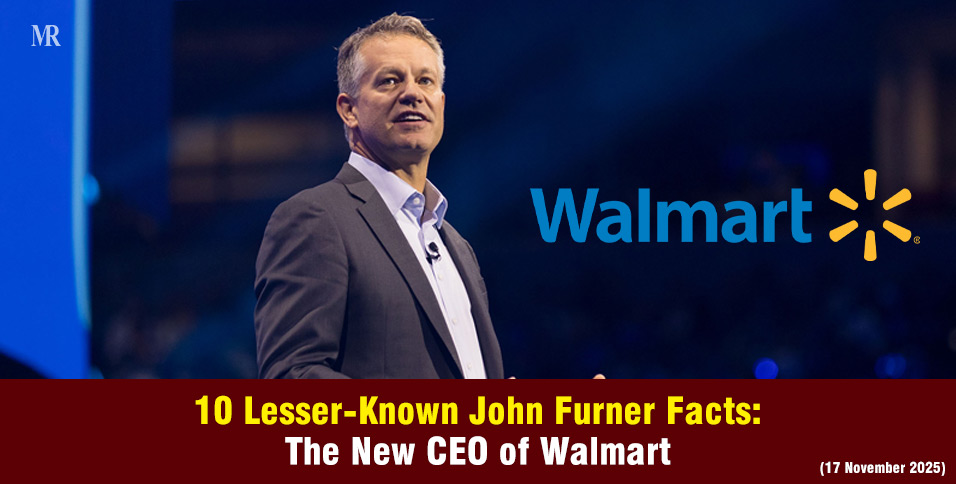
On November 14, 2026, Walmart announced that John Furner will become President and Chief Executive Officer of Walmart Inc., succeeding Doug McMillon, who will retire on January 31, 2026.
Moreover, McMillon will stay on the board until the next shareholders’ meeting and advise until January 2027 to ensure a smooth transition.
This transition marks a major moment in the history of Walmart, because the incoming leader is not an outsider. He is a homegrown leader who started as an hourly worker and spent more than 30 years inside the company.
So who is John Furner?
To understand the CEO of the world’s largest retail store, let’s look at some of the most interesting facts about John Furner.
List of 10 interesting John Furner facts: Walmart’s new CEO and President
1. He began working at Walmart to pay for college, not to build a career
John Furner joined Walmart in 1993 at Store 100 in Bentonville as a garden center associate, earning $4.25 per hour, which was the federal minimum wage at the time.
He took the job for one reason: he needed money for college.
He did not plan on a corporate career, let alone becoming the Walmart chief executive decades later.
This matters because Furner understands hourly jobs on a personal level. Throughout his leadership roles, he has consistently pushed for:
- higher wages
- simpler promotion pathways
- clearer training opportunities
His early experience helps explain why he built Walmart’s most comprehensive frontline wage structures in years.
2. Walmart associates once raised $37,000 for his mother’s cancer care
This emotional story is one of the least-known yet most defining John Furner facts.
When John’s mother faced cancer treatments, Walmart associates raised $37,000 to support the Furner family.
This event shaped his belief in Walmart’s community culture. It also drives why he champions Walmart DEI policies, associate well-being, and large-scale benefits programs.
Furner later said that this support taught him why “people come before processes.”
3. His retail worldview was shaped in China long before global supply chains became a hot topic
John Furner spent two years in Shenzhen as head of merchandising and marketing for Walmart China.
There, he learned:
- rapid inventory cycling
- early-stage retail automation
- fast-response decision making
- localized merchandising strategies
This experience became essential during the COVID-19 pandemic.
While leading Walmart U.S., Furner leaned on China’s early adjustments, especially forecasting models, to keep inventory stable during panic buying.
His global exposure gives him an advantage as the next CEO of Walmart as the company faces geopolitical, supply chain, and regulatory complexity.
4. He closed 63 Sam’s Club stores, and sales went up
When John Furner became CEO of Sam’s Club in 2017, the warehouse chain faced intense competition from Costco.
His solution was bold: close 63 underperforming stores to redirect resources to profitable regions and e-commerce investments.
The result surprised critics.
Sam’s Club recorded 11 consecutive quarters of positive comps, improved membership retention, and built momentum in higher-margin categories.
This shows a CEO unafraid to make tough, data-backed decisions, even if they carry short-term backlash for long-term wins.
5. He turned Walmart Connect into a $4 billion business
Under Furner’s leadership, Walmart Connect expanded from a small retail media network into a $4 billion business.
This reflects Walmart’s strategy of moving beyond retail margins toward high-margin digital revenue streams. In an era where companies like Amazon profit heavily from advertising, Furner’s results signal how Walmart will compete.
His track record suggests that as CEO, he will double down on:
- digital marketplaces
- high-profit advertising
- AI-driven targeting
- brand partnerships
This is one of the clearest indicators of his long-term strategic direction.
6. He reshaped manager pay to create “owner mentality”
Furner pushed through one of Walmart’s most ambitious compensation upgrades:
Store manager pay packages now range from $420,000 to $620,000, including stock grants and performance bonuses.
His reasoning was simple: “We want managers to feel like owners.”
This move did more than increase salaries. It:
- boosted leadership retention
- attracted high-performance managers
- aligned local decisions with company-level goals
- strengthened accountability and innovation on the sales floor
This also ties back to Furner’s roots since he knows the difference great managers make in store culture.
7. He believes AI will grow jobs, not kill them
During the 2024 Brainstorm Tech conference, Furner stated that Walmart’s workforce will stay “steady or slightly larger,” even with increased automation.
This mindset sets a clear direction for Walmart’s AI retail transformation, which includes:
- AI-driven search and chatbots
- Automation in warehouses
- Predictive analytics for inventory
- Computer vision for store operations
His view blends innovation with job stability, aligning with Walmart DEI policies and community expectations.
8. He learned leadership from a Depression-era grandfather
John Furner often cites his grandfather’s hands-on problem-solving spirit. Growing up on a farm taught him:
- responsibility
- hands-on problem solving
- value of early mornings
- the idea that “no task is beneath you”
His grandfather’s habit of building solutions from what he had, rather than buying new tools. This influenced Furner’s low-cost, high-innovation leadership style.
It was proved during the pandemic and tariff uncertainty, when he adapted stores using internal teams and fast on-the-ground decisions instead of large external contracts.
9. He is one of Walmart’s strongest relationship builders
Walmart insiders describe John Furner as collaborative and outward-facing. He values external partnerships, industry conversations, and global expertise.
This matters because the CEO Walmart role requires navigating:
- Regulatory scrutiny
- Global trade tensions
- Investor expectations
- Labor and workforce evolution
Ex-Walmart CEO Doug McMillon endorsed Furner personally, noting, “I’ve worked with John for more than 20 years. His love for our associates and this company runs deep. His curiosity and digital acumen, combined with a deep commitment to our people and culture, will enable him to take us to the next level.”
His ability to build trust may be one of his strongest assets.
10. His long-term vision is a “future-proof Walmart”
Furner’s plans focus on strengthening Walmart through technology and global dominance. Key pillars include:
- a dominant AI-powered retail ecosystem
- faster fulfillment through automation
- Walmart+ as a loyalty powerhouse
- data-driven supply chains
- international expansion with localized strategies
- deeper digital profitability beyond stores
Greg Penner summed up the Board’s view: “John understands every dimension of our business – from the sales floor to global strategy. He has proven that he can deliver results while living our values.”
Furner’s track record indicates he will position Walmart as a tech-powered retail giant where automation and people coexist.
Why the Walmart Leadership Change Matters
To understand why John Furner’s leadership matters, consider the landscape he is stepping into:
- Walmart’s scale: 2.1 million employees, nearly 11,000 stores, $700 billion in global revenue, and a market cap of $817.5B.
- Shift in strategy: From a traditional retailer to a technology-powered ecosystem focused on automation, AI, logistics, and global supply chain optimization.
- The leadership scale: Doug McMillon delivered strong profit growth, digital reinvention, and aggressive tech adoption. Furner now takes on the job of accelerating this transformation.
Doug McMillon added in the corporate press release: “He’s a merchant, an operator, an innovator, and a builder. I know that our future is bright with his leadership.”
What The New CEO Means for Walmart’s Next Era
1. AI becomes the engine of retail operations
Expect AI-powered decision-making to define pricing, in-store efficiency, theft reduction, and fulfillment.
2. Walmart+ strengthens competitive advantage
Membership benefits, partnerships, and digital loyalty will become a bigger competitive moat.
3. A renewed focus on associates
Expect expansions in wages, training, career pathways, and DEI-aligned hiring.
4. Smarter, data-driven global expansion
His China experience will shape how Walmart handles international markets and supply chain shocks.
Conclusion
As Walmart prepares for a historic leadership shift, these facts about Walmart and John Furner reveal a Walmart CEO shaped by experience on the sales floor, lessons from global markets, people-centered values, and a bold approach to technology.
His story captures Walmart’s identity: a mix of community, scale, and constant reinvention.
And as the new CEO of Walmart, John Furner will define how millions shop, work, and connect with the world’s largest retailer.
If the past is any sign, Walmart’s next era will be fast, innovative, and built on simple principles that started back in Store 100.