Mirror Review
January 23, 2026
Intel, known for building the chips that power personal computers, is now seeing its biggest trend as enterprise customers pour money into AI infrastructure.
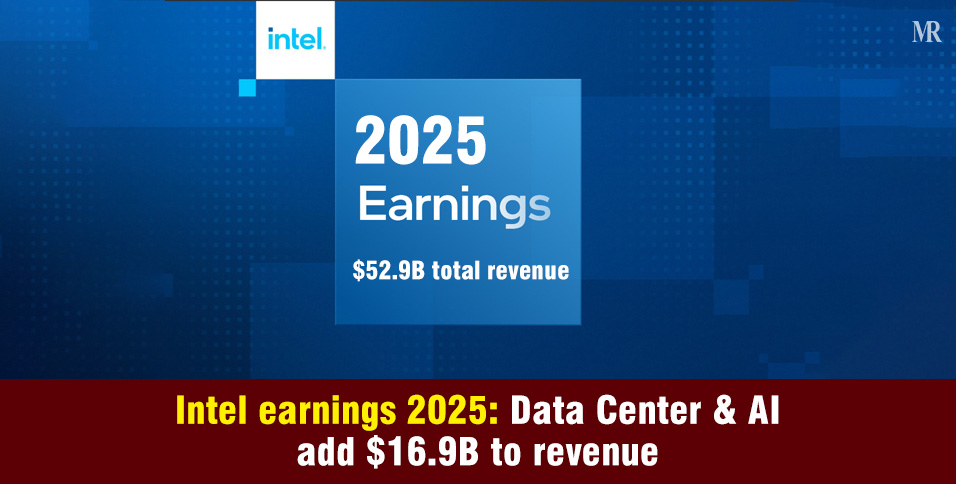
Intel earnings 2025 show that while overall revenue stayed flat, the company’s Data Center and AI (DCAI) business quietly became the most reliable growth engine, delivering $16.9 billion in full-year revenue.
The message is clear: AI-focused data center demand is no longer a side story for Intel. It is now carrying a large part of the company’s financial weight.
What Intel earnings 2025 reveal at a glance
Intel closed 2025 with $52.9 billion in total revenue, roughly flat compared to last year. Under the surface, however, the business mix changed in a meaningful way.
Here are the highlights from 2025 Intel earnings report:
- Data Center and AI revenue: $16.9 billion, up 5% year over year
- Client Computing Group revenue: $32.2 billion, down 3%
- Intel Q4 earnings 2025: Data Center and AI revenue: $4.7 billion, up 9%
- Full-year operating cash flow: $9.7 billion
Why Data Center and AI (DCAI) is doing the heavy lifting
The rise of AI workloads has changed how enterprises buy hardware. Training and running AI models require high-performance CPUs, accelerators, and efficient platforms that can scale inside data centers.
Intel’s Data Center and AI group benefits from three overlapping trends:
- Enterprise AI adoption
Many companies prefer upgrading existing x86-based infrastructure instead of rebuilding systems from scratch.
- CPU relevance in AI systems
Even GPU-heavy AI workloads still rely on CPUs for orchestration, memory handling, and networking tasks.
- Edge and distributed AI growth
AI inference is moving closer to where data is created, which favors Intel’s Xeon platforms.
Intel CEO Lip-Bu Tan summed up this strategy clearly, saying “Our conviction in the essential role of CPUs in the AI era continues to grow. We delivered a solid finish to the year and made progress on our journey to build a new Intel.”
Intel earnings 2025 show a clear split inside the business
While Data Center and AI expanded, Intel’s traditional PC-focused business moved in the opposite direction.
The Client Computing Group declined as consumer demand stayed uneven and device upgrade cycles slowed.
This contrast matters because it shows where Intel’s future revenue stability is coming from.
| Segment | Full-Year 2025 Revenue | YoY Change |
| Data Center and AI | $16.9B | Up 5% |
| Client Computing | $32.2B | Down 3% |
| Intel Foundry | $17.8B | Up 3% |
The numbers suggest Intel is slowly becoming less dependent on consumer PCs and more tied to long-term enterprise spending.
How manufacturing strategy supports AI growth
Another reason Data Center and AI revenue held up is Intel’s push into advanced manufacturing.
In 2025, Intel began shipping its first products built on the Intel 18A process, produced in the United States. These chips are designed to improve performance per watt, a critical metric for data centers running AI workloads around the clock.
CFO David Zinsner noted, “We exceeded Q4 expectations across revenue, gross margin, and EPS even as we navigated industry-wide supply shortages.” He further added, “Demand fundamentals across our core markets remain healthy as the rapid adoption of AI reinforces the importance of the x86 ecosystem.”
What the numbers suggest about Intel’s near future
Intel’s guidance for early 2026 remains cautious, with expected Q1 revenue between $11.7 billion and $12.7 billion. Still, the internal signals are more optimistic than the headline forecast suggests.
Based on current trends, a few outcomes look likely:
- Data Center and AI will continue to outgrow Intel’s average revenue rate
- Enterprise and government AI spending will stay resilient even if consumer demand weakens
- Intel’s AI revenue mix will matter more than total revenue growth
This makes the Intel earnings 2025 report less about recovery and more about repositioning.
Why this matters for investors and the AI ecosystem
Intel does not need to dominate AI accelerators to stay relevant. Its value lies in being the backbone provider of CPUs, platforms, and manufacturing capacity that AI systems still depend on.
The $16.9 billion Data Center and AI figure shows Intel has a seat at the AI table, even as competition intensifies.
Conclusion
The Intel earnings 2025 make one thing clear. AI-driven data center demand is no longer a future bet. It is already shaping Intel’s revenue structure today.
With $16.9 billion coming from Data Center and AI alone, Intel’s path forward depends less on PC cycles and more on how deeply AI becomes embedded in global computing.
If AI spending continues on its current path, Intel’s most important growth story may already be in motion.
Maria Isabel Rodrigues