Mirror Review
October 24, 2025
Google has just announced a breakthrough in Quantum science that could change how we study the smallest parts of nature: molecules.
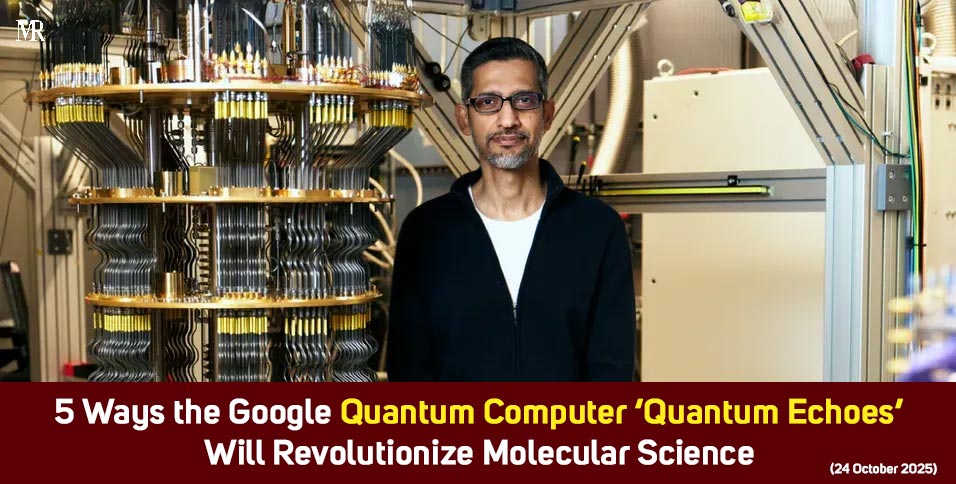
Using its latest Google Quantum Computer, running an algorithm called Quantum Echoes on the new Willow processor, the company says it has achieved a verifiable quantum advantage.
In simple terms, that means Google’s quantum computer solved a physics problem 13,000 times faster than the world’s best classical supercomputer and the result can be double-checked!
This marks the first time a quantum computer has beaten traditional systems in a useful, measurable way.
Google scientists say this achievement could reshape fields like molecular science, materials research, and drug discovery because their quantum computer can now simulate how molecules actually behave at the atomic level, something that’s impossible for ordinary computers.
In this piece, we’ll explore five real-world ways the Google Quantum Computer and its “Quantum Echoes” algorithm could revolutionize molecular science.
1. Seeing Molecules More Clearly Than Ever Before
What Google Actually Did
Google’s algorithm mimics a process similar to NMR (Nuclear Magnetic Resonance) — a technique scientists use to determine molecular structures.
In NMR, magnetic fields are used to measure how atoms in a molecule “spin” and interact, which helps scientists figure out their positions.
The Google quantum computer recreated this process inside.
Instead of using magnets, they used qubits (quantum bits) to model how atoms behave in a molecule.
This lets them calculate atomic distances and interactions far faster and more precisely than ever before.
Why It Matters
- In drug discovery, even tiny errors in molecular structure can mean the difference between a working treatment and a failed one.
- In materials science, precise atomic maps reveal how materials conduct electricity, resist heat, or form stronger bonds.
- This technology could act as a “quantum-scope microscope”, letting scientists see molecules the way an electron microscope sees cells, but at a much deeper quantum level.
2. Simulating What Was Once Impossible
Why Classical Computers Have Limits
Today’s supercomputers can only simulate small molecules accurately.
That’s because the number of possible quantum states in a molecule grows exponentially with each added atom.
After about 30 atoms, even the fastest supercomputers give up since there are simply too many calculations to perform.
What the Google Quantum Computer Changed
Using Quantum Echoes on the Willow chip, Google ran a complex molecular simulation in just over two hours.
A classical supercomputer, even the fastest in the world, would have taken over three years to finish the same task.
Why This Matters for Science
This kind of speed and accuracy makes it possible to:
- Simulate large organic molecules (like proteins or catalysts) that were previously too complex.
- Predict how new materials might behave before they’re built.
- Design more efficient batteries, superconductors, or medical compounds by testing millions of possibilities quickly.
3. Building a Bridge Between Experiments and Simulations
Quantum Echoes and “Virtual NMR”
What makes the Google Quantum Echoes algorithm especially powerful is that it can act like a virtual version of an NMR experiment.
Scientists can “probe” how molecules behave inside the quantum computer, just like they’d probe them in a physical lab. But this will be much faster and without needing to synthesise every compound first.
Think of it as running an experiment inside a quantum model instead of a test tube.
Why That’s Revolutionary
- Experimental data (like real NMR readings) can be combined with quantum simulations to correct or interpret unclear results.
- Chemists can now predict spectra or the unique “fingerprints” of molecules before they even make them.
- It could drastically shorten the discovery timeline from years to months.
Example
Imagine a new cancer drug molecule that produces confusing lab data.
With quantum simulation, a scientist can test different molecular shapes and instantly see which one fits the data best with no trial and error, no guesswork.
4. Accelerating the Design-to-Discovery Loop
How It Works Today
Developing a new material or medicine follows a slow cycle:
- Design → Simulate → Build → Test → Redesign
Each step takes weeks or months, especially the simulation part.
How The Google Quantum Computer Changes It
Quantum computers can simulate and test molecular behaviour instantly, making the process more like:
- Design → Quantum Simulate → Build → Refine
This faster feedback loop allows thousands of molecular designs to be tested virtually before spending any money in the lab.
Real-World Impact
- Pharma companies could identify drug candidates in weeks instead of years.
- Material engineers could model how atomic changes affect conductivity or flexibility instantly.
- Universities could run advanced simulations without a billion-dollar infrastructure.
5. Peering into the Hidden Quantum Dynamics of Matter
The Deeper Scientific Leap
Quantum Echoes algorithm doesn’t just show what molecules look like — it reveals how they move and interact at the quantum level.
The algorithm measures something called out-of-time-order correlations (OTOCs), which basically track how a small change in one part of a molecule ripples through the rest.
Simply put: it’s like watching how one tiny vibration in a molecule triggers a chain reaction across its atoms.
Why It’s Important
- This helps scientists understand energy flow, chemical reactions, and electron movement (the hidden physics behind life and materials).
- It could uncover new molecular behaviours we’ve never observed before, like exotic quantum phases or superconducting pathways.
- It lays the groundwork for creating quantum materials (matter engineered to exploit quantum effects directly).
Conclusion: The Google “Quantum-Scope” Era
The Google Quantum Computer has crossed a critical milestone with Quantum Echoes.
- For quantum computing itself, this marks a turning point: it proves that quantum systems can do something meaningful — like modelling molecules, predicting materials, and simulating nature.
- For molecular science, that means more than just speed. It means seeing, testing, and understanding matter at its most fundamental level: the quantum level.
If microscopes once revealed the cellular world, quantum computers may soon reveal the atomic universe inside it.
In the coming decade, we might look back at this new Google Quantum Chip as the moment molecular science took its first true quantum leap.