Mirror Review
November 14, 2025
If you are like most people today, you probably open Disney+ whenever you want something familiar to relax with. It might be an old Hannah Montana episode, a nostalgic Toy Story rewatch, or a weekend marathon of Star Wars and Marvel classics.
Disney has become the comfort corner of streaming, a place people return to for stories they grew up with.
That is why the latest Disney Q4 earnings matter. They show how the company behind these classics is adapting in a streaming-driven world where audiences are shifting faster than ever.
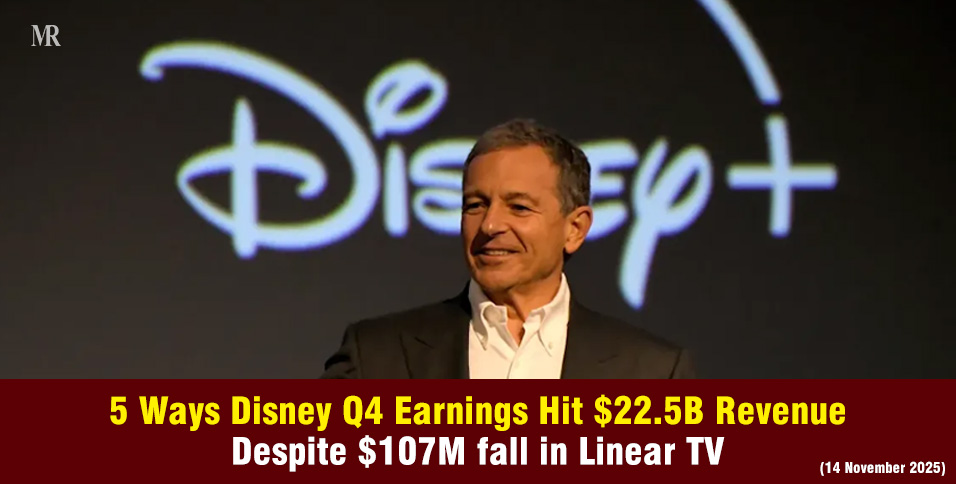
In Q4, Disney brought in $22.5 billion in revenue even as Linear TV fell by $107 million. Full-year revenue reached $94.4 billion, proving Disney’s new businesses are driving its growth.
CEO Bob Iger said fiscal 2025 showed “continued execution of our strategic priorities” and set up “double-digit adjusted EPS growth” over the next two years.
Disney is clearly changing how it operates and how it reaches fans. These shifts are shaping what entertainment will look like in 2026.
Now let’s look at the 5 things that helped Disney Q4 earnings hit $22.5B in revenue.
1. Streaming Profit Is Now Disney’s New Growth Engine
Disney’s transformation in fiscal 2025 can be summed up in one sentence: streaming finally started paying for itself.
For years, Disney+ and Hulu were considered expensive bets that needed time to mature. In Q4, those bets delivered real returns.
- Disney’s Direct-to-Consumer division brought in $352 million in Q4 operating income, a 39 percent jump, and $1.3 billion in streaming profit for the full year.
- This came from a combination of factors: better pricing strategy, stronger bundles, reduced churn, disciplined content spending, and a lineup that brought users back more consistently.
- The platform also gained 12.4 million subscribers in one quarter, which is impressive in a saturated streaming market.
The key shift is structural. Disney used to rely heavily on theatrical hits and cable revenue.
Now, streaming provides a cushion that absorbs volatility from both. That stability is why the company expects a 10 percent operating margin for streaming in 2026, something that only a few platforms in the world can realistically target.
In short, streaming is no longer the problem to solve. It is now the engine that lets Disney take bigger swings elsewhere.
2. The Unified Disney+ Hulu App Strengthens Retention
One of Disney’s smartest moves this year had nothing to do with new releases. It was the quiet but powerful decision to merge Disney+ and Hulu into a unified app.
This matters because the entertainment world is fragmented, noisy, and overwhelming for viewers who just want something to watch after work.
- By placing general entertainment and franchise content in one place, Disney reduces the biggest enemy in streaming: friction.
- Users no longer have to switch apps or remember where a show is available. That lowers churn and increases the number of hours viewers spend inside the ecosystem.
- The new interface being rolled out in 2026 includes improved recommendations, better categories, and a redesigned home screen that treats Disney+ like a complete entertainment hub, not a kids-and-franchise platform.
- International markets are already using this model with Hulu living inside Disney+, and early engagement data suggests that unified platforms keep audiences longer and improve ad-tier performance.
This consolidation is not just a UX upgrade. It is the foundation for how Disney will compete in a world where subscribers are quick to cancel and move on.
3. Disney’s 2026 Content Slate Rebuilds Franchise Strength
Disney’s future has always been tied to its franchises, and the Disney Q4 earnings show the company returning to what it does best.
After a few uneven years with mixed box office results, Disney is using fiscal 2026 to bring back audience confidence.
The lineup includes:
- The Mandalorian and Grogu (one of the biggest Star Wars events since The Mandalorian S1)
- Toy Story 5, reuniting one of Disney’s most iconic film series
- Avengers: Doomsday, a major Marvel milestone
- The Devil Wears Prada 2, reviving a beloved classic
- The live-action Moana, expected to match the cultural pull of the animated version
On top of sequels, Disney acquired rights to Impossible Creatures, a new multi-book fantasy universe that could become the next long-term franchise.
This mix of nostalgia, proven IP, and new worlds positions Disney to dominate box office cycles and streaming households.
These projects drive merchandise, gaming tie-ins, park attractions, cruises, and branding synergy. Disney’s 2026 slate is not just content. It is a revenue ecosystem.
4. ESPN’s Direct-to-Consumer Launch Modernizes Sports Viewing
For decades, ESPN’s biggest strength was cable. Today, that loyalty lives online.
- Disney made a decisive move by launching ESPN as a full direct-to-consumer service, finally giving sports TV fans a way to access games without a cable subscription.
- This strategy allows Disney to reclaim viewers who left traditional TV behind.
- It also helps the company collect richer viewer data, control ad sales more efficiently, and build new interactive features around real-time sports, betting partnerships, and athlete-driven content.
- Even though Q4 sports income dipped slightly due to rights payments and launch spending, the full year grew 20 percent, proving that demand remains strong.
- As rights costs stabilize and ad models expand, ESPN expects steady growth in 2026.
More importantly, this move positions Disney at the center of the next chapter of sports consumption.
Younger fans watch on mobile. They expect flexibility. They want streaming-first sports. And now, ESPN is finally built for them.
5. Record Parks Income and Cash Flow Stabilize Disney’s Business
Disney’s parks and cruises have become the company’s most reliable growth engine. In the Disney Q4 earnings alone, Experiences delivered $1.9 billion in operating income.
For the full year, the segment hit a historic $10 billion, driven by high spending, strong international attendance, and new attractions across Asia and Europe.
This segment provides revenue stability in ways that streaming and film cannot. Even when viewers cut subscriptions or skip movies, they still travel, book cruises, and buy merchandise.
Disney is leaning into this strength with:
- new ships like Disney Destiny and Disney Adventure
- major expansions, including World of Frozen in Paris
- new character-driven experiences tied to franchises like Stitch
Financially, this is supported by a powerful base:
- $18 billion in operating cash flow
- $10 billion in free cash flow
- strategic investments across content, technology, and parks
At a time when legacy TV is shrinking, Disney’s parks give the company a level of stability that few media companies enjoy. It is the physical backbone of the Disney ecosystem.
AI and UGC are the Next Phase of Disney+ Engagement: CEO Bob Iger Calls
While the Disney Q4 earnings report focuses on financials, Disney CEO Bob Iger has recently spoken in interviews about AI and user-generated content shaping the future of Disney+.
He said that the company plans to explore “safe and brand-appropriate” AI tools that let fans personalize their viewing experience.
According to Iger, AI can help in:
- personalized recommendations
- dynamic storytelling inside Disney+
- interactive experiences linked to characters
- enhanced animation and production workflows
On user-generated content, Iger said Disney wants to allow fans to “engage more deeply with franchises in ways that feel authentic to the brand.”
He hinted at supervised environments where users can create clips, reactions, and interactive elements without infringing on character rights.
This suggests that Disney+ may evolve from a passive library into a platform where fans can interact, remix, or explore content in controlled ways.
For 2026, these initiatives could act as a differentiator in a streaming market dominated by pure consumption.
The Disney–YouTube Rivalry Shows the Battle for New Gen Viewers
A key trend shaping Disney’s next chapter is its growing competition with YouTube for younger viewers. YouTube dominates UGC and daily watch time, while Disney owns premium IP and trusted franchises.
As Disney introduces AI-driven personalization and limited UGC tools, it is entering a space that YouTube has defined for over a decade. The goal is not to replace YouTube but to compete for attention and viewing habits.
CFO Hugh Johnston noted Disney now competes in “a broader attention market” and must understand how young audiences “choose to spend their hours.”
If Disney+ becomes more interactive and family-safe, parents may steer kids toward its ecosystem. This rivalry will influence how Disney designs its unified app in 2026 and how it deepens engagement beyond traditional streaming.
Why The Disney 2025 Results Are a Blueprint for Entertainment in 2026
The Walt Disney 2025 earnings report reveals several signals about the future of content, platforms, and fan behavior.
The company is shifting from a traditional media giant to a hybrid of streaming platform, global franchise machine, theme park leader, and sports technology brand.
The biggest themes shaping 2026 include:
- Restructuring through layoffs
- streaming profitability at scale
- integrated apps
- stronger franchises
- global experiences
- AI-driven personalization
- new ways for fans to interact with content
- direct access to ESPN
- record cash flow supporting expansion
The Disney fiscal 2025 lays the foundation for these shifts.
The company has the advantage of strong cash generation and powerful franchises. It also has leadership that understands the balance between technology and storytelling.
Conclusion
The Disney Q4 earnings show a company entering 2026 with clarity, discipline, and momentum.
Streaming is profitable, parks are at record highs, ESPN is reinventing sports media, and Disney+ is evolving with AI and new engagement tools.
Disney is reshaping the entertainment landscape with a mix of technology, storytelling, and global experiences.
As the competition intensifies and the Disney–YouTube rivalry grows, fiscal 2026 will test how well Disney can execute its ambitious roadmap.
If the trends in the Walt Disney earnings 2025 report continue, Disney will not only grow stronger but could redefine how entertainment works in the next decade.