Mirror Review
February 03, 2026
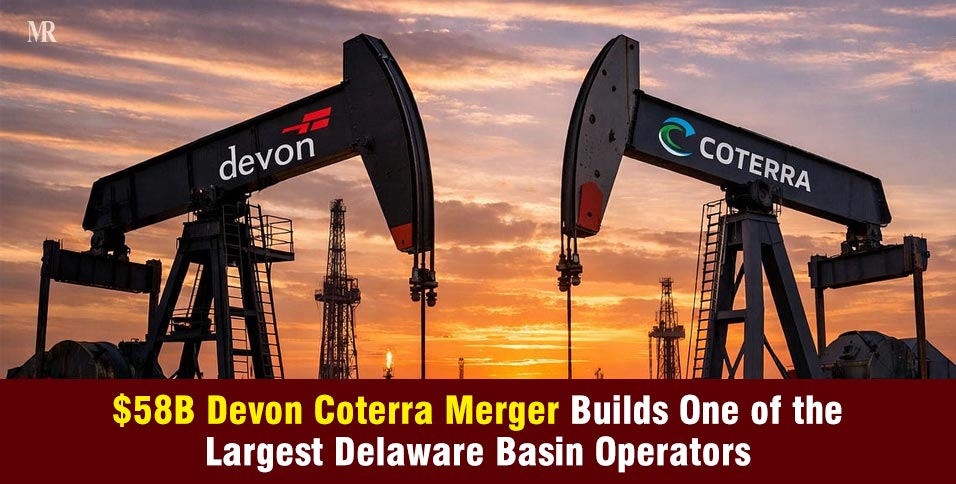
Known as pioneers of the American shale revolution, Devon Energy and Coterra Energy are joining forces in a massive $58 billion all-stock merger to create a dominant player in the US energy sector.
This Devon Coterra merger aims to reshape how independent operators compete in the high-stakes Permian Basin.
At its core, the deal combines two strong portfolios into a single company with massive production scale, low-cost inventory, and stronger pricing power.
The message here is clear: In today’s energy market, bigger is not about drilling more wells. It is about drilling smarter ones.
Devon Coterra Merger Details at a Glance
The numbers of the Coterra Devon Energy Deal explain why it stands out in the current shale cycle.
(The shale cycle refers to the boom-and-bust pattern in U.S. shale oil and gas production driven by commodity prices, drilling activity, and capital availability.)
- Transaction value: $58 billion (pro forma enterprise value)
- Structure: All-stock merger
- Ownership: 54% Devon shareholders, 46% Coterra shareholders
- Expected close: Q2 2026, subject to approvals
- Headquarters: Houston, with a continued presence in Oklahoma City
The combined company becomes a large-cap independent shale producer with scale across oil, gas, and NGLs. It also enters the next phase of U.S. energy consolidation with a stronger balance sheet and deeper inventory than most peers.
Why the Delaware Basin Matters and Who Operates There
The Delaware Basin, part of the larger Permian Basin spanning West Texas and southeastern New Mexico, is the most valuable oil-producing region in the U.S.
It stands out for three reasons:
- low break-even costs often below $40 per barrel
- more than 10 years of high-quality drilling inventory
- deep infrastructure that supports large-scale operations
Following the Devon Energy Coterra Energy merger, the Delaware Basin accounts for over 50 percent of total production and free cash flow, with the combined company controlling roughly 746,000 net acres.
This scale places Devon and Coterra among the most dominant operators in the region and explains why the Delaware anchors the entire merger strategy.
Delaware Basin operators are oil and gas companies that explore, drill, and produce hydrocarbons in this region. They play a critical role because they drive a major share of U.S. oil supply, influence global energy markets, and attract long-term capital due to their lower costs and stronger margins.
Key competitors in the Delaware Basin include:
- ExxonMobil
- Chevron
- Occidental Petroleum
- ConocoPhillips
- EOG Resources
- Permian Resources
With the Devon Coterra Merger, the combined company now competes directly with these industry leaders on both scale and efficiency.
Production Scale and Asset Mix
The combined Devon Coterra company expects more than 1.6 million barrels of oil equivalent per day (MMBOED) in 2026.
Production mix:
- Oil: 34%
- Natural gas: 44%
- NGLs: 22%
This balanced mix reduces risk. When oil prices fall, gas and NGLs help stabilize cash flow. When prices rise, the company captures upside without overspending on growth.
The Real Story Is Synergies, Not Size
The most important part of the Coterra Devon merger is not acreage or production volume. It is $1 billion in targeted pre-tax synergies by the end of 2027.
These savings come from:
- Capital optimization
- Operating margin improvements
- Elimination of overlapping corporate costs
Management expects these efficiencies to improve free cash flow rather than inflate spending.
According to Devon leadership, the goal is not expansion for its own sake but disciplined value creation.
Devon CEO Clay Gaspar summed it up by saying the merger creates a “must-own large-cap shale company built for returns, not cycles.”
Technology as a Competitive Advantage
Both companies already use artificial intelligence across drilling, completions, and production. Together, they form a technology-driven operator that applies AI to:
- Predict well performance before drilling
- Optimize well spacing and frac designs
- Reduce downtime through automated production controls
This matters because shale margins now depend more on execution than geology. The companies that deploy data faster and more accurately win.
What The Devon Coterra Merger Means for Shareholders
The Devon Coterra merger news also focuses heavily on shareholder returns.
Planned capital actions:
- Quarterly dividend of $0.315 per share, subject to approval
- Expected $5 billion share repurchase authorization
- Target reinvestment rate below 50%
The combined company also reports a fortress balance sheet, with:
- Net debt to EBITDAX of 0.9x
- Liquidity of $4.4 billion
This positions the company to weather commodity price swings while continuing payouts.
Why The Devon Coterra Deal Signals a Bigger Trend
This merger fits a larger pattern in U.S. shale. Growth-at-any-cost is over. Investors now reward:
- Scale
- Inventory depth
- Cash flow discipline
Large players can spread costs, negotiate better service pricing, and return more capital. Smaller operators struggle to compete under these conditions. That is why consolidation continues.
The Devon Coterra Merger suggests the shale industry is entering a mature phase, where survival favors the strongest balance sheets and the smartest operators.
What Comes Next
If approvals move smoothly, the new company begins operations in mid-2026. The real test will come in how quickly management delivers promised synergies without disrupting production.
Given the overlap in assets, experienced leadership team, and clear capital discipline, the odds favor execution over expansion.
Conclusion
The $58 billion Devon Coterra Merger reflects how U.S. shale has evolved from rapid growth to calculated scale.
By building one of the largest Delaware Basin operators, Devon and Coterra aim to dominate the most valuable oil region in America while delivering steady returns in an uncertain energy future.
In today’s shale market, this merger looks less like a gamble and more like a logical next step.
Maria Isabel Rodrigues