Mirror Review
September 16, 2025
Summary:
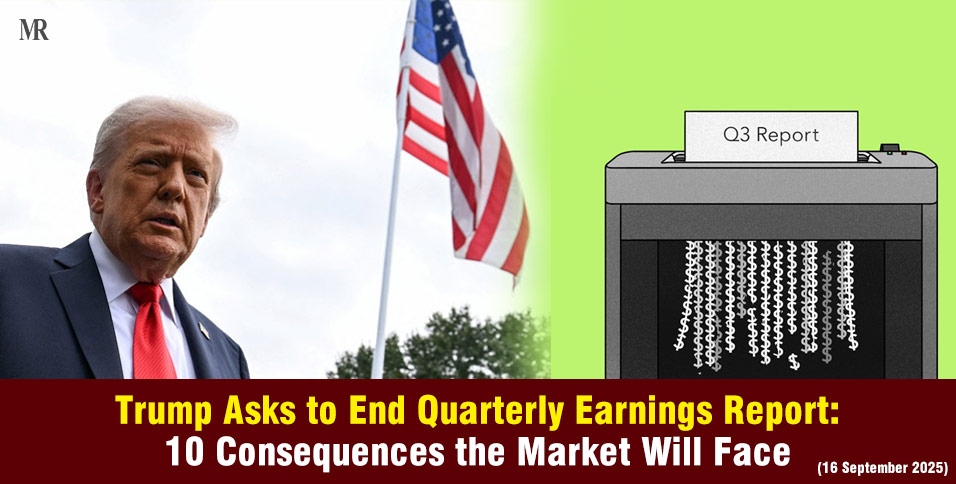
- President Donald Trump has proposed ending the requirement for public companies to file quarterly earnings reports, suggesting they report results only twice a year.
- The White House argues this will reduce compliance costs and push companies to focus on long-term growth instead of short-term targets.
- The idea, however, is drawing mixed reactions from investors, analysts, and regulators, with critics warning of higher risks and lower transparency.
Quarterly earnings have long been the backbone of Wall Street. They set the rhythm for analyst calls, investor strategies, and corporate decisions.
If companies shift to semiannual reporting, the flow of information slows down, and markets will have to adapt.
Here are 10 key consequences the market could face if the proposal to end quarterly earnings report is accepted:
1. Information Gaps Will Widen
Quarterly reports give investors four clear snapshots of company health every year. If that drops to two, the official flow of information slows by half.
Investors will find it harder to monitor sales trends, profit margins, or risks as they unfold.
This gap could increase uncertainty and make predicting company performance more difficult.
2. Volatility Around Semiannual Reports
With fewer updates, every report becomes a high-stakes event.
Stock prices could swing sharply when results are finally released because investors will have more pent-up expectations.
Missing or beating estimates could trigger bigger rallies or sell-offs than under the quarterly system.
3. Rise of Alternative Data
Investors will lean more on alternative data like supply chain tracking, web traffic, or satellite imagery to guess company performance between reports.
This could create a “data premium” where those with better access gain an advantage.
4. Small-Cap Stocks May Suffer
Large companies can afford to keep issuing voluntary updates. Smaller firms, however, may cut back on disclosures, losing analyst coverage and liquidity in the process.
This will make raising capital harder, therefore becoming “invisible” in the market.
5. Big Funds Could Gain More Power
Large institutional investors with deep research teams can handle fewer disclosures better than retail investors. They can meet management privately or buy alternative data.
If quarterly reports end, this tilts the playing field further toward Wall Street giants, leaving smaller investors at a disadvantage.
6. Corporate Strategy May Shift
Without the constant pressure to “meet the quarter,” companies may take bolder steps like expanding into new markets, increasing R&D spending, or acquiring rivals.
However, fewer updates could also tempt some executives to postpone revealing weak performance or delay cost-cutting decisions.
7. Analyst Jobs Could Decline
Quarterly earnings seasons keep thousands of analysts busy preparing forecasts and writing notes. If reporting halves, the workload drops.
Coverage may become concentrated around mega-cap firms, leaving mid-cap and small-cap companies with little analyst attention.
That means less visibility for many firms.
8. Short-Term Trading Will Be Riskier
Day traders and hedge funds that rely on quarterly “beat-or-miss” cycles will have fewer signals.
If those events happen only twice a year, they will have fewer predictable opportunities.
This could push short-term traders to take bigger risks around limited windows, potentially increasing volatility and losses.
9. Regulatory Scrutiny Will Increase
Even if quarterly reports end, the SEC still has to ensure companies disclose material events on time.
Expect a heavier reliance on 8-K filings for events like acquisitions, leadership changes, or sudden losses.
Regulators may also tighten rules on insider trading since information gaps increase the chance of misuse.
10. Global Impact Could Follow
If the U.S. ends quarterly earnings reports, it could influence reporting norms elsewhere.
But not all markets will follow, creating inconsistency.
Global investors could face a patchwork system where U.S. firms report semiannually, while European or Asian firms continue quarterly updates.
Expert Reactions
- Former SEC Chair Jay Clayton noted in 2018, when a similar idea was floated, that “short-termism is a problem, but quarterly reports also provide valuable discipline.”
- Analysts quoted by Financial Times argued that the biggest risk is “information asymmetry,” where some investors gain access to updates long before the broader market.
Conclusion
To end quarterly earnings report may cut compliance costs and give companies more room to plan for long-term growth.
But it also risks creating greater uncertainty, sharper market swings, and less transparency, especially for smaller firms that may reduce disclosures.
While some large companies might continue issuing voluntary updates, the overall shift could redefine how businesses communicate, how investors trade, and how markets price risk.
Whether this change strengthens long-term decision-making or fuels deeper instability will depend on how regulators, companies, and investors respond.