Mirror Review
October 17, 2025
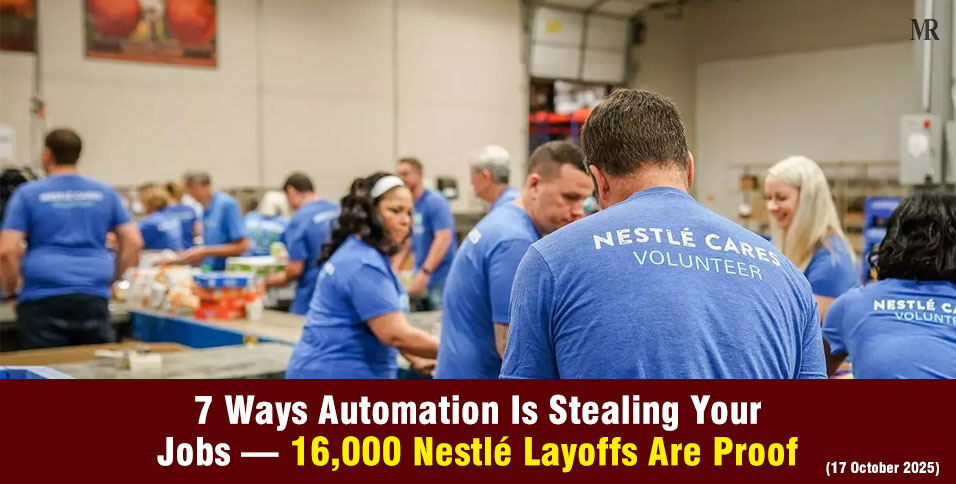
Nestlé, the world’s largest food and beverage company, has announced plans to cut 16,000 jobs globally in 2025.
This isn’t just another corporate downsizing. It’s a wake-up call for white-collar workers who once believed automation wouldn’t touch them.
Nestlé’s decision to lay off about 6% of its global workforce has a deeper reality: machines are taking over routine human work, and even highly skilled roles aren’t immune.
From finance and logistics to marketing and manufacturing, automation and AI are quietly rewriting the rules of employment, and the Nestlé layoffs are the latest proof that this revolution is accelerating faster than ever.
Below are 7 key ways automation is reshaping the modern workplace and why Nestlé’s sweeping layoffs could signal what’s next for global labor.
1. White-Collar Jobs Are No Longer Safe
Nestlé’s announcement shattered the long-held myth that automation only threatens factory or blue-collar roles.
Of the 16,000 jobs cut, nearly 12,000 are office-based positions in finance, procurement, HR, and IT.
These functions are now being consolidated under digital shared service centers, where algorithms handle what humans once did: budgeting, scheduling, and report generation.
2. Data Analytics and AI Replacing Middle Management
Nestlé’s digital transformation initiative is replacing layers of middle management with automated analytics systems.
Decision-making, once driven by human oversight, is now led by data dashboards powered by predictive AI.
These are tools that can analyze markets, forecast demand, and even flag inefficiencies in real time.
3. Manufacturing Is Becoming “Lights-Out”
At some of Nestlé’s factories in Europe and North America, robots already run production lines with minimal human supervision.
This “lights-out” manufacturing, where operations can run 24/7 in the dark, has drastically reduced the need for machine operators, maintenance crews, and warehouse staff.
4. Shared Service Centers and Robotic Process Automation (RPA)
In finance and supply chain departments, Nestlé has scaled up Robotic Process Automation (RPA) to automate repetitive data entry and compliance work.
One robot can now perform the same task as several employees without breaks, pay raises, or sick days.
The global rollout of RPA tools across Nestlé’s regional hubs is expected to save over CHF 1 billion.
5. Smart Supply Chains Are Self-Optimizing
Nestlé’s logistics and procurement teams are increasingly run by AI systems that auto-select suppliers, optimize delivery routes, and forecast raw material needs.
The result: leaner teams, faster decisions, and fewer people needed to do them.
6. Marketing and Customer Insights Are Going Algorithmic
AI-driven customer analytics tools now handle segmentation, A/B testing, and ad targeting, which were previously managed by marketing teams.
Nestlé’s digital marketing divisions are among the areas being “restructured” as AI tools take on campaign management, content optimization, and consumer sentiment tracking.
7. Restructuring Under New Leadership
The automation wave gained momentum under new Nestlé CEO Philipp Navratil, who took over in late 2025 after a management shake-up.
His mandate: save CHF 3 billion by 2027, accelerate digital efficiency, and push Nestlé’s transformation into a “leaner, smarter” organization.
The Nestlé layoffs, which include 16,000 positions, are the direct result of this renewed focus on technology over manpower.
The Domino Effect: What It Means for the Global Workforce
Nestlé’s move echoes a broader corporate trend: from Amazon’s warehouse robotics to banks adopting generative AI, companies are replacing large sections of their workforce with automation.
The food giant’s decision sets a new precedent in the consumer goods sector, one where efficiency gains come at the cost of job stability.
Experts warn that this is only the beginning. As AI tools grow more capable, companies will inevitably question which human roles truly add value and which can be replaced by AI.
Conclusion
Nestlé layoffs reflect the next phase of the global economy. Automation isn’t coming; it’s already here, quietly rewriting job descriptions and redrawing the corporate organization chart.
The lesson? It’s time for workers everywhere to reskill, rethink, and prepare because if even Nestlé’s white-collar ranks aren’t safe, no one is.