Mirror Review
January 13, 2026
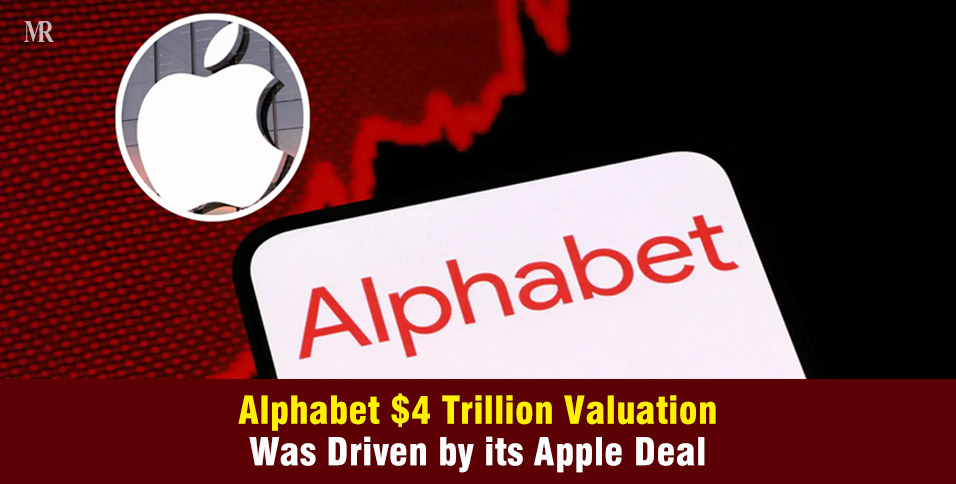
Alphabet Inc., Known for Google Search, YouTube, Android, and the world’s most profitable digital ad engine, has crossed a $4 trillion market capitalization on January 13, 2026.
This Alphabet $4 trillion valuation milestone did not come from ads, smartphones, or cloud revenue alone. It came from Apple quietly choosing Google’s Gemini AI to power the future of Siri.
That single decision reshaped how investors see Alphabet.
It turned Google from an AI competitor into AI infrastructure for the most valuable consumer ecosystem on the planet.
Why Apple’s Choice Changed the Alphabet Narrative
For years, Alphabet faced a lingering doubt. Could Google defend its dominance if AI changed how people search and interact with technology?
Apple answered that question for the market.
After evaluating multiple AI platforms, Apple selected Google’s Gemini models to support Apple Intelligence and the long-awaited Siri overhaul. Apple stated that Google offered “the most capable foundation” for its next phase of AI.
This mattered because Apple rarely depends on outside companies for core experiences. But when it does, investors listen.
Apple’s endorsement reframed Gemini from “one of many AI models” into industry-grade infrastructure. That shift played a major role in pushing the Alphabet $4 trillion valuation.
Alphabet Now Controls All Three Critical Layers of The AI Economy
Alphabet is no longer just competing in ai. it is supplying it. Most AI players operate in one layer. Alphabet operates across all of them.
- AI Models: Gemini 3 and Gemini Flash power reasoning, language, and multimodal tasks at scale.
- AI Infrastructure: Google Cloud and custom TPU chips reduce dependence on Nvidia and lower long-term costs.
- Global Distribution: Android, Chrome, Search, YouTube, Samsung phones, and now Apple’s Siri.
That full-stack control is a major reason the Alphabet $4 trillion valuation appears defensible rather than speculative.
What the Siri Upgrade Actually Means for Google
The Apple deal is not about branding. Users may never see the Gemini name.
Instead, Gemini will handle complex reasoning tasks behind the scenes, while Apple maintains privacy through on-device processing and Private Cloud Compute.
In practical terms, Siri will:
- Understand personal context from emails and messages
- Perform multi-step actions across apps
- Answer questions instead of redirecting users
- Feel conversational rather than scripted
These features are expected to roll out in 2026. When they do, Google’s AI will quietly serve over two billion Apple devices.
That level of default usage is more powerful than any consumer app launch.
How Alphabet Valuation Reached $4 Trillion While Others Struggled
Alphabet’s rise looks different from its peers.
| Company | Market Value | Core Driver |
| Nvidia | $4.5T | AI chips |
| Alphabet | $4.0T | Gemini and Apple deal |
| Apple | $3.8T | Device ecosystem |
| Microsoft | $3.5T | OpenAI partnership |
Alphabet did not rely on one product cycle. It relied on becoming essential to competitors.
That model reduces volatility and strengthens long-term confidence, which is exactly what valuation markets reward.
Legal Relief Strengthened Investor Confidence
In late 2025, a US court ruled against breaking up Google’s Chrome and Android businesses. That outcome preserved Alphabet’s largest advantage: distribution at scale.
Without Chrome and Android, Gemini would need to fight for adoption. With them, Alphabet can deploy AI features instantly across billions of users.
As CNBC noted after the ruling: “The decision allowed Google to continue making major commercial deals, including its expanding partnership with Apple.”
The ruling removed a major downside risk just as AI optimism peaked, accelerating momentum toward the Alphabet $4 trillion valuation.
What Industry Leaders Are Saying
Apple publicly stated that Google’s technology offered the strongest foundation after careful evaluation.
Analysts described the Google Gemini Apple Siri deal as a validation moment for Google’s AI comeback.
Alphabet CEO Sundar Pichai has emphasized that AI is expanding search usage rather than replacing it. He has also acknowledged market excitement but stressed that infrastructure players tend to outlast hype cycles.
That balance between ambition and caution has reassured investors.
Why The Apple Google AI Deal Matters More Than Revenue
Reports suggest Apple may pay Alphabet around $1 billion annually for Gemini access. That figure is small compared to Alphabet’s total revenue.
The real value lies elsewhere:
- Being the default AI engine
- Operating invisibly inside premium devices
- Becoming infrastructure rather than a product
As one Forbes analysis put it: “This is a massive win for Google. Gemini becomes embedded intelligence, not an optional feature.”
In technology, defaults create habits and habits create dominance. Alphabet secured that dominance without owning the hardware.
Risks That Still Exist
The Alphabet $4 trillion valuation does not remove challenges.
Key risks include:
- Rising AI infrastructure costs
- Global regulatory scrutiny
- Competitive pressure from OpenAI and emerging startups
- Advertising market cyclicality
However, Alphabet’s cash flow, diversified businesses, and control over AI costs give it flexibility most rivals lack.
What Comes Next for Alphabet
If Siri’s AI upgrade succeeds, Alphabet strengthens its role as the backbone of consumer AI. If it struggles, Apple absorbs most of the user backlash.
That imbalance works in Alphabet’s favor.
More partnerships like the Apple Google Siri are likely as companies look for reliable AI providers without betting everything on a single startup. Alphabet’s neutral, infrastructure-first approach fits that need.
Final Word on Alphabet $4 Trillion Valuation
The Alphabet $4 trillion valuation is not about hype. It is about trust.
Apple trusted Google with one of its most visible weaknesses. The market followed that signal.
Alphabet did not win by outshining rivals. It won by becoming unavoidable.
In the AI era, the companies that quietly power everything tend to matter more than the ones that shout the loudest.
At $4 trillion, Alphabet is no longer chasing the future. It is helping define it.
Maria Isabel Rodrigues