Mirror Review
February 18, 2026
The Adani Group, an Indian multinational conglomerate known for its massive footprint in ports, logistics, and energy, is moving toward the future of silicon and software.
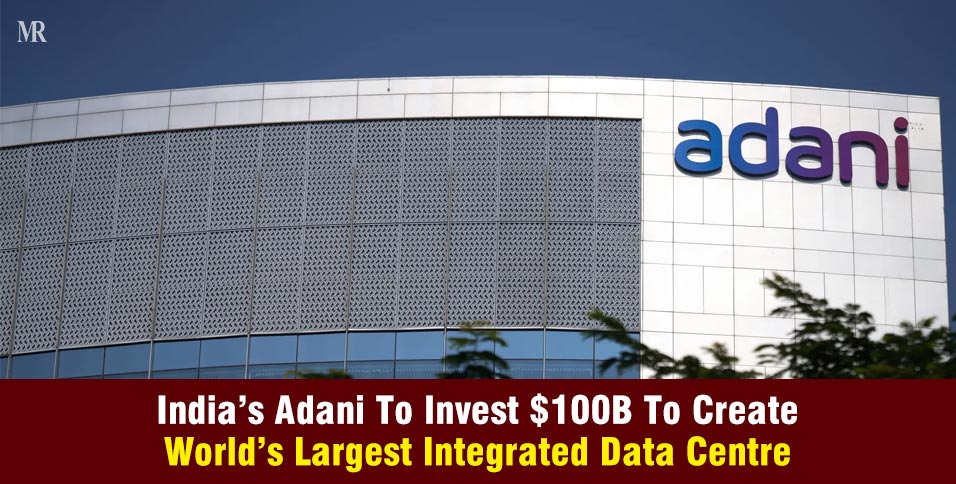
During the India AI Summit 2026, Adani Group announced a $100 billion investment to build renewable-energy-powered, world’s largest integrated data centre by 2035.
This is a foundational bid to build the “energy-compute backbone” for the age of Artificial Intelligence.
Why Adani Is Investing In AI Data Centers Now?
We are currently transitioning from the Digital Age to what Gautam Adani, Chairman of the Adani Group, calls the “Intelligence Revolution.”
If the 20th century was defined by the mastery of oil and electricity, the 21st will be defined by the “symmetry between energy and compute.”
Training a single Large Language Model (LLM) requires more electricity than thousands of homes use in a year.
As the world moves toward AI-driven economies, the nations that control both the power (energy) and the processing units (data centres) will hold the keys to global influence.
Breaking Down Adani’s $250 Billion Investment
The Adani Group expects to catalyse an additional $150 billion in the world’s largest integrated data centre investments across the broader ecosystem, including:
- Server Manufacturing: Moving from importing hardware to building it in India.
- Sovereign Cloud Services: Ensuring that Indian data stays on Indian soil, managed by Indian firms.
- Advanced Cooling & Power: Developing the industrial thermal management systems needed to keep massive supercomputers from overheating.
By 2035, this creates a $250 billion “AI stack” in India that will control everything from the sun that hits the solar panels to the data that flows through the servers.
The Green Edge: Gujarat’s Khavda Project
The problem of global data centres is their carbon footprint.
Major tech hubs in Europe and Northern Virginia are currently facing “power crunches” where the grid cannot keep up with AI demand.
India, however, has a geographic advantage that Adani is leveraging via the Khavda project in Gujarat (the world’s largest renewable energy park).
With over 10 GW already operational and a target of 30 GW, this provides a massive source of “clean” electrons.
By linking the world’s largest integrated data centre directly to one of the world’s largest renewable energy sources, Adani is solving the two biggest hurdles of AI: cost and sustainability.
Partnerships With Google, Microsoft, and Flipkart
Adani’s plan is already in motion through high-profile collaborations. AdaniConneX, the group’s data centre arm, is already building a 2 GW platform, with plans to scale to 5 GW.
Key pillars of this growth include:
- Vizag Gigawatt Campus: A landmark partnership with Google to establish a massive AI data centre in Visakhapatnam.
- Cloud Expansion: Ongoing projects with Microsoft in Hyderabad and Pune.
- E-commerce Synergy: An expanded partnership with Flipkart to build a second high-performance AI data centre specifically designed for digital commerce and large-scale AI workloads.
These partnerships suggest that global tech giants are no longer looking at India just as a market for users, but as the preferred “factory” for computing power.
Sovereign AI: India as a Creator, Not Just a Consumer
Historically, developing nations have been consumers of technology developed in the West or China. This investment to create the World’s Largest Integrated Data Centre aims to change that narrative.
A significant portion of the new GPU (Graphics Processing Unit) capacity will be reserved for Indian startups and research institutions.
This is a move toward Sovereign AI.
By providing local entrepreneurs with affordable, high-performance compute power, India can develop its own LLMs that understand local languages, cultural nuances, and specific economic needs.
It moves India up the AI value chain: from a country that provides IT back-office support to a country that owns the digital infrastructure of the future.
The Human Element: India’s Talent and Supply Chains
A project of this magnitude requires more than just money and steel; it requires brains. The Adani Group has announced plans to work with academic institutions to create specialized “AI Infrastructure Engineering” curricula.
The goal is to bridge the “Global AI Divide” by ensuring that the next generation of Indian engineers knows how to build and maintain the physical world that AI lives in.
Furthermore, to derisk the project from global supply chain shocks, the group is co-investing in domestic manufacturing for critical components like high-capacity transformers and grid systems.
This aligns with the “Aatmanirbhar Bharat” (Self-Reliant India) mission, ensuring that India isn’t vulnerable to external trade tensions.
End Note
Adani’s announcement to invest in the world’s largest integrated data centre made in Ahmedabad on February 17, 2026, is a huge step for India.
By committing $100 billion, the Adani Group is betting that the future of wealth is no longer just in physical ports or coal, but in the “ports” of the digital age—data centres.
If successful, this integrated model will not only secure India’s energy future but will also position the nation as the “intelligence office” of the world.
In the words of Gautam Adani, India will no longer be a mere consumer; it will be the “builder and exporter of intelligence.”
For a world hungry for compute power and desperate for green energy, India’s new backbone might be exactly what the future ordered.