Mirror Review
January 15, 2026
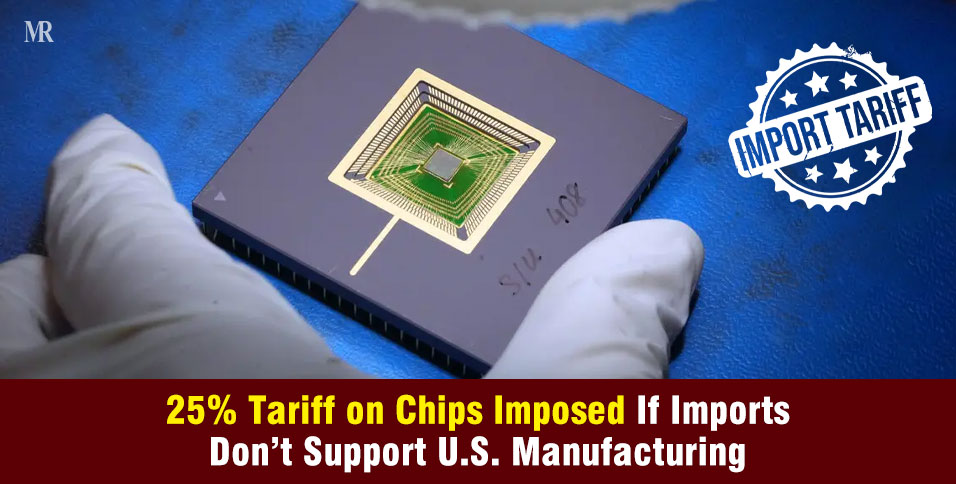
President of the United States, Donald J. Trump, has imposed a 25% tariff on certain advanced computing chips, escalating America’s push to secure domestic manufacturing and reduce reliance on foreign semiconductor supply chains.
The 25% Tariff on Chips imposed this week marks one of the most consequential trade actions of President Donald Trump’s second term. The announcement was made through a White House proclamation under Section 232 of the Trade Expansion Act of 1962.
According to the White House fact sheet, the tariff applies to select advanced chips, including Nvidia’s H200 and AMD’s MI325X. Still, it excludes chips imported to support domestic data centers, startups, and supply chain buildouts.
The message is clear: import if you build in America, pay if you don’t.
This tariff news is already changing how markets, manufacturers, and allies interpret the US’s long-term strategy toward semiconductors.
Why the 25% Tariff on Chips Imposed Matters Now
The 25% Tariff on Chips did not emerge in isolation.
It follows a nine-month Section 232 investigation by the U.S. Department of Commerce, which concluded that America’s dependence on foreign semiconductor manufacturing poses a national security risk.
The investigation found that domestic capacity remains insufficient to meet demand, particularly for advanced chips used in AI, defense, and critical infrastructure.
“Semiconductors are essential to the United States’ economic, industrial, and military strength,” the White House stated, warning that supply disruptions could strain both industrial output and defense readiness.
Historically, the U.S. once dominated global chip manufacturing.
In the 1990s, it produced nearly 40% of the world’s semiconductors. Today, that figure is closer to 12%, with much of advanced manufacturing concentrated in East Asia
The US tariff ruling on chips reflects a broader realization in the US: efficiency-driven globalization left strategic vulnerabilities that can no longer be ignored.
Trump Tariff Ruling and Section 232
This 25% Tariff on chips follows a familiar pattern.
During his first term, President Trump used Section 232 tariffs to protect steel, aluminum, autos, and other critical industries. The semiconductor action builds on that legacy, extending the same national security logic to the digital economy.
“Restoring domestic production capacity is critical for economic and national security,” the proclamation noted, emphasizing that the tariff is not punitive by default but conditional by design.
Commerce Secretary Howard Lutnick has been granted broad discretion to grant exemptions, signaling flexibility rather than a blanket crackdown.
Reuters reported that the administration is taking a “light touch, for now,” leaving room for negotiation and compliance rather than immediate escalation.
This approach increases the probability that major chipmakers will accelerate U.S. investments rather than risk long-term cost disadvantages.
Industry Reaction: Cautious Support, Market Signals
Market response has been measured.
Shares of Nvidia, AMD, and Qualcomm traded slightly lower in after-hours trading following the announcement, reflecting short-term uncertainty rather than panic.
NVIDIA, whose chips sit at the heart of the AI boom, welcomed the policy’s intent. In a statement cited by CNN, the company said it applauds Trump’s “decision to allow America’s chip industry to compete to support high-paying jobs and manufacturing in America”.
AMD echoed compliance, stating, “We comply with all U.S. export control laws and policies,” underscoring the industry’s awareness that regulatory alignment is now a competitive necessity.
Top tech voices have long warned that overreliance on offshore manufacturing carries systemic risks.
As one former Pentagon advisor noted in earlier policy debates, “You can’t run a 21st-century military on 20th-century supply assumptions.” The 25% Tariff on Chips reflects that strategic recalibration.
The Tariff Exemptions Reveal the Real Story
Perhaps the most important detail in the tariff ruling today lies in what it excludes.
Chips imported for U.S. data centers, startups, non-consumer industrial uses, and public sector applications are exempt. This design minimizes inflationary pressure while preserving momentum in AI development and cloud infrastructure.
CNN highlighted the ambiguity around exemption criteria, noting that the White House has not yet detailed how companies qualify.
That uncertainty introduces negotiation leverage, which is a classic Trump-era tactic.
Historically, tariffs with built-in exemptions function less as blunt instruments and more as behavioral nudges.
The probability is high that firms announcing U.S. fabs, research hubs, or supply chain partnerships will find doors open rather than closed.
Geopolitics, China, and Strong Strategies
The tariff news also intersects with the US-China tech rivalry.
Trump previously signaled frustration with China’s pursuit of semiconductor dominance, delaying broader actions until 2027 while laying groundwork through investigations and targeted measures.
Reuters noted that China-bound chips now face additional routing requirements through U.S. testing facilities, ensuring they fall under the new tariff regime. This adds oversight without outright bans, like a calibrated escalation.
From a historical lens, this mirrors Cold War-era industrial policy, where strategic technologies, from aerospace to nuclear energy, were shielded through domestic investment and controlled trade.
Semiconductors have now joined that list.
What Comes Next: Broader Tariffs Likely
The White House fact sheet explicitly warns that broader tariffs on semiconductors and derivative products may follow in the near future. That conditional language matters.
It suggests a phased approach, allowing markets time to adjust and companies time to commit.
If domestic manufacturing accelerates, broader tariffs may remain a threat rather than a reality. If not, escalation becomes likely.
As one trade policy expert put it recently, “Tariffs today are less about revenue and more about leverage.”
Conclusion
The 25% Tariff on Chips is a bet that America can rebuild its semiconductor backbone through pressure paired with incentives.
Rooted in national security concerns and historical precedent, the policy reflects a broader rethinking of globalization’s limits.
Whether this Trump tariff ruling succeeds will depend on execution: clarity of exemptions, speed of domestic investment, and coordination with allies.
But the direction is unmistakable.
The US is signaling that advanced chips are no longer just commercial products, but strategic assets.
In that sense, the tariff ruling today may be remembered less for its immediate market impact and more for marking the moment when U.S. industrial policy fully entered the AI age.
Maria Isabel Rodrigues