Mirror Review
September 4, 2025
Why does Kraft Heinz, with a market cap of $31.8B, want to split even with half-year net sales of over $12M?
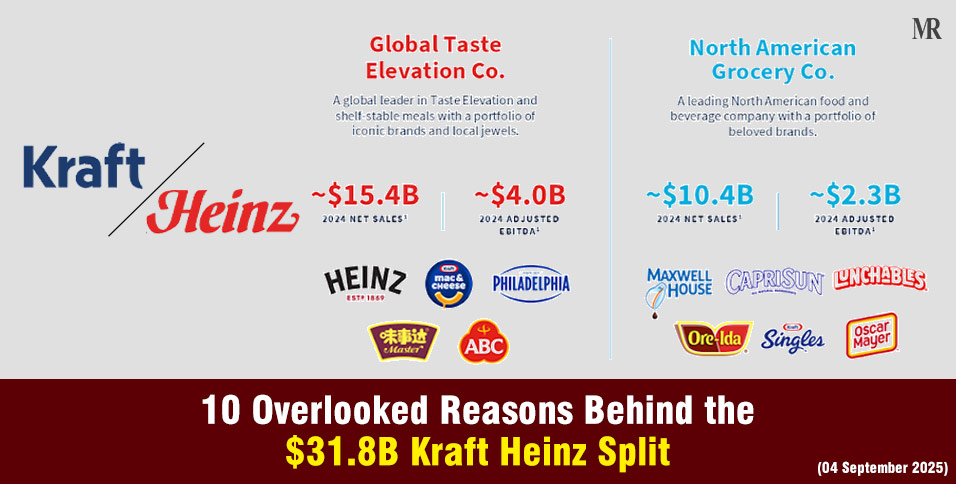
On September 2, 2025, Kraft Heinz announced that it would separate into two independent, publicly traded companies by 2025.
One will focus on global Taste Elevation brands like Heinz and Philadelphia; the other will focus on US-centered grocery and meal staples.
But the reasons behind the Kraft Heinz split may be more than just strategy, growth, and shareholder value, as they stated.
The Real Drivers of the Kraft Heinz Split
While focus is the public rationale, several underlying pressures and smart calculations are at play.
1. Shedding the “Big and Slow” Label:
Large conglomerates often get weighed down by numerous processes. Decisions take longer, experiments move more slowly, and opportunities slip away.
Splitting into two leaner entities means easy pivot, from launching new flavors to testing new markets, without the drag of being “too big to pivot.”
2. Attracting the Right Investors:
Right now, Kraft Heinz is a “mismatch” stock: growth investors see it as too sluggish, and income investors worry about risk in global expansion.
By splitting, shareholders will see the Kraft Heinz dividend maintained “in aggregate,” but with two stocks to choose from:
- Grocery Co. to appeal to those seeking stable returns
- Taste Co. to attract investors chasing international growth.
This creates clarity in investor identity.
3. Moving Past the 3G Capital Playbook:
The 2015 Kraft Heinz merger, engineered by 3G Capital and Berkshire Hathaway, was defined by aggressive cost-cutting (zero-based budgeting).
While it initially boosts profits, this approach has been criticized for starving brands of the investment needed for innovation and marketing.
A split allows one or both new entities to adopt a more growth-oriented financial strategy.
4. Unlocking a Higher Valuation:
Wall Street often undervalues conglomerates. Analysts call this the “conglomerate discount.”
Separating a high-margin global brand business from a slower-growth U.S. grocery business removes that drag.
In other words: together they’re worth less, apart they could be priced higher.
5. Opening the Door for M&A:
The Kraft Heinz split will create two smaller firms that are easier to pair with partners.
The global Taste Co. could bolt on niche startups in sauces or plant-based categories, while the U.S. Grocery Co. might itself be targeted by private equity looking for steady cash flows.
6. Responding to Shifting Consumer Habits:
Shoppers are demanding healthier, fresher, and more premium options.
Legacy grocery staples like Jell-O or boxed dinners need a modern strategy, while global sauces and spreads have stronger growth momentum.
Splitting lets each management team pursue tailored consumer playbooks.
7. Simplifying the Supply Chain:
Managing logistics for globally sourced condiments and US-centric refrigerated and packaged goods is incredibly complex.
By splitting, each firm can design supply chains optimized for its geography and product type. This can result in fewer compromises, lower costs, and faster delivery.
8. Creating Distinct Corporate Cultures:
The innovation-driven global unit needs risk-takers who think like entrepreneurs. The U.S. grocery unit needs steady operators skilled in cost control and retail negotiations.
The split gives each business freedom to hire and build a culture around its true mission.
9. Focusing on Core Strengths:
The split acknowledges that one business is best at building global brands and chasing growth. Meanwhile, the other is best at managing supply chains and winning price wars in U.S. grocery aisles.
Each can now focus on doing what it does best, without distraction.
10. Following Proven Precedent
Kellogg’s did it in 2023, creating Kellanova (snacks) and WK Kellogg (cereal). Mondelez did it earlier with Kraft snacks.
Both moves showed that splitting growth assets from mature ones creates clearer stories for markets.
Why Now?
The timing is crucial. Kraft Heinz isn’t breaking up under stress. It posted $6.3M in Q2 2025 sales and remains profitable.
This proves that the Kraft Heinz split isn’t because they are struggling financially. Instead, it shows a bigger industry logic: that smaller, focused companies can move faster in today’s fragmented food market.
It also shows a generational shift. The 3G Capital era of ruthless cost cuts is giving way to an era where agility, brand reinvention, and consumer responsiveness matter more.
The Struggle Of The Kraft Heinz Split
Kraft Heinz expects around $300 million in annual dis-synergies. It’s the extra costs of running two separate companies instead of one. That’s the immediate financial drag investors will watch closely.
Execution is another hurdle. Splitting supply chains, IT systems, and teams without losing efficiency is a heavy lift.
As CEO Carlos Abrams-Rivera put it, “…we believe we are in a position of strength to execute a separation of our businesses.”
So, the real test is whether both sides can build momentum quickly enough to outweigh the new costs.
The Bigger Picture
The Kraft Heinz Split is a sign that in today’s packaged food business, scale is no longer everything.
Two smaller, focused companies may stand a better chance of thriving in markets shaped by changing diets, evolving investor expectations, and tougher competition.
In other words, sometimes shrinking is the only way to grow.