The New Year of 2026 is starting with a clear message: technology is no longer a background enabler; it is the front‑stage engine of how people create, communicate, and grow businesses. Generative AI, real‑time video, and multimodal tools are converging into a new “always‑on” creative layer that sits on top of work and life.
A New Year Defined by Generative AI
Analysts expect 2026 to push generative AI from experimentation into deep operational use, especially in media, marketing, and enterprise workflows. Reports on 2026 AI trends highlight a shift from static content generation to systems that can generate and edit video, images, and audio in one integrated pipeline, driven by simple prompts and references.
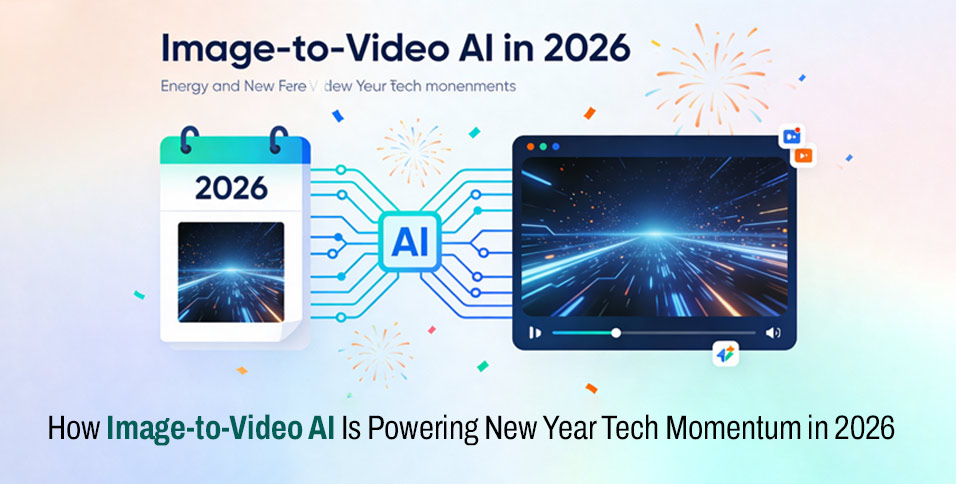
This momentum is especially visible in video: industry recaps for 2025–2026 forecast “dream to video in seconds,” automatic editing, and AI agents that handle entire production workflows from script to final cut. In that landscape, image‑to‑video technology is emerging as one of the clearest, most practical on‑ramps into the new era.
Image to Video AI as the On‑Ramp
For many creators and businesses, the first tangible taste of “new year AI momentum” is taking a single image and turning it into a finished video without touching a timeline. Tools marketed as Image to Video AI lower the threshold dramatically: upload a photo, describe motion and mood, and get a social‑ready clip in minutes instead of hours or days.
Arting’s Image to Video AI leans into this idea by offering free, browser‑based image‑to‑video generation without login or watermark, using a three‑step flow: upload, choose a model or style, click generate. VideoPlus’s Image to Video AI focuses on more granular control, including resolution, movement amplitude, aspect ratios, camera movement presets, and multiple AI video effects packaged in one interface.
Why Short‑Form Video Is Driving 2026 Tech Momentum
Tech outlooks for 2026 consistently point to video as one of the highest‑velocity areas of innovation because it sits at the crossroads of attention, communication, and commerce. Platforms and vendors expect automated video editing and AI‑first production to become standard—in marketing, education, customer support, and even internal documentation.
This shift is being pushed by three forces:
- Audiences prefer short, visual content on social and mobile.
- Teams are under pressure to ship more content with fewer resources.
- AI video tools now match or exceed “good enough” quality for many use cases, removing the need for traditional production in a large share of projects.
Image‑to‑video AI slots neatly into that triangle: a static product shot, illustration, or slide can become a motion‑driven asset for TikTok, Instagram Reels, YouTube Shorts, or in‑app explainers with almost no friction.
Two Paths: Arting vs. VideoPlus in the 2026 Wave
The New Year’s momentum is not just about “more AI,” but about different flavors of creation and control. Arting’s Image to Video AI positions itself as a zero‑barrier, free‑to‑try creator tool: no login, no watermark, designed for people who want to quickly animate photos or prompts for social, education, and lightweight marketing use cases. This makes it attractive for individual creators, students, and small teams who value speed and simplicity over detailed configuration.
VideoPlus’s Image to Video AI, by contrast, behaves more like a compact production console in the browser. Its workflow lets users:
- Upload images or text prompts and optionally add reference frames.
- Set resolution (up to 1080p), duration, movement amplitude, and aspect ratio (16:9, 9:16, 1:1).
- Choose camera moves such as push, pull, track left/right, rotation, or static shots, and apply film or visual art styles.
On top of that, VideoPlus layers specialized AI video effects (dance, emotion, romance, seasonal themes) plus text‑to‑video, reference‑to‑video, video enhancement, and watermark removal, so it can serve as a multi‑tool for more ambitious campaigns and recurring content schedules. This makes it particularly relevant for marketers, agencies, and small businesses who are building repeatable workflows, not just one‑off clips.
How Image-to-Video Fits Broader 2026 AI Trends
Generative AI trend reports for 2026 emphasize several big arcs that connect directly to image‑to‑video tools. First is real‑time or near‑real‑time generation: predictions for AI video in 2026 include interactive video scenes where creators adjust camera angles, lighting, or character expressions live and see the scene update immediately. Image‑to‑video pipelines are often used as a testing ground for this kind of responsive, low‑latency rendering.
Second is hyper‑personalization and branching experiences: AI video systems are expected to support dynamic scripts, custom avatars, and viewer‑dependent story paths at scale. Here, image‑to‑video AI becomes a way to rapidly generate variant shots—localized, personalized, or niche‑themed—from the same base imagery without re‑shooting.
Third is integrated sound and post‑production: forecasts point to AI systems that generate visuals, soundscapes, foley, and music with shared context, while folding editing into the generation loop. Platforms like VideoPlus already include AI video enhancement and voiceover/transition features in the same environment as image‑to‑video, foreshadowing that convergence.
Businesses Riding the New Year’s Wave
For businesses planning the year, 2026 is framed as a window to convert AI experiments into permanent, value‑producing workflows. Enterprise‑focused outlooks describe a move from “pilot projects” to integrated content pipelines where AI generates most routine video, image, and copy assets, while humans focus on strategy, concept, and oversight.
In this context, pairing tools like Arting’s Image to Video AI (for rapid ideation, quick social content, and education assets) with VideoPlus’s Image to Video AI (for more configurable, campaign‑oriented outputs) gives teams a layered stack: one for speed, one for control. Together, they illustrate a broader New Year trend: generative AI is not one monolithic solution, but a set of specialized capabilities that can be mixed and matched to meet different creative and business needs.
From Novelty to Infrastructure
Strategic perspectives on 2026 argue that generative AI—including image‑to‑video—is on its way to becoming infrastructure, similar to cloud or mobile. Once that happens, competitive advantage comes from how well organizations orchestrate these tools, not just whether they use them.
The New Year therefore marks a shift in mindset: instead of asking “Should we try AI video?”, teams are asking “Which workflows do we rebuild around Image to Video AI, and which platform—Arting or VideoPlus—fits each step best?” As 2026 unfolds, the organizations that answer that question early will be the ones turning technological momentum into durable creative and commercial momentum.