
There is a particular quality of attention that only live entertainment seems to produce. The crowd thickens as showtime approaches. The air changes. And somewhere between the sound and the light and the collective willingness of thousands of strangers to feel the same thing at the same time, people open up in a way that almost no other environment can replicate. They are present. They are emotionally available. They are, in the vocabulary of modern marketing, precisely the audience that every brand in the world wants to reach.
Mitch Strong noticed this years ago. But he also noticed something that sat alongside that observation like an uninvited guest: the industry built around that extraordinary human moment was, commercially speaking, deeply fractured.
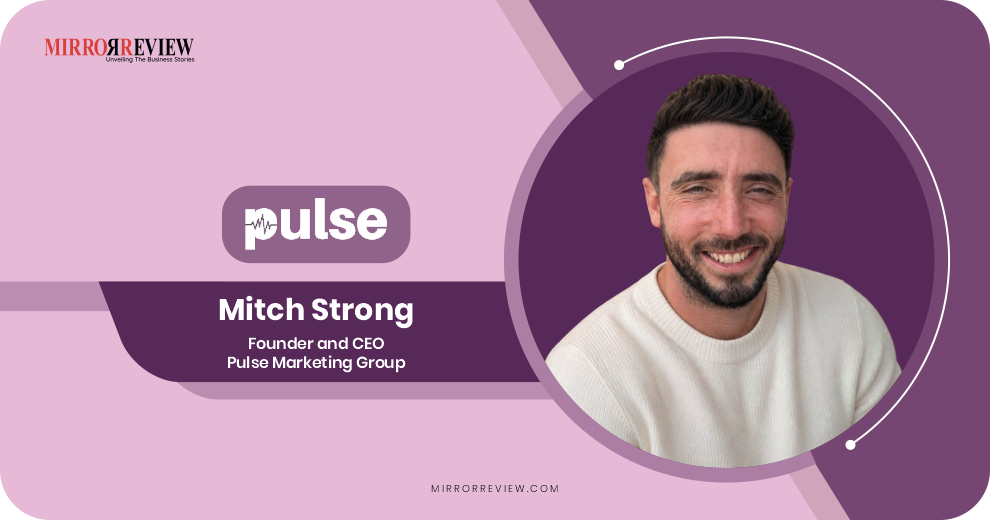
Strong is the Founder and CEO of Pulse Marketing Group, a London-based agency he founded in 2022. He is measured, warm, and carries the particular conviction of someone who has watched a problem go unsolved for long enough that building the solution begins to feel less like a choice and more like an obligation. His entire professional life has been spent in marketing, leading commercial teams and building brand partnerships, working agency-side as a Commercial Director, developing and delivering award-winning partnership strategies for some of the world’s most recognised brands.
The work was sophisticated. The results were measurable. And throughout all of it, his heart was elsewhere.
The Gap That Became Impossible to Ignore
“My personal passion has always been live entertainment,” Mitch says. “Festivals, music, culture. That’s where audiences are most engaged, most emotionally connected, and most open to brand interaction when it’s done well. That’s also where I’ve had the most fun.”
What he observed, standing at the intersection of his professional expertise and his personal passion, was a gap of striking proportions. On one side, modern marketing has evolved rapidly into a world of content strategy, social platforms, performance metrics, and measurable, accountable outcomes. On the other hand, the live entertainment sponsorship model had barely stirred. It was still running on static rights packages, logo placements, and deal-making spread across multiple disconnected parties who operated largely in isolation from one another.
“Despite being one of the most powerful environments for brand engagement,” Mitch reflects, “it wasn’t operating like a modern marketing channel.”
Brands were struggling to extract real value from live environments. Rights holders were underutilising the platforms they owned. Advertisers were spending enormous energy piecing solutions together across multiple agencies, with no unified thread holding any of it in place. The industry was powerful in theory and inefficient in practice.
That gap, as Mitch would later describe it, became impossible to ignore. And so, in 2022, he stopped ignoring it.
One Problem, One Solution, One Company
Pulse was built to solve a single, clearly defined problem: fragmentation. The live entertainment industry, for all the emotional and cultural weight it carries, was completely disjointed. A brand wanting to activate in this space had to navigate multiple festivals, multiple agencies, multiple production partners, and multiple media channels, all separately, all without a unifying hand on the wheel.
“It’s inefficient, expensive, and almost impossible to scale properly,” Mitch says.
The solution he created was Pulse: a single, unified partner for brands, capable of handling everything from strategy and sponsorship through to creative video production, experiential activations, media planning, and delivery at scale. One entry point into an entire landscape. The mission, stated plainly, is “to make live entertainment work like a modern marketing channel. Not a one-off activation. Not a vanity spend. A scalable, measurable, high-performing channel.”
Crucially, Pulse was designed to be independent by design. Not tied to any specific network, inventory, or pre-packaged solution. This matters considerably. As Mitch observes, most rights holders are structurally set up to sell their own assets, with commercial teams incentivised to move their own portfolio regardless of whether it truly serves the brand in question.
“Instead of objective guidance, brands are often being sold what’s available or what ‘needs’ to be sold, rather than what will deliver the best outcome,” he says. Pulse was built precisely to be the alternative to that model.
Five Pillars, One Connected System
Pulse operates across five core areas, each designed to address a specific failure point in the traditional industry structure.
Strategy and Discovery sit at the foundation, powered by Songbird, Pulse’s proprietary intelligence technology. Rather than relying on relationships or instinct, Songbird maps the global live entertainment ecosystem and enables brands to input a structured brief covering objectives, audience, target markets, and budget, instantly surfacing the most strategically and commercially aligned opportunities.
Sponsorship and Rights Management provides centralised access to Pulse’s global network spanning hundreds of festivals, venues, and live experiences, including major festivals, independent events, grassroots venues, and emerging cultural spaces. What would otherwise require multiple disjointed negotiations is streamlined into a single, cohesive approach.
Creative and Production develops content-led ideas designed to live both on-site and across digital platforms, with a focus on producing work that audiences actively engage with rather than passively ignore.
Experiential and Brand Activations handles the physical dimension of a campaign, designing and delivering brand experiences built to feel entirely native to the live environment, from initial concept through to full execution on the ground.
Media and Amplification extends campaigns well beyond the event itself, delivering precise digital media strategy, targeted distribution, and detailed reporting across the Pulse network, transforming what was once a single live moment into an ongoing, scalable media channel.
But the component that underpins all of this, and where Mitch believes the real differentiation lives, is Songbird. In execution, it functions as the centralised platform where an entire partnership resides, bringing together rights, costs, creative designs, content plans, event mapping, and media outputs into one transparent system. It creates a level of visibility and control that simply hasn’t existed in this category before.
“Instead of managing multiple trackers, suppliers, and conversations, brands have a single view of everything,” Mitch explains. “What they’re investing in, how it works, and what it delivers.”
That combination of intelligence and delivery, discovery and execution housed in a single platform, is what transforms a traditionally complex and disjointed process into something structured, transparent, and commercially accountable.
Authenticity Is Not an Aesthetic Choice
Ask Mitch what separates a partnership that genuinely works from one that is little more than a logo on a banner, and his answer arrives without hesitation.
“You have to start with the audience, not the brand,” he says.
It sounds self-evident. In practice, it cuts sharply against the way most sponsorship deals are assembled. Brands arrive with a message they want to deliver, and then attempt to find a space in which to deliver it, regardless of whether that space belongs to them culturally or experientially. The result is the kind of activation that festival crowds walk past without registering.
Mitch tests every partnership against three clear questions: Does the brand make sense in that space? Does it add genuine value to the audience experience? Would people engage with it even if it were not branded? “If the answer to those isn’t yes, it needs rethinking.”
The best partnerships, in his view, do not interrupt the experience. They become part of it. And they do not end when the event does. The real value lies in the content, the storytelling, and the amplification that audiences continue to encounter and engage with long after the stages have been dismantled.
“The best partnerships today are hybrid models,” Mitch notes, “part sponsorship, part media engine, part content platform.”
The Numbers That Changed the Conversation
Pulse was founded in 2022 and built without a single pound of external investment. Completely bootstrapped, it grew from zero to a multi-million-pound business in just over two years. Last year, the company scaled 7x year-on-year. This year, Pulse has already matched that full revenue figure at the midpoint of the financial year alone.
These are not modest numbers for a young agency in a category that the broader marketing world has historically treated as peripheral.
But the figures Mitch reaches for most readily are not his own. They belong to the brands he works with. In 2025 alone, Pulse delivered over 100 million impressions for brands across its campaigns. Across experiential activations, it achieved over 90% in purchase intent, advocacy, and brand love. On branded content, engagement rates came in at up to 8x higher than industry benchmarks.
Those results have done something that pitch decks and persuasive conversations rarely achieve on their own: they have changed how people think.
“Partners who initially approached live entertainment as a one-off activation are now coming to us to treat it as a core part of their marketing strategy,” Mitch says. “Integrated, measurable, and commercially accountable.”
Brands where Pulse has already demonstrated the effectiveness of its model include Nivea, Lululemon, and Heineken. Looking into 2026, the roster continues to grow, with global partners including L’Oréal, FIAT, COTY, Calvin Klein, Capri-Sun, and Henkel now coming on board.
“That change in perception,” Mitch says, “is the real milestone. The growth simply reflects it.”
The long-term vision is clear and unambiguous: to become the operating system for live entertainment marketing. Not simply to serve campaigns, but to reshape the infrastructure of how the entire industry operates.
Not a Luxury. A Strategic Channel.
One of the most persistent narratives Mitch encounters is the idea that live entertainment is a discretionary budget item. Something brands invest in during the good years and quietly remove when priorities tighten. He understands the origin of that perception.
Historically, live entertainment sponsorship has lacked the measurement infrastructure that would make it defensible in a performance-driven marketing environment. It was positioned as brand-building rather than performance-driving. Atmospheric rather than accountable. And without accountability, it was always going to be vulnerable.
Pulse’s approach is a direct challenge to that framing. By structuring partnerships with defined media outputs, tracking performance across reach, engagement, and brand impact, and embedding live entertainment within the wider marketing ecosystem rather than treating it as a standalone event, the channel becomes something categorically different.
“When you can show that a festival partnership can deliver millions of impressions, high engagement, and real audience connection,” Mitch says, “it stops being a luxury. It becomes a strategic channel.”
The comparison he draws is deliberate and pointed. When measured and executed properly, live entertainment is capable of delivering scaled attention, meaningful engagement, and commercially accountable outcomes that sit on par with, and often outperform, more traditional digital and social investments.
The Man Behind the Mission
It would be easy, reading all of this, to picture Mitch Strong as someone entirely consumed by the architecture of his industry. The systems, the technology, the commercial logic. And the evidence suggests he is very serious about all of it.
But he is also, and perhaps more importantly, someone who goes home.
“My family comes first,” he says, with a simplicity that feels entirely genuine. His wife and his two boys set the structure of his days. He is present in the mornings. He is there at the end of the day to help get them to bed. “That time is non-negotiable.”
He speaks with equal warmth about his close group of friends and the importance of staying socially connected. These are not afterthoughts. They are the things he protects deliberately.
What makes this balance sustainable, he suggests, is partly structural and partly something harder to articulate. “I’ve built a business in a space I genuinely love. We’re creating new things every day, working on exciting ideas, building world-first campaigns, and doing it with a team that has a great culture. It doesn’t feel like a burden.”
His philosophy, stated simply, is this: “Balance through structure. Be present at home, show up for people you love, work hard when it’s time to work, and make space for the people around you.”
His closing message to anyone navigating their own industry, whether in live entertainment or anywhere else, is as direct as the man himself.
“Don’t accept broken systems. The reason Pulse exists is that we challenged the way things were done. Every industry has inefficiencies. Most people work around them. The opportunity is in fixing them.”
That, in the end, is what Pulse is. Not simply an agency. Not only a technology platform. It is the deliberate, considered product of someone who looked at a space he loved, saw precisely what was wrong with it, and decided that the most commercially intelligent thing he could do was also the most personally meaningful.
The heartbeat of live entertainment, it turns out, simply needed someone willing to listen to it properly.
Quotes
“The old model was simple: pay for space, show up, hope it works. That’s not a strategy. That’s a .”
Read more : The Most Trailblazing Live Entertainment & Music Marketing Leaders


