
AI is already writing copy, triaging support tickets, and nudging people to “take a deep breath” when they’re stressed out, but what does that actually mean for mental health?
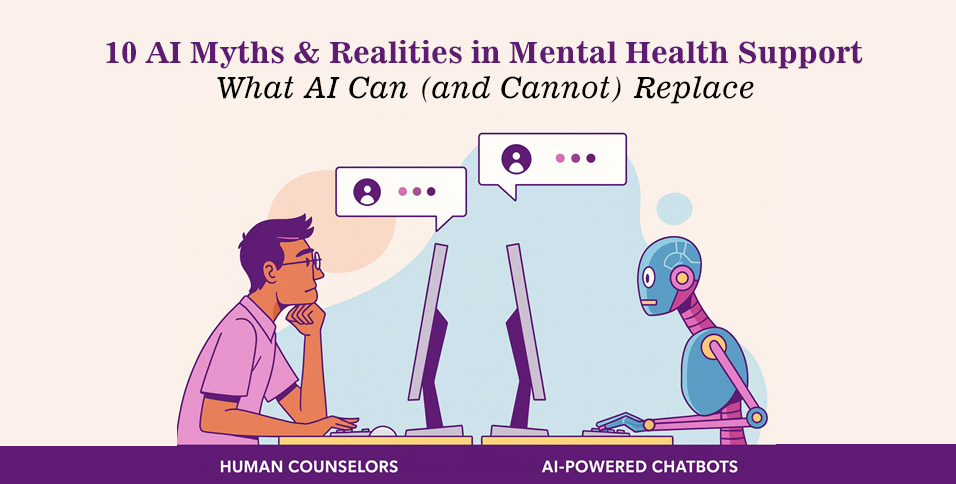
In the last few years, AI therapy software, chatbots, and digital mental health apps have exploded in popularity. At the same time, clinicians, researchers, and regulators keep repeating one important point: AI can support mental health. It cannot replace human counselors or licensed therapists.
This blog breaks down 10 myths and truths about AI in mental health, with an honest look at what AI does well, where it can go wrong, and why human care remains irreplaceable.
1. Myth: AI therapy software can replace human therapists
Reality: AI is a support tool, not a therapist.
Researchers and professional bodies are increasingly clear as confirmed by APA Services, that unregulated AI chatbots should not be used as a substitute for mental health treatment. The American Psychological Association notes that generic AI chatbots can mislead users and pose serious risks, especially for vulnerable people seeking emotional support.
A Stanford analysis of “AI therapy chatbots” found they may be less effective than human therapists and can even reinforce stigma or produce harmful replies if used without safeguards. A Brown University study in 2025 went further, showing that many AI chatbots systematically violate core mental health ethics standards, highlighting the need for oversight and regulation.
National health systems are also sounding alarms. In the UK, NHS England has warned young people not to treat AI chatbots as therapy, emphasizing that these systems lack nuance, emotional awareness, and crisis-handling capabilities. While AI tools can support mental health education and offer self-guided exercises, real emotional care still requires human connection. That is why many firms take a fundamentally different approach. To bring genuine, empathetic support to employees, it is becoming increasingly common for organizations across the U.S. to partner with mental health companies to provide consistent, human-led mental health care.
Instead of automated chatbots or AI therapy software, most mental health companies offers:
- 24/7 access to live, text-based sessions with trained, licensed human counselors.
- Some companies offer non-therapy, non-diagnostic models, designed to help people navigate everyday stress, relationships, challenges, and emotional well-being.
- A private, secure way to talk to a human without stigma or judgment.
In a nutshell:
- AI tools educate.
- Therapists support.
- AI can scale.
- Humans heal.
So, AI can offer guidance, exercises, and education. It cannot ethically:
- Diagnose mental health conditions
- Provide psychotherapy
- Manage crisis situations
- Take responsibility for clinical outcomes
That work still firmly belongs to trained humans.
2. Myth: AI really “understands” your feelings
Reality: AI recognizes patterns in language, it doesn’t feel or understand like humans do.
Modern large language models (LLMs) are built on transformer architectures, introduced in the landmark 2017 paper Attention Is All You Need. These models convert text into numerical representations and learn statistical relationships between words.
So when you type:
“I feel completely overwhelmed and alone.”
An AI model doesn’t feel concern or empathy. It identifies patterns similar to millions of sentences it has seen, then generates a likely “helpful” response.
Psychologists and reviewers of mental health chatbots consistently note that empathy, context, and emotional presence remain major limitations of AI-based tools.
That’s why AI responses may sound caring but still:
- Miss important risk cues
- Misinterpret severity
- Offer generic or mismatched suggestions
Human counselors bring lived experience, emotional attunement, and ethical judgment to the conversation, things AI does not have.
3. Truth: AI mental health tools can expand access
This is where AI genuinely shines, when used carefully.
Multiple reviews show that digital mental health tools (including apps, web platforms, and VR-based interventions) can reduce short-term stress, anxiety, and depressive symptoms, especially when they’re evidence-informed and properly designed.
A large review of chatbot-based mobile mental health apps found that they can deliver practical, scalable support, including basic cognitive behavioral strategies and mood tracking, though long-term evidence and safety data are still emerging.
From a systems perspective:
- Employers are using digital mental health tools to support employee resilience and well-being
- Insurers and health organizations see AI-powered chatbots as a way to reduce access barriers like cost, stigma, geography, and wait times.
- Governments (e.g., India’s Tele MANAS program) are exploring AI-based mental health solutions as part of national strategies to scale care.
Used ethically, AI can:
- Offer 24/7 psychoeducation and coping tools
- Help students and employees reflect earlier, before issues escalate
- Complement (not replace) existing counseling or support programs
4. Myth: AI therapy software is “safe enough” out of the box
Reality: There are serious, documented risks.
Recent research and investigations show that generic AI chatbots can:
- Provide harmful or pro-disorder guidance to people with eating disorders, including tips for hiding symptoms and generating “thinspiration” images.
- Systematically violate mental health ethics, for example, failing to prioritize safety or recommend professional help when needed.
- Offer inappropriate or stigmatizing responses to vulnerable users, according to studies from Stanford and others.
OpenAI itself has reported that more than a million users per week show suicidal intent in conversations with ChatGPT, underlining the scale of mental-health-related interactions happening with general AI tools.
Regulators and health systems are therefore emphatic:
- AI chatbots must not be marketed or used as stand-alone therapy.
- Human oversight, clear disclaimers, crisis protocols, and strict safety controls are non-negotiable.
Takeaway for organizations: if you deploy AI-powered mental health tools, you must design them as supports within a broader, human-led ecosystem, not as clinical care.
5. Truth: Both the brain and AI learn through “prediction”
Neuroscientist Donald Hebb’s famous principle, often summarized as “neurons that fire together, wire together”, captures how repeated patterns of activity strengthen brain connections over time.
Modern neuroscience calls this experience-dependent neuroplasticity: the brain continually rewires itself based on what we pay attention to, think about, and practice.
In parallel:
- AI language models learn by adjusting billions of numerical weights to better predict the next word in a sentence, based on massive training datasets.
The analogy has limits, but it’s useful:
- Human brains: learn from lived experience, emotion, social feedback, and meaning.
- AI models: learn from statistical patterns in data.
Both improve with quality input and focused “attention,” but only humans bring values, context, and lived perspective to decisions about mental health.
6. Myth: AI in mental health is brand new
Reality: AI is decades old, what’s new is visibility and scale.
The term “artificial intelligence” was coined in the 1950s during the Dartmouth Summer Research Project on AI, often called the founding event of the field.
Long before chatbots and mental health apps:
- Machine learning powered search ranking, fraud detection, and recommendation engines (think ads, Netflix suggestions, and credit card fraud alerts).
- Basic AI systems were quietly embedded in medical imaging, decision support, and triage tools.
What changed in the late 2010s and early 2020s?
- The transformer architecture radically improved language understanding and generation, unlocking today’s wave of large language models (LLMs).
- These LLMs became accessible to the public through chat interfaces, making AI feel “suddenly” everywhere, including in mental health.
7. Truth: AI can boost productivity for clinicians and organizations, if used wisely
Studies of digital tools in employee wellness and healthcare show that thoughtfully designed technology can enhance well-being and resilience by making support more personalized and accessible.
For mental health professionals and institutions, AI can help with:
- Drafting psychoeducational materials and handouts
- Summarizing intake notes or anonymized session reflections (with strict privacy controls)
- Identifying recurring themes in large volumes of de-identified feedback
- Supporting triage in non-crisis contexts (e.g., routing users to self-help, peer support, or human-led services)
AI-driven virtual therapists and chatbots are already being explored as scalable complements to traditional services, especially in low-resource settings, but researchers repeatedly stress that evidence is mixed and they must not be used as stand-alone replacements.
Good practice: use AI to reduce admin burden and increase reach, while keeping clinical judgment, ethics, and care firmly in human hands.
8. Myth: AI mental health tools work equally well for everyone
Reality: AI reflects the data it’s trained on, and that data is not neutral.
Systematic reviews of mental health chatbots highlight multiple limitations:
- Bias and representativeness: If training data underrepresents certain cultures, languages, or identities, AI tools may offer less relevant or even harmful guidance to those groups.
- Empathy and personal connection: Chatbots struggle to simulate the depth of human conversation, particularly for complex emotional experiences.
- Risk of misinterpretation: Without rich context, AI can misread seriousness, misclassify symptoms, or overlook crucial safety cues.
This is especially important when working with:
- marginalized communities
- LGBTQ+ youth
- people with complex trauma
students or employees facing overlapping stressors
Takeaway: fairness, inclusion, and safety cannot be assumed, they must be designed, tested, and audited into AI systems. On the other hand, human-based solutions like a mental health coach can pick up on tone, context, and subtle emotional cues that AI simply doesn’t understand. A coach can respond with genuine empathy, recognize cultural or personal nuances, and build the kind of trust that only develops through real human connection.
9. Truth: AI and humans share a “superpower” called attention, but they use it differently
The transformer models behind tools like ChatGPT are built around a mechanism literally called “attention”, they learn to focus on the most relevant parts of the input when generating each word.
Humans also rely on attention:
- What you repeatedly focus on shapes neural pathways over time, “mental states become neural traits.”
- This neuroplasticity is the basis for many therapeutic and coaching techniques: practicing new ways of thinking, behaving, and relating strengthens corresponding circuits in the brain.
The parallel is helpful, but not identical:
- For AI: attention is a mathematical operation over vectors.
- For humans: attention is tied to meaning, values, and lived experience.
Used well, AI can help people direct their attention toward healthier habits, gratitude practices, reflection prompts, coping strategies, while human support provides context, safety, and depth.
10. Myth: You need a fancy degree to use AI safely in mental health contexts
Reality: The fundamentals are widely accessible, and often free.
Understanding AI at a practical level is no longer restricted to engineers or researchers. Some globally recognized organizations now offer beginner-friendly AI courses that focus on responsible use:
- Google AI Essentials – teaches foundational AI concepts and how to use generative AI tools productively, with no prior experience required.
- IBM SkillsBuild AI courses – introduce core AI topics (machine learning, NLP, chatbots) and include credentials for completing fundamental tracks.
- Harvard’s CS50: Introduction to Artificial Intelligence with Python – a free-to-audit university-level course covering the core algorithms behind modern AI.
For mental health organizations, schools, and workplaces, the goal is not to turn everyone into AI engineers, but to:
- Understand what AI can and cannot do
- Ask good questions about safety, privacy, and ethics
- Integrate AI into mental health strategies in measured, human-first ways
Last Words
AI therapy software and mental health apps can bring something genuinely new:
- Immediate, 24/7 access to structured exercises
- Gentle prompts to reflect, journal, or practice coping skills
- Bridge support between sessions or when human staff are unavailable
- An entry point for people who feel too anxious or stigmatized to seek help initially
But they cannot replace:
- The therapeutic relationship
- Clinical assessment and diagnosis
- Nuanced, culturally informed understanding
- Crisis intervention and safety planning
- Long-term, relational work on trauma, identity, and meaning
Research and regulators are aligned: AI should be treated as adjacent to care, not as care itself. The most promising path forward is hybrid: AI-powered tools helping more people reach human clinicians and trained supporters sooner, with better information and ongoing support between touchpoints.
Disclaimer: Nothing here is medical advice. If you’re in crisis or concerned about your mental health, please contact a licensed professional or local emergency services.








