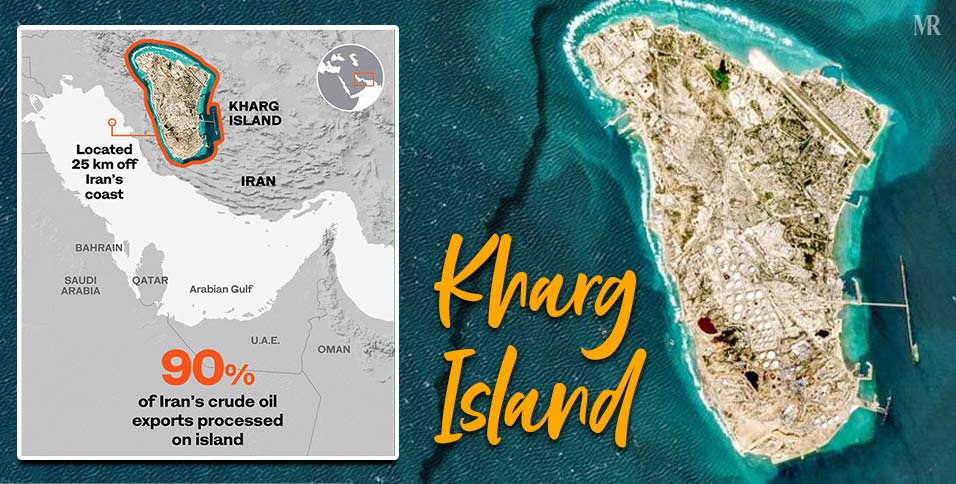
Did you know about a small coral island that runs its nation’s economy and steals the attention of global powers?
That is the power of Iran’s Kharg Island.
Just 25 km off Iran’s coast, Kharg Island does what the mainland cannot:
It welcomes massive supertankers into its deep waters, channeling nearly 90–94% of Iran’s oil exports. That makes it both indispensable and dangerously exposed, especially amid rising tensions in the 2026 Iran conflict.
In this blog, we’ll break down why Kharg Island matters so much, from its unique geography and massive oil infrastructure to its role in war, history, and global energy stability.
Kharg Island at a Glance
The physical and operational characteristics of the island define its role in the global energy market. The following table summarizes the key data points that illustrate why this location is so critical to Iranian national security.
| Category | Technical and Demographic Data |
| Official Designation | Kharg Island (also known as Khark) |
| Geographic Location | 25 km (16 mi) off the coast; 55 km (34 mi) NW of Bushehr |
| Total Land Area | Approximately 20–22 square kilometers |
| Dimensions | 8 km long (North-South) by 3–5 km wide |
| Population | 8,193 (as of 2016 census) |
| Oil Export Capacity | 7 to 10 million barrels per day |
| Oil Storage Capacity | 24.5 to 30 million barrels |
| Loading Facilities | 10-berth T-jetty; 4-berth Sea Island |
| Security Force | Islamic Revolutionary Guard Corps (IRGC) |
| Highest Elevation | Kūh-e Dīdeh Bānī (70 meters) |
Kharg Island Location & Geography
The strategic value of Kharg Island Iran is due to its unique geological and maritime positioning.
Located in the northern reaches of the Persian Gulf, the island sits approximately 25 kilometers from the Iranian mainland and 55 kilometers northwest of the major port of Bushehr.
It is a continental island composed primarily of rocky limestone and coral outcrops, which has allowed for a level of structural stability necessary for massive industrial development.
The primary geographic advantage of Kharg Island is the depth of the sea immediately surrounding its shores.
While much of the Persian Gulf is relatively shallow, making it difficult for the world’s largest oil tankers to maneuver near the coast, the waters around the island are deep enough to accommodate Ultra Large Crude Carriers (ULCCs) and supertankers.
This allows these vessels to dock and load crude oil directly from the island’s facilities rather than relying on more expensive and time-consuming ship-to-ship transfers or offshore buoy systems.
Furthermore, the Kharg is one of the few islands in the Persian Gulf that possesses its own natural freshwater resources.
The porous limestone structure acts as a natural reservoir for rainwater, which has historically allowed for permanent human settlement in an otherwise arid maritime environment.
Furthermore, this freshwater also supports a unique local ecosystem, most notably a population of gazelles that roam the island, providing a stark contrast to the sprawling refineries and storage tanks.
Moreover, the highest point on the island, Kūh-e Dīdeh Bānī, reaches 70 meters and has historically served as a lookout point for monitoring maritime traffic in the Gulf.
Strategic & Economic Importance Of Kharg Island
The modern significance of Kharg Island is almost entirely tied to its role as the economic lifeblood of the Iranian state. The island is the undisputed backbone of the national economy and acts as the primary gateway for the country’s most valuable resource: Oil.
Revenue Generation and National Stability
Iran oil exports account for approximately half of the national budget, and because 90% to 94% of those exports leave via Kharg Island, the island’s operational status is directly linked to the government’s ability to pay salaries, fund social programs, and maintain its military.
Moreover, the island handles an average of 950 million barrels of oil every year, with a historical loading capacity that has reached as high as 7 to 10 million barrels per day.
The primary destination for the oil leaving Kharg is Asia, with China serving as the leading importer. In recent years, China has purchased nearly 90% of the oil exported from the island, creating a critical economic partnership that bypasses many Western sanctions.
This makes the island not just a domestic asset, but a vital link in the energy security of the world’s second-largest economy.
Geopolitical Leverage and Vulnerability
The concentration of nearly all of Iran’s export capacity on a single 22-square-kilometer Kharg island creates a profound paradox.
While it allows Iran to centralize its resources and protect them with elite forces like the IRGC, it also provides a clear “center of gravity” for its enemies.
In military terms, the island is a “high-value target.” Any sustained disruption to its facilities would immediately cripple the Iranian economy, potentially leading to domestic instability and a collapse of the regime’s foreign policy reach.
This vulnerability gives the island immense leverage in international negotiations.
Moreover, Iran has frequently used the threat of closing the Strait of Hormuz or disrupting regional oil flow as a deterrent against foreign intervention.
Thus, Kharg Island is the physical manifestation of this leverage, and its safety is a MUST for regional economic stability.
Kharg Island Oil Terminal: How Does It Move Crude Oil
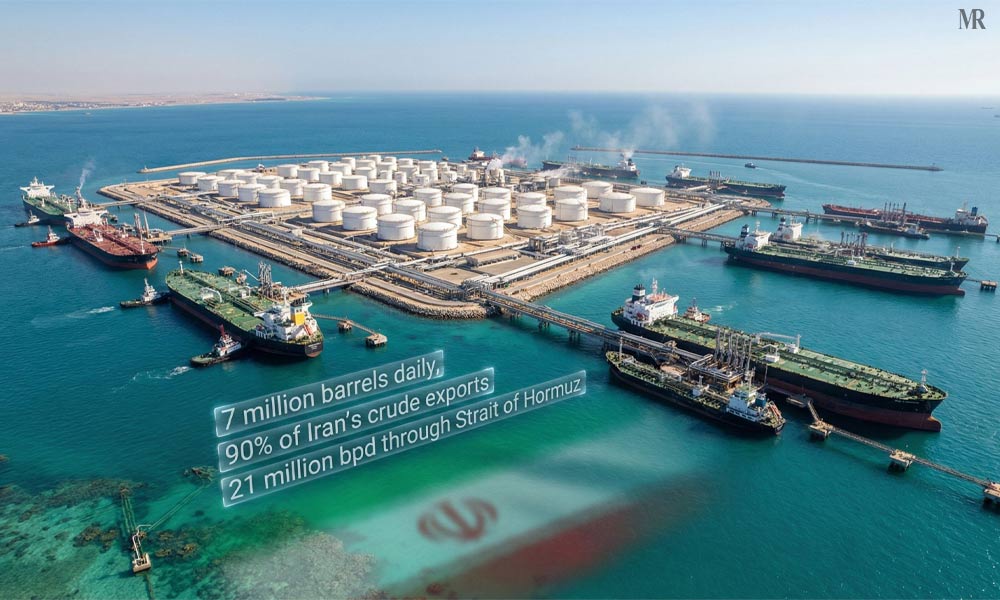
The oil terminal on Kharg Island is a marvel of 20th-century engineering, designed to move massive quantities of crude oil with speed and reliability.
The facility is managed by the National Iranian Oil Company (NIOC) and consists of an intricate network of pipelines, storage tanks, and loading berths.
Pipeline Infrastructure and the Gurreh Connection
Crude oil does not originate on Kharg Island; it is transported from the massive onshore fields of the Khuzestan province. The oil flows through two primary trunkline systems that converge at the Ganaveh manifold station on the Iranian coast.
- The Gachsaran-Ganaveh System: This 30-inch pipeline system began operations in 1960 and was later expanded to handle crude from the Bibi Hakimeh and Binak fields.
- The Agha Jari-Ganaveh System: Built in 1965, this 42-inch pipeline was one of the first long-distance gravity delivery lines of its size, capable of transporting nearly a million barrels per day without the need for active pumping.
- The Ahvaz-Ganaveh System: Completed in 1972, this system utilizes 42-inch and 48-inch pipes to deliver crude from the Ahvaz field to the coast.
From the Ganaveh station, the oil is pushed through six major submarine pipelines that cross the 25-kilometer stretch of sea to Kharg Island. These include multiple 30-inch lines, a 42-inch light crude line, and a massive 52-inch heavy crude line.
A critical component of this network is the Gurreh booster station, located 40 kilometers upstream from the coast. This station ensures that the oil maintains the necessary pressure to reach the island’s storage tanks.
Storage and Loading Mechanics
Once the oil reaches Kharg Island, it is stored in a massive tank farm. The island features 41 operational crude oil storage tanks with a total capacity of approximately 24.5 to 30 million barrels.
In a move to expand its export resilience, Iran added 2 million barrels of capacity in 2025 by rehabilitating two large tanks, each capable of holding 1 million barrels.
The loading process itself is optimized by the island’s topography.
The storage tanks are situated on elevated ground, allowing the oil to flow via gravity to the tankers at the docks. This gravity-flow system is a key defensive feature, as it allows loading to continue even if the island’s electrical power systems are compromised.
There are two primary loading areas:
- The T-Jetty: An L-shaped pier on the eastern side of the island with 10 berths that can handle tankers up to 250,000 deadweight tons.
- The Sea Island: A specialized four-berth facility located 2 kilometers off the western shore in deeper water, designed specifically to accommodate 500,000-ton supertankers.
Military History & Attacks (Iran-Iraq War)
Because of its economic importance, Kharg Island has been a primary theater of military operations for decades. Its ability to withstand and recover from attack is a central part of its legend in Iranian history.
The “Tanker War” of the 1980s
During the Iran-Iraq War (1980–1988), the island was the target of a relentless campaign by Iraqi forces. Known as the “Tanker War,” this period saw Iraq launch hundreds of air strikes against the island’s facilities and the tankers attempting to load there. Iraq’s goal here was to cut off Iran’s oil revenue and force a surrender.
The island’s defenses were tested to their limit. Iraqi Mirages and Super Étendards frequently struck the T-jetty and the tank farms, causing significant damage. However, the island proved surprisingly resilient. The gravity-flow system and the redundancy of the loading berths allowed Iran to maintain a steady, if reduced, flow of oil throughout the conflict.
Furthermore, Iranian engineers became adept at “battlefield repairs,” often patching together damaged pipelines and jetties under the cover of night to ensure that the next morning’s tankers could still be filled.
Lessons from the Conflict
The Iran-Iraq War taught the Iranian leadership that Kharg Island was its most vulnerable point. Following the war, they invested heavily in advanced air defense systems, including surface-to-air missiles and hardened underground facilities, to protect the island.
They also placed the island under the direct protection of the IRGC, transforming it into a “Forbidden Island” where security is the highest priority.
These historical lessons set the stage for the island’s role in the 2026 conflict.
Current News & Developments
In 2026, Kharg Island once again became the epicenter of a major regional war. The conflict, which began on February 28, 2026, involved the United States and Israel launching a series of operations against Iranian infrastructure.
The March 2026 Strikes
On March 13, 2026, U.S. forces conducted a massive precision Kharg Island attack. According to CENTCOM, over 90 military targets were hit, including facilities used for storing naval mines and missiles intended to block the Strait of Hormuz.
These strikes were strategically designed to “totally obliterate” the military threat on the island while leaving the oil export infrastructure intact.
This decision by the U.S. government was a calculated move. By destroying the military assets but sparing the oil terminals, the U.S. aimed to maintain leverage over the Iranian regime without causing an immediate global economic catastrophe.
However, President Donald Trump warned that if Iran continued to interfere with international shipping, the oil facilities themselves would be targeted next.
Leadership Changes and Economic Impact
The 2026 war conflict also saw a dramatic change in Iranian leadership.
Following the death of Supreme Leader Ali Khamenei in the early days of the war, his son, Mojtaba Khamenei, was appointed as the new leader. This transition indicates a regime that is investing more in security and survival.
Meanwhile, the war has caused global oil prices to skyrocket. Brent crude rose to $115 per barrel in late March, with analysts predicting it could reach $153 or even $200 if the facilities on Kharg Island are ultimately destroyed.
Challenges & Risks Of Kharg Island
Kharg Island faces a set of challenges that are as immense as its importance. These risks range from immediate military threats to long-term economic and environmental concerns.
1. Military Seizure vs. Blockade:
In the 2026 conflict, military experts have debated whether the U.S. should seize the island or simply blockade it. While seizing the island would give the U.S. total control over Iran’s oil, holding it would be extremely difficult. The island is only 26 kilometers from the coast, making U.S. troops vulnerable to constant artillery and drone attacks from the mainland.
2. Environmental Fragility:
The concentration of oil activity in a sensitive coral reef environment is a constant risk. Even small leaks, which are occasionally visible on satellite imagery, can have long-term impacts on the Persian Gulf’s biodiversity. A major strike on the tank farm could lead to an environmental disaster of unprecedented scale.
3. The “Orphan Pearl” Paradox:
The writer Jalal Al-e-Ahmad once called the island the “Orphan Pearl” because of its isolated beauty. Today, that pearl is encased in steel and concrete. The challenge for the future is whether the island can ever return to being a place of cultural and biological significance, or if it is destined to remain a “forbidden” industrial fortress forever.
End Note
The story of Kharg Island is the story of modern Iran itself: a nation built on an ancient and diverse foundation that has become increasingly defined by its struggle to control and defend its massive energy reserves.
As the economic heart of the country, the Kharg Island is both its greatest strength and its most dangerous vulnerability.
The world’s eyes will remain fixed on this small coral outcrop, for as long as the oil flows from its docks, the fate of the global economy and the stability of the Middle East will remain inextricably linked to the survival of Kharg Island.
Maria Isabel Rodrigues
FAQs
- Why is Kharg Island important to Iran?
Kharg Island is the primary export hub for Iranian crude oil, handling approximately 90% of the nation’s total exports. Its importance is primarily economic, as it provides the revenue necessary to fund the national government and its military operations. Strategically, its deep-water access is the only way for Iran to load large supertankers efficiently.
- What is the significance of Kharg Island?
Beyond its economic role, the island is significant for its long history as a crossroads of civilizations. It contains ancient Achaemenid inscriptions, 7th-century Christian ruins, and evidence of colonial occupations by the Portuguese, Dutch, and British. It is also a site of unique biological importance, being one of the few islands in the Persian Gulf with a natural freshwater supply.
- What language is spoken on Kharg Island?
The official and most commonly spoken language is Persian. However, there is an indigenous dialect known as Khargi, which is a Southwestern Iranian language. Due to the influx of workers from the mainland over the last 60 years, the Khargi language is now considered endangered.
- What is Kharg Island Battlefield 3?
In the video game Battlefield 3, Kharg Island is featured as a large-scale multiplayer map. The map is designed to simulate a coastal invasion, with one team attacking from the sea and the other defending the island’s industrial facilities. Key features of the map include a harbor, a series of roads, and a large warehouse that serves as a focal point for combat.