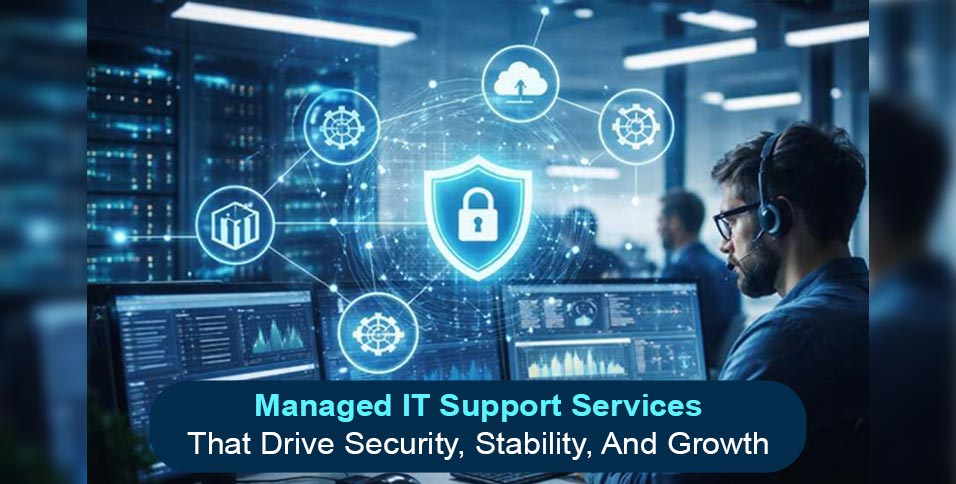
Managed IT support services provide businesses with a structured, proactive approach to technology management that goes far beyond basic troubleshooting. Instead of reacting to outages or security incidents, organizations gain continuous monitoring, disciplined maintenance, and expert guidance that strengthen cybersecurity, improve system reliability, and reduce operational risk.
By combining 24/7 help desk support, remote monitoring, cloud management, and strategic IT planning, managed service providers (MSPs) create stable, scalable environments designed for long-term success. The result is a predictable IT framework that protects critical assets, minimizes downtime, controls costs, and empowers businesses to grow with confidence.
What Managed IT Support Includes: From Help Desk to Co-Managed Models and SLAs
Modern managed IT services combine 24/7 IT support, remote monitoring, and disciplined maintenance into a predictable, outcome-based program. A mature service provider unifies Help Desk operations, network management, device management, and cloud computing expertise under one agreement—whether fully outsourced IT or a co-managed engagement augmenting your internal team.
Core Components of Managed IT Services
- Help Desk and escalation: A staffed Help Desk resolves user issues, triages tickets, and escalates complex problems to engineers using Professional Services Automation and RMM tools. This keeps IT support consistent while preserving institutional knowledge through rigorous IT documentation and a well-structured IT support page.
- Remote monitoring and maintenance: Always-on RMM (Remote Monitoring and Management) delivers proactive remote monitoring, automated maintenance, and system updates across endpoints, servers, and cloud services. Automation handles routine patch updates, security patches, and antivirus signature distribution to enhance threat protection and performance optimization.
- Asset inventory and warranty management: Accurate asset inventory, lifecycle tracking, and warranty management reduce downtime and surprise costs. This foundation lets the service provider schedule replacements, manage Windows 11 upgrades, and coordinate device refreshes before warranties lapse.
Cloud computing and professional services: Cloud services from Microsoft Azure, AWS, and Google pair with professional services and IT consulting to design resilient architectures, adopt productivity applications, and deploy technology solutions tailored to industry needs.
Co-Managed IT and Collaborative Models
Co-managed managed IT services allow an outsourced IT partner to operate side by side with in-house staff. The provider supplies remote monitoring, maintenance playbooks, and automated solutions while your team retains strategic control. Law firms, engineering firms, and other specialized organizations often prefer this hybrid model to access advanced cybersecurity capabilities and surge capacity without losing context.
Governance, SLAs, and Reporting
A capable service provider defines clear SLAs for response and resolution times, offers monthly reporting on ticket metrics, patch compliance, and uptime, and sets cadence meetings to review roadmaps. Firms like CMIT Solutions and NexusTek exemplify this discipline, using Professional Services Automation platforms to ensure accountability, predictable costs, and continuous improvement across managed IT services and IT support.
Building a Security-First Posture: Proactive Monitoring, Patching, and Incident Response
Security-first managed IT services integrate continuous remote monitoring, proactive maintenance, and rapid incident response into daily operations. This approach reduces risk while supporting compliance mandates such as CMMC and sector regulations.
Continuous Remote Monitoring and Threat Detection
- MDR (Managed Detection and Response) integrates with RMM tools to analyze telemetry, spot anomalies, and accelerate containment. Combining MDR with traditional antivirus and advanced threat protection closes gaps across endpoints, identities, and cloud computing workloads.
- Mobile device management enforces policies on smartphones and tablets, protecting data wherever work happens.
- Asset inventory underpins cybersecurity by ensuring every device, app, and cloud instance is accounted for and monitored.
Patch Management and Maintenance Discipline
Routine maintenance with automated patch updates, security patches, and system updates is nonnegotiable. A strong service provider schedules maintenance windows, validates rollbacks, and aligns updates with vendor advisories from Microsoft, AWS, and Google. The same lifecycle tracking used for warranty management informs when legacy systems should be retired rather than endlessly patched.
Incident Response Readiness and Playbooks
Preparedness blends incident response runbooks, tabletop exercises, and IT documentation with 24/7 support. Co-managed or fully outsourced IT teams coordinate responsibilities so that escalations are clear, evidence is preserved, and business continuity remains the north star during a crisis.
Security Baselines and Compliance Mapping
- Baseline configurations for Windows 11, Azure, and SaaS applications lock down defaults.
- Compliance frameworks (including CMMC) are mapped to controls, logging, and reporting. Tools such as NexusIQ can complement software supply chain risk management for engineering firms concerned with component governance.
Delivering Stability and Resilience: Uptime, Continuity, and Risk Management
Stability arises from engineered reliability, not luck. Managed IT services prioritize uptime, resilience, and risk reduction through layered architectures and disciplined operations.
Uptime Engineering and Performance Optimization
- Network management with redundant paths, QoS, and health checks prevents bottlenecks and supports performance optimization.
- Remote monitoring alerts teams before users experience issues, while scheduled maintenance keeps infrastructure tuned.
- Asset inventory helps correlate performance incidents to specific devices, drivers, or firmware, guiding timely warranty management actions.
Continuity Planning and Data Protection
Business continuity and data protection require tested backups, offsite replicas, and immutable storage. Cloud computing expands options: snapshot-based backups in Azure, cross-region resilience in AWS, and managed databases from Google. A seasoned service provider validates recovery time and recovery point objectives and integrates cloud services for rapid failover.
Risk Management Across Assets and Vendors
Risk registers should track hardware age, warranty expirations, software end-of-life, and third-party exposure. Lifecycle tracking, warranty management, and asset inventory together enable proactive refresh cycles and eliminate single points of failure. For law firms and engineering firms, these fundamentals also support client audits and due diligence.
Fueling Growth: Strategic Roadmapping, Scalability, and Cost Predictability
Beyond keeping the lights on, managed IT services accelerate growth by aligning technology with business strategy.
Strategic IT Roadmap and Professional Services
Through IT consulting and professional services, your service provider develops a 12–24 month roadmap that sequences migrations, upgrades, and new technology solutions. Examples include Windows 11 modernization, identity consolidation, and adoption of productivity applications like Microsoft 365 to boost business productivity.
Scaling Securely with Cloud Computing
Cloud computing enables rapid scalability without heavy capex. Managed IT services coordinate multi-cloud patterns across Azure, AWS, and Google, balancing portability, governance, and cost control. Automated solutions provision environments, enforce policies, and maintain configuration drift baselines while remote monitoring ensures consistent security and maintenance standards across cloud services.
Financial Clarity and Predictable Costs
Fixed-fee models provide predictable costs, driving measurable cost savings compared with ad hoc break-fix. Monthly reporting ties spend to outcomes—uptime, ticket volumes, patch compliance—so executives can see how outsourced IT investments map to risk reduction and growth.
Selecting the Right MSP and Proving Value: Evaluation Criteria, Onboarding, and KPIs
Choosing a managed service provider is a strategic decision that affects security, stability, and growth trajectories.
Evaluation Criteria for a Service Provider
- Breadth of IT support: Verify 24/7 support, Help Desk depth, and tiered escalation.
- Security maturity: MDR integration, incident response expertise, and proven cybersecurity frameworks.
- Cloud and scalability: Reference architectures for Azure, AWS, and Google; ability to right-size cloud computing for evolving needs.
- Operations excellence: Demonstrated asset inventory rigor, warranty management processes, and maintenance schedules using modern RMM tools.
- Industry experience: Case studies for law firms and engineering firms, plus compliance familiarity (e.g., CMMC).
- Culture and communication: Clear SLAs, cadence reviews, and transparent monthly reporting.
CMIT Solutions, NexusTek, and other regional providers can be compared on these dimensions alongside their toolchains and partner ecosystems.
Onboarding Checklist and Co-Managed Alignment
- Discovery and IT documentation: Capture network diagrams, security baselines, user roles, and application dependencies.
- RMM (Remote Monitoring and Management) deployment: Enable remote monitoring, maintenance automation, and patch orchestration.
- Asset inventory and warranty management: Normalize records, validate lifecycle tracking, and schedule refreshes.
- Security hardening: Implement antivirus, mobile device management, and threat protection; execute initial system updates and security patches.
- Help Desk integration: Align ticket routing, knowledge transfer, and Professional Services Automation workflows for seamless IT support.
Effective onboarding ensures outsourced IT or co-managed arrangements deliver value from day one.
KPIs and Monthly Reporting That Prove Value
- Service delivery: First response time, mean time to resolve, SLA attainment, and end-user satisfaction.
- Cyber posture: Patch compliance, vulnerability aging, MDR detections, and incident response metrics.
- Reliability: Uptime by service, backup success rates, and recovery test results tied to business continuity.
- Financial outcomes: Cost savings from consolidation, predictable costs adherence, and project ROI linked to technology solutions and productivity applications.
When a service provider consistently meets these KPIs—backed by transparent monthly reporting—managed IT services evolve from tactical IT support to a strategic, outsourced IT partnership that advances cybersecurity, sustains maintenance discipline, and leverages cloud computing to scale with confidence.